
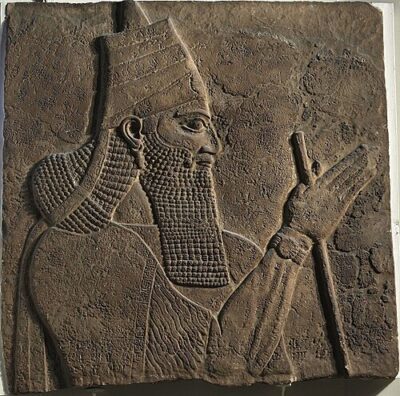
Tiglath-Pileser III
Tiglath-Pileser III was a King of Assyria who ruled 745-727 BCE. Died 727 BC. Positions held include King of Assyria (-745–-727) and King of Babylon (-729–-727).
Facts
10 facts · 0 confirmed by two sources · 0 cited · 10 from one source
Where this comes from
Papalocal keeps its own record. It started from these sources; what each one said is kept here as it was copied, so a change on their side never changes this page by itself. Tap one to read its version.
What Wikidata says · copied November 16, 2026 · revision 2561373823
- Described as
- King of Assyria who ruled 745-727 BCE
- Other names
- Pul
- Died
- 727 BC
- Citizen of
- Assyrian Empire; Babylon
- Occupation
- king
- Positions held
- King of Assyria (-745–-727); King of Babylon (-729–-727)
- Children
- Shalmaneser V; Sargon II
- Father
- Adad-nirari III
- Religion
- Ancient Mesopotamian religion
- Wikipedias with a page
- 55
Wikidata item Q210074 (wikidata.org/wiki/Q210074), public domain (CC0). Copied November 16, 2026.
What Wikipedia says · copied November 16, 2026 · revision 1384711233
Tiglath-Pileser III (Neo-Assyrian Akkadian: 𒆪𒋾𒀀𒂍𒈗𒊏, romanized: Tukultī-apil-Ešarra, meaning "my trust belongs to the son of Ešarra", Biblical Hebrew: תִּגְלַת פִּלְאֶסֶר, romanized: Tiglaṯ Pilʾeser, Old Aramaic: 𐤕𐤂𐤋𐤕𐤐𐤋𐤉𐤎𐤓, romanized: tgltplysr), sometimes called Pulu or Pul (see below), was the Neo-Assyrian emperor from 745 BC to his death in 727BC. One of the most prominent and historically significant Assyrian rulers, Tiglath-Pileser ended a period of Assyrian stagnation, introduced numerous political and military reforms, and doubled the lands under Assyrian control. He consolidated power and maintained control through the use of extraordinarily brutal and ruthless methods including impaling and mass dislocation. Because of the massive expansion and centralization of Assyrian territory and the establishment of a standing army, some researchers consider Tiglath-Pileser's reign to mark the actual transition of Assyria into an empire. The reforms and methods of control introduced under Tiglath-Pileser laid the groundwork for policies enacted not only by later Assyrian kings but also by later empires for millennia after his death.
The circumstances of Tiglath-Pileser's rise to the throne are not clear. Because ancient Assyrian sources give conflicting accounts concerning Tiglath-Pileser's lineage and there are records of a revolt around the time of his accession, many historians have concluded that Tiglath-Pileser was a usurper, who seized the throne from his predecessor Ashur-nirari V, who was either his brother or his father. Other historians postulate that the evidence could just as easily be interpreted as Tiglath-Pileser inheriting the throne through legitimate means, and the debate remains unresolved.
Tiglath-Pileser increased royal power and authority by curbing the influence of prominent officials and generals. After securing some minor victories in 744 and 743, he defeated the Urartian king Sarduri II in battle near Arpad in 743. This victory was significant since Urartu had briefly equalled Assyria in power; Sarduri had defeated Tiglath-Pileser's predecessor Ashur-nirari eleven years earlier.
After defeating Sarduri, Tiglath-Pileser turned his attention to the Levant. Over several years, he conquered most of the Levant, defeating and then either annexing or subjugating previously influential kingdoms, notably ending the kingdom of Aram-Damascus. Tiglath-Pileser's activities in the Levant were recorded in the Hebrew Bible. After a few years of conflict, Tiglath-Pileser conquered Babylonia in 729, becoming the first king to rule as sovereign of both Assyria and Babylonia.
From the Wikipedia article “Tiglath-Pileser III” (en.wikipedia.org/wiki/Tiglath-Pileser_III), by its contributors, under CC BY-SA 4.0 (creativecommons.org/licenses/by-sa/4.0/). Copied November 16, 2026; not changed.
Confirmed Two sources agree. Cited One source, and it names where it got it. One source One source, without a reference of its own. Sources disagree The sources disagree. We show the best-supported value and keep theirs below.
