
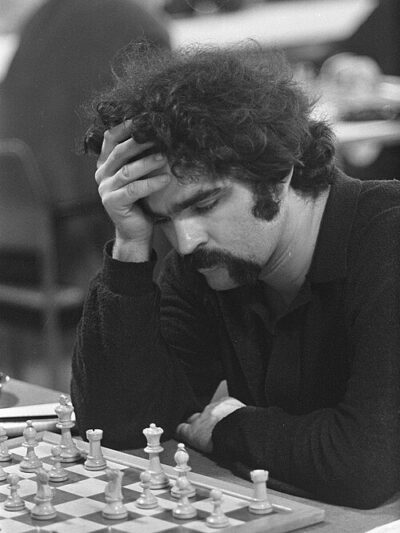
Tim Krabbé
Tim Krabbé is a Dutch journalist and novelist. Born April 13, 1943, in Amsterdam. Educated at University of Amsterdam. Awards include Gouden Strop and Best Crime Novel in Swedish Translation.
Facts
19 facts · 1 confirmed by two sources · 7 cited · 11 from one source
Where this comes from
Papalocal keeps its own record. It started from these sources; what each one said is kept here as it was copied, so a change on their side never changes this page by itself. Tap one to read its version.
What Wikidata says · copied November 17, 2026 · revision 2551694305
- Described as
- Dutch journalist and novelist (born 1943)
- Other names
- Tim Krabbe
- Born
- April 13, 1943 · 2 references
- Born in
- Amsterdam · 1 reference
- Citizen of
- Kingdom of the Netherlands
- Occupation
- writer · 1 reference; chess player · 1 reference; journalist · 1 reference; autobiographer; screenwriter · 1 reference; chess composer; painter · 1 reference
- Education
- University of Amsterdam
- Sport
- chess
- Awards
- Gouden Strop (1995) · 1 reference; Best Crime Novel in Swedish Translation (1993)
- Spouse
- Liz Snoijink (1985–)
- Father
- Maarten Krabbé
- Siblings
- Mirko Krabbé; Jeroen Krabbé
- Website
- https://timkr.home.xs4all.nl
- Wikipedias with a page
- 26
Wikidata item Q352975 (wikidata.org/wiki/Q352975), public domain (CC0). Copied November 17, 2026.
What Wikipedia says · copied November 17, 2026 · revision 1382338906
Hans Maarten Timotheus "Tim" Krabbé (born 13 April 1943) is a Dutch journalist, novelist and chess player.
Krabbé was born in Amsterdam. His writing has appeared in most major periodicals in the Netherlands. Once a competitive cyclist, he is known to Dutch readers for his novel De Renner (The Rider), first published in 1978 and translated into English in 2002, of which The Guardian's Matt Seaton wrote: "Nothing better is ever likely to be written on the subjective experience of cycle-racing". English readers know him primarily for The Vanishing (Dutch: Spoorloos, literally: "Traceless" or "Without a Trace"), the translation of his 1984 novel Het Gouden Ei (The Golden Egg), which was made into an acclaimed 1988 Dutch film for which Krabbé co-wrote a script. A poorly received American remake was made in 1993. In 1997 he published De grot, translated as The Cave and published in the U.S. in 2000. In 2009, he wrote the "Boekenweekgeschenk", called Een Tafel vol Vlinders.
Krabbé is a strong chess player who competed in two Dutch Chess Championships in 1967 and 1971. He maintains a chess website, and is renowned for his writings on the subject, in particular on chess problems; for instance, one of his publications is devoted to the Babson task.
No longer an active player, his peak FIDE rating was 2290.
His father was the painter Maarten Krabbé (1908–2005) and his mother the Jewish film translator Margreet Reiss. He is the brother of actor Jeroen Krabbé and the multimedia artist/designer Mirko Krabbé, and the uncle of Martijn Krabbé, a Dutch media personality.
- Born, in its opening lines
- April 13, 1943
From the Wikipedia article “Tim Krabbé” (en.wikipedia.org/wiki/Tim_Krabbé), by its contributors, under CC BY-SA 4.0 (creativecommons.org/licenses/by-sa/4.0/). Copied November 17, 2026; not changed.
Confirmed Two sources agree. Cited One source, and it names where it got it. One source One source, without a reference of its own. Sources disagree The sources disagree. We show the best-supported value and keep theirs below.
