
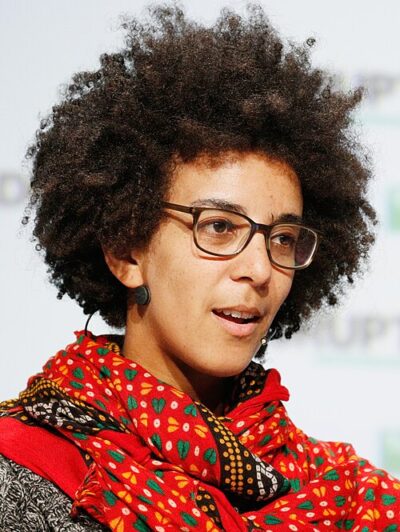
Timnit Gebru
Timnit Gebru is a computer scientist and AI ethics researcher. Born 1983, in Addis Ababa. Known for Black in AI, On the Dangers of Stochastic Parrots: Can Language Models Be Too Big? 🦜 and Distributed Artificial Intelligence Research Institute. Educated at Stanford University. Awards include Time 100, BBC 100 Women and Right Livelihood Award.
Facts
20 facts · 0 confirmed by two sources · 8 cited · 12 from one source
Where this comes from
Papalocal keeps its own record. It started from these sources; what each one said is kept here as it was copied, so a change on their side never changes this page by itself. Tap one to read its version.
What Wikidata says · copied November 15, 2026 · revision 2565993719
- Described as
- computer scientist and AI ethics researcher
- Other names
- Timnit W. Gebru
- Born
- 1983 · 2 references
- Born in
- Addis Ababa · 1 reference
- Citizen of
- United States · 1 reference
- Occupation
- researcher · 1 reference; artificial intelligence researcher · 1 reference; AI ethicist
- Worked for
- Google (–2020) · 1 reference; Microsoft Research · 1 reference
- Education
- Stanford University · 1 reference
- Known for
- Black in AI; On the Dangers of Stochastic Parrots: Can Language Models Be Too Big? 🦜; Distributed Artificial Intelligence Research Institute
- Awards
- Time 100 (2022) · 1 reference; BBC 100 Women (2023) · 1 reference; Right Livelihood Award (2026) · 1 reference
- Field
- algorithmic bias · 1 reference; data mining · 1 reference; artificial intelligence; ethics of artificial intelligence
- Website
- https://ai.stanford.edu/~tgebru/ · 1 reference
- Wikipedias with a page
- 27
Wikidata item Q59753117 (wikidata.org/wiki/Q59753117), public domain (CC0). Copied November 15, 2026.
What Wikipedia says · copied November 15, 2026 · revision 1385796886
Timnit W. Gebru (Amharic and Tigrinya: ትምኒት ገብሩ; 1983) is an Ethiopian-born Eritrean computer scientist who works in the fields of artificial intelligence (AI), algorithmic bias and data mining. She is a co-founder of Black in AI, an advocacy group that has pushed for more Black roles in AI development and research. She is the founder of the Distributed Artificial Intelligence Research Institute (DAIR).
In December 2020, public controversy erupted over the circumstances surrounding Gebru's departure from Google, where she was technical co-lead of the Ethical Artificial Intelligence Team. Gebru had coauthored a paper on the risks of large language models (LLMs) acting as stochastic parrots, and submitted it for publication. According to Jeff Dean, head of Google AI, the paper was submitted without waiting for Google's internal review, which then asserted that it ignored too much relevant research. Google management requested that Gebru either withdraw the paper or remove the names of all the authors employed by Google. Gebru requested the identity and feedback of every reviewer, and stated that if Google refused, she would talk to her manager about "a last date". Google terminated her employment immediately, stating that they were accepting her resignation. Gebru maintained that she had not formally offered to resign, and only threatened to.
Gebru has been widely recognized for her expertise in the ethics of artificial intelligence. She was named one of the World's 50 Greatest Leaders by Fortune and one of Nature's ten people who shaped science in 2021, and in 2022, one of Time's most influential people.
From the Wikipedia article “Timnit Gebru” (en.wikipedia.org/wiki/Timnit_Gebru), by its contributors, under CC BY-SA 4.0 (creativecommons.org/licenses/by-sa/4.0/). Copied November 15, 2026; not changed.
Confirmed Two sources agree. Cited One source, and it names where it got it. One source One source, without a reference of its own. Sources disagree The sources disagree. We show the best-supported value and keep theirs below.
