
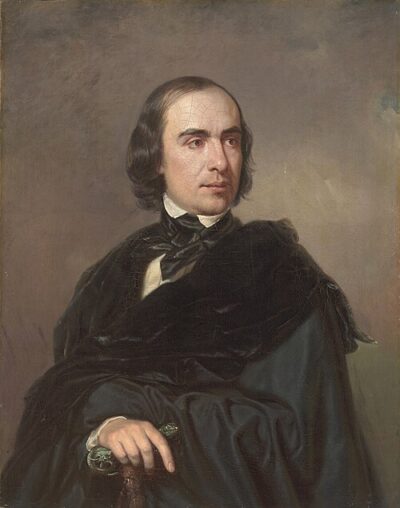
Timofey Granovsky
Timofey Granovsky was a Russian historian. Born March 9, 1813, in Oryol. Died October 4, 1855, in Moscow. Educated at Faculty of Law, Saint Petersburg State University and Imperial St. Petersburg University.
Facts
16 facts · 2 confirmed by two sources · 4 cited · 10 from one source
What’s different
- Born: we show March 9, 1813 (Confirmed). Wikidata also lists March 21, 1813
- Died: we show October 4, 1855 (Confirmed). Wikidata also lists October 16, 1855
Where this comes from
Papalocal keeps its own record. It started from these sources; what each one said is kept here as it was copied, so a change on their side never changes this page by itself. Tap one to read its version.
What Wikidata says · copied November 18, 2026 · revision 2551885228
- Described as
- Russian historian (1813-1855)
- Other names
- Granovsky, Timofey Nikolayevich Granovsky, T. N. Granovsky
- Born
- March 9, 1813 · 3 references; March 21, 1813 · 1 reference
- Died
- October 4, 1855 · 3 references; October 16, 1855 · 1 reference
- Born in
- Oryol · 3 references
- Died in
- Moscow · 2 references
- Buried in
- Pyatnitskoye cemetery
- Citizen of
- Russian Empire
- Occupation
- medievalist · 1 reference; historian · 1 reference; university teacher; sociologist; philosopher · 1 reference
- Worked for
- Lomonosov Moscow State University (1839–) · 1 reference
- Education
- Faculty of Law, Saint Petersburg State University; Imperial St. Petersburg University
- Field
- medieval studies
- Spouse
- Elisabeth Granovskij
- Wikipedias with a page
- 22
Wikidata item Q555693 (wikidata.org/wiki/Q555693), public domain (CC0). Copied November 18, 2026.
What Wikipedia says · copied November 18, 2026 · revision 1366929344
Timofey Nikolayevich Granovsky (Russian: Тимофей Николаевич Грановский; 9 March 1813 – 4 October 1855) was a founder of medieval studies in the Russian Empire.
Granovsky was born in Oryol, Russia. He studied at the universities of Moscow and Berlin, where he was profoundly influenced by Hegelian ideas of Leopold von Ranke and Friedrich Carl von Savigny. He felt that the Western history was superior to that of his own country and became the first Russian to deliver courses on the medieval history of Western Europe (1839). Due to the strict censorship of the period, Granovsky assumed that lecturing provided a surer way of disseminating Western ideals in Russia than writing. His major printed work was his doctoral dissertation of 1849, Abbat Sugerii (Abbot Suger), in which he "portrayed the great abbot as the architect of royal centralization." His master's thesis of 1845, "Volin, Yumsberg, i Vineta" (Wolin, Jomsborg, and Vineta), attempted to disprove the historicity of Vineta and was very controversial, offending the Slavophiles.
His readings in the Moscow University were immensely popular and brought him in touch with other Westernizers. One of these, Alexander Herzen, described Granovsky's lectures as "a draught of freedom in Nicholas I's Russia".
Fyodor Dostoyevsky's novel Demons features a character, Stepan Trofimovich Verkhovensky, that is partly based on Granovsky. According to Edward Alan Cole, this "liberal who unwittingly inspired a generation of nihilists is unfair to Granovsky but is nevertheless another tribute to his importance as an inspiring teacher and a man of his age."
- Born, in its opening lines
- March 9, 1813
- Died, in its opening lines
- October 4, 1855
From the Wikipedia article “Timofey Granovsky” (en.wikipedia.org/wiki/Timofey_Granovsky), by its contributors, under CC BY-SA 4.0 (creativecommons.org/licenses/by-sa/4.0/). Copied November 18, 2026; not changed.
Confirmed Two sources agree. Cited One source, and it names where it got it. One source One source, without a reference of its own. Sources disagree The sources disagree. We show the best-supported value and keep theirs below.
