
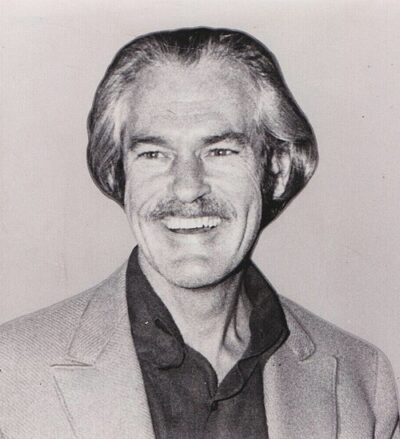
Timothy Leary
Timothy Leary was an American psychologist. Born October 22, 1920, in Springfield. Died May 31, 1996, in Beverly Hills. Educated at Washington State University and University of California, Berkeley.
Facts
25 facts · 2 confirmed by two sources · 5 cited · 18 from one source
Where this comes from
Papalocal keeps its own record. It started from these sources; what each one said is kept here as it was copied, so a change on their side never changes this page by itself. Tap one to read its version.
What Wikidata says · copied November 13, 2026 · revision 2568259210
- Described as
- American psychologist (1920–1996)
- Other names
- Dr. Timothy Leary, Timothy Francis Leary
- Born
- October 22, 1920 · 11 references
- Died
- May 31, 1996 · 12 references
- Born in
- Springfield · 1 reference
- Died in
- Beverly Hills
- Buried in
- Celestis 01
- Cause of death
- prostate cancer
- Citizen of
- United States
- Occupation
- psychologist · 1 reference; writer · 1 reference; actor · 1 reference
- Worked for
- University of California, Berkeley; Kaiser Family Foundation; Harvard University (–1963) · 1 reference
- Education
- Washington State University; University of California, Berkeley; University of Alabama; College of the Holy Cross
- Record label
- ESP-Disk
- Field
- psychology
- Spouse
- Nena von Schlebrügge (1964–1965) · 1 reference; Rosemary Woodruff Leary (1967–1976) · 1 reference; Barbara Chase (1978–1992) · 1 reference
- Children
- Marlon Gobel · 1 reference
- Religion
- Hinduism
- Military branch
- United States Army
- Wikipedias with a page
- 65
Wikidata item Q211731 (wikidata.org/wiki/Q211731), public domain (CC0). Copied November 13, 2026.
What Wikipedia says · copied November 13, 2026 · revision 1384427645
Timothy Francis Leary (October 22, 1920 – May 31, 1996) was an American psychologist and author known for strongly advocating psychedelic drugs. Evaluations of Leary are polarized, ranging from "bold oracle" to "publicity hound". According to poet Allen Ginsberg, he was "a hero of American consciousness", while writer Tom Robbins called him a "brave neuronaut". President Richard Nixon disagreed, calling Leary "the most dangerous man in America". During the 1960s and 1970s, at the height of the counterculture movement, Leary was arrested 36 times.
As a clinical psychologist at Harvard University, Leary founded the Harvard Psilocybin Project after an experience with magic mushrooms he had in Mexico in 1960. For two years, he tested psilocybin's therapeutic effects, in the Concord Prison Experiment and the Marsh Chapel Experiment. He also experimented with lysergic acid diethylamide (LSD), which was then legal in the US. Other Harvard faculty questioned his research's scientific legitimacy and ethics because he took psychedelics himself along with his subjects and allegedly pressured students to join in. Harvard fired Leary and his colleague Richard Alpert (later known as Ram Dass) in May 1963. Many people learned of psychedelics after the Harvard scandal. Leary continued to publicly promote psychedelic drugs and became a well-known figure of the counterculture of the 1960s; he popularized catchphrases that promoted his philosophy, such as "turn on, tune in, drop out", "set and setting", and "think for yourself and question authority".
Leary believed that LSD showed potential for therapeutic use in psychiatry. He developed an eight-circuit model of consciousness in his 1977 book Exo-Psychology and gave lectures, occasionally calling himself a "performing philosopher". He also developed a philosophy of mind expansion and personal truth through LSD. He also wrote and spoke frequently about transhumanism, human space migration, intelligence increase, and life extension (SMI²LE).
- Born, in its opening lines
- October 22, 1920
- Died, in its opening lines
- May 31, 1996
From the Wikipedia article “Timothy Leary” (en.wikipedia.org/wiki/Timothy_Leary), by its contributors, under CC BY-SA 4.0 (creativecommons.org/licenses/by-sa/4.0/). Copied November 13, 2026; not changed.
Confirmed Two sources agree. Cited One source, and it names where it got it. One source One source, without a reference of its own. Sources disagree The sources disagree. We show the best-supported value and keep theirs below.
