
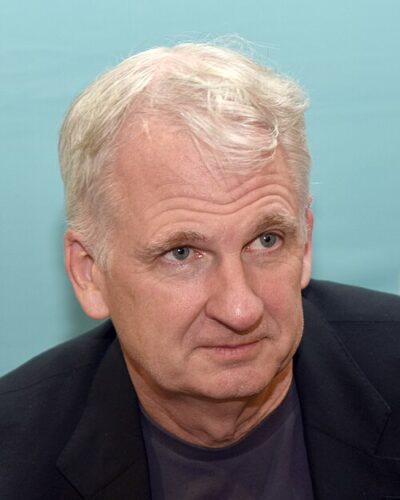
Timothy Snyder
Timothy Snyder is an American historian. Born August 18, 1969, in Dayton. Positions held include Cleveringa chair (2012–2013). Known for The Road to Unfreedom: Russia, Europe, America, Bloodlands and On Tyranny: Twenty Lessons from the Twentieth Century. Educated at Brown University and Balliol College. Awards include Hannah Arendt Prize, Ralph Waldo Emerson Award and Marshall Scholarship.
Facts
46 facts · 1 confirmed by two sources · 20 cited · 25 from one source
Where this comes from
Papalocal keeps its own record. It started from these sources; what each one said is kept here as it was copied, so a change on their side never changes this page by itself. Tap one to read its version.
What Wikipedia says · copied November 13, 2026 · revision 1384970769
Timothy David Snyder (born August 18, 1969) is an American historian specializing in the history of Central and Eastern Europe, the Soviet Union, and the Holocaust. He holds the inaugural Chair in Modern European History, supported by the Temerty Endowment for Ukrainian Studies, at the Munk School of Global Affairs and Public Policy at the University of Toronto. From 2017 to 2025 he was the Richard C. Levin Professor of History at Yale University.
He is a permanent fellow at the Institute for Human Sciences in Vienna.
Snyder serves on the Committee on Conscience of the United States Holocaust Memorial Museum, and is a member of the Council on Foreign Relations.
Snyder has written many books, including Bloodlands: Europe Between Hitler and Stalin (2010), On Tyranny: Twenty Lessons from the Twentieth Century (2017), The Road to Unfreedom (2018), and Our Malady (2020). Several of these have been described as best-sellers.
- Born, in its opening lines
- August 18, 1969
From the Wikipedia article “Timothy Snyder” (en.wikipedia.org/wiki/Timothy_Snyder), by its contributors, under CC BY-SA 4.0 (creativecommons.org/licenses/by-sa/4.0/). Copied November 13, 2026; not changed.
What Wikidata says · copied November 14, 2026 · revision 2569087228
- Described as
- American historian (born 1969)
- Other names
- Timothy David Snyder, Timothy D. Snyder, T.D. Snyder, Tim Snyder
- Born
- August 18, 1969 · 3 references
- Born in
- Dayton
- Citizen of
- United States
- Occupation
- historian · 2 references; writer; literary critic; university teacher · 2 references; political scientist · 2 references; academic · 1 reference; non-fiction writer · 1 reference
- Positions held
- Cleveringa chair (2012–2013) · 1 reference
- Worked for
- Yale University (2017–2025) · 1 reference; National Center for Scientific Research; Institute of Human Sciences; Weatherhead Center for International Affairs; Leiden University (2012–2013) · 1 reference; Munk School of Global Affairs and Public Policy (2025–) · 1 reference
- Education
- Brown University (1987–1991); Balliol College (1991–1995); Centerville High School · 1 reference; University of Oxford
- Member of
- Council on Foreign Relations; Shevchenko Scientific Society in the US
- Known for
- The Road to Unfreedom: Russia, Europe, America; Bloodlands; On Tyranny: Twenty Lessons from the Twentieth Century
- Awards
- Hannah Arendt Prize (2013) · 1 reference; Ralph Waldo Emerson Award (2011) · 1 reference; Marshall Scholarship; Antonovych prize (2014) · 1 reference; George Louis Beer Prize (2003) · 1 reference; Leipzig Book Award for European Understanding (2012) · 1 reference; Guggenheim Fellowship (2017) · 1 reference; Prize of the Foundation for Polish Science (2018) · 1 reference; Officer's Cross of the Order of Merit of the Republic of Poland; The VIZE 97 Prize (2015) · 1 reference; Order of the Cross of Terra Mariana, 3rd Class; Bene Merito; Commander of the Order for Merits to Lithuania (2023) · 1 reference; Carnegie Fellow (2015) · 1 reference; Medal for Distinguished Contribution to Diplomacy (2024) · 1 reference
- Field
- history; history of Eastern Europe; Holocaust studies; Central Europe
- Spouse
- Marci Shore · 1 reference
- Wikipedias with a page
- 50
Wikidata item Q747312 (wikidata.org/wiki/Q747312), public domain (CC0). Copied November 14, 2026.
Confirmed Two sources agree. Cited One source, and it names where it got it. One source One source, without a reference of its own. Sources disagree The sources disagree. We show the best-supported value and keep theirs below.
