
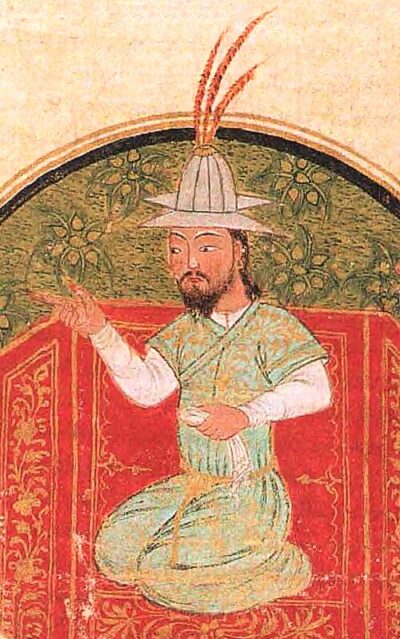
Timur
Timur was the founder of the Timurid Empire. Born April 9, 1336, in Shahrisabz. Died February 18, 1405, in Otrar. Positions held include Amir (1370–1405).
Facts
25 facts · 0 confirmed by two sources · 1 cited · 22 from one source · 2 where the sources disagree
What’s different
- Born: we show April 9, 1336 (Sources disagree). Wikidata also lists April 8, 1336
- Died: we show February 18, 1405 (Sources disagree). Wikidata also lists February 19, 1405
Where this comes from
Papalocal keeps its own record. It started from these sources; what each one said is kept here as it was copied, so a change on their side never changes this page by itself. Tap one to read its version.
What Wikidata says · copied November 16, 2026 · revision 2570031880
- Described as
- the founder of the Timurid Empire (1370–1405)
- Other names
- Timberlane, Timur i-Lenk, Tamerlane the Great, Timur the Lame, Timur the Great, Timūr, Timur-i-Lenk, Timür Lang, Timür, Timur Lenk, Tiemuer, Timur Lang
- Born
- April 9, 1336 · 3 references; April 8, 1336 · 2 references
- Died
- February 19, 1405 · 1 reference; February 18, 1405 · 2 references
- Born in
- Shahrisabz
- Died in
- Otrar
- Buried in
- Gur-e Amir
- Occupation
- warrior; Conqueror · 1 reference
- Positions held
- Amir (1370–1405)
- Spouse
- Saray Malik Katun; Uljay-Turkan aga · 1 reference; Cholpan-Mulk Aga; Dilshad aga
- Children
- Shah Rukh; Miran Shah; Jahangir Mirza ibn Timur · 1 reference; Umar Shaikh; Aka Begi; Jahanshah Mirza
- Father
- Taraqai
- Mother
- Tekina Khatun
- Religion
- Sunni Islam
- Military rank
- Baig · 1 reference; Mirza · 1 reference; khagan · 1 reference
- Height
- 1.72 m (5 ft 8 in)
- Wikipedias with a page
- 161
Wikidata item Q8462 (wikidata.org/wiki/Q8462), public domain (CC0). Copied November 16, 2026.
What Wikipedia says · copied November 16, 2026 · revision 1382450655
Timur (1320s – 17/18 February 1405), also known as Tamerlane, was a Turco-Mongol conqueror, first ruler of the Timurid dynasty, and the founder of the Timurid Empire, which ruled over modern-day Afghanistan, Iran, and Central Asia. He was undefeated in most battles and is widely regarded as one of the greatest military leaders and tacticians in history, as well as one of the most brutal and deadly. Timur is also considered a great patron of the arts, for he interacted with scholars and poets such as ibn Khaldun, Hafez, and Hafiz-i Abru. His reign led to the Timurid Renaissance.
Born into the Turkicized Mongol confederation of the Barlas in Transoxiana (now in Uzbekistan) in the 1320s, Timur gained control of the western Chagatai Khanate by 1370 and from there he led a series of military campaigns defeating the Khans of the Golden Horde, the Mamluk Sultanate in Egypt and Syria, the emerging Ottoman Empire, as well as the Delhi Sultanate in the Indian subcontinent, thus becoming the most powerful ruler in the Muslim world. These conquests led to the creation of the Timurid Empire, which fragmented shortly after his death. He spoke several languages, including the Karluk Turkic language Chagatai (an ancestor of modern Uzbek and Uyghur), as well as Classical Mongolian and New Persian, which he used for diplomatic correspondence.
Timur was the last of the major nomadic conquerors of the Eurasian Steppe, and his empire set the stage for the rise of the more organized and lasting Muslim gunpowder empires of the 16th and 17th centuries. Timur was of Mongol descent, and, while probably not a direct descendant on either side, he shared a common ancestor with Genghis Khan on his father's side, though some authors have suggested his mother may have been a descendant of the Khan. He clearly sought to revive the legacy of Genghis Khan and saw himself as the restorer of the Mongol Empire. According to Gérard Chaliand, Timur considered himself Genghis Khan's heir.
Timur referred to himself as the "Sword of Islam". He was a patron of religion and the arts, but styled himself a ghazi (Arabic: غازي, romanized: ghāzī, lit. 'religious warrior') in the last years of his life. By the end of his reign, Timur had gained complete control over all the remnants of the Chagatai Khanate, the Ilkhanate, and the Golden Horde, and had even attempted to restore the Yuan dynasty in China. Timur's armies were multi-ethnic and much feared, and laid waste to sizable parts of Asia, Africa, and Europe. Scholars estimate that his military campaigns caused the deaths of millions of people. Of all the areas he conquered, Khwarazm suffered the most, as it repeatedly rose against him.
He was the grandfather of the Timurid sultan, astronomer and mathematician Ulugh Beg, who ruled Central Asia from 1411 to 1449, and the great-great-great-grandfather of Babur (1483–1530), founder of the Mughal Empire.
From the Wikipedia article “Timur” (en.wikipedia.org/wiki/Timur), by its contributors, under CC BY-SA 4.0 (creativecommons.org/licenses/by-sa/4.0/). Copied November 16, 2026; not changed.
Confirmed Two sources agree. Cited One source, and it names where it got it. One source One source, without a reference of its own. Sources disagree The sources disagree. We show the best-supported value and keep theirs below.
