
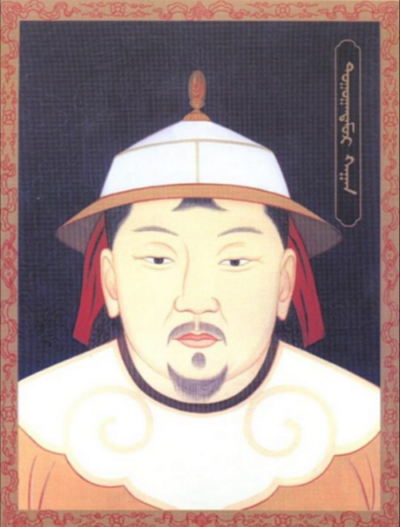
Toghon Temür
Toghon Temür was a Yuan and Northern Yuan emperor from 1333 to 1370. Born May 25, 1320, in Yuan dynasty. Died May 23, 1370, in Yingchang. Positions held include khagan (1333–1370) and Emperor of China (1333–1368).
Facts
27 facts · 2 confirmed by two sources · 5 cited · 20 from one source
Where this comes from
Papalocal keeps its own record. It started from these sources; what each one said is kept here as it was copied, so a change on their side never changes this page by itself. Tap one to read its version.
What Wikidata says · copied November 16, 2026 · revision 2569100960
- Described as
- Yuan and Northern Yuan emperor from 1333 to 1370
- Other names
- Huizong, Kaisar Huizong, Pouyuandaizhudi, Shundi, Beierzhijin Tuohuantiemuer
- Born
- May 25, 1320
- Died
- May 23, 1370
- Born in
- Yuan dynasty · 1 reference
- Died in
- Yingchang
- Cause of death
- dysentery
- Citizen of
- Mongol Empire · 1 reference; Yuan dynasty · 1 reference; Northern Yuan dynasty
- Occupation
- astronomer; calligrapher; painter; aristocrat
- Positions held
- khagan (1333–1370); Emperor of China (1333–1368)
- Spouse
- Danashri; Bayan Khutugh; Empress Gi; Munashili
- Children
- Biligtü Khan Ayushiridara · 1 reference; Uskhal Khan Tögüs Temür · 1 reference; Xueshan · 1 reference
- Father
- Khutughtu Khan
- Siblings
- Rinchinbal Khan; Budaxini; Zoey; Margad Kelmish
- Religion
- Buddhism
- Wikipedias with a page
- 47
Wikidata item Q8666 (wikidata.org/wiki/Q8666), public domain (CC0). Copied November 16, 2026.
What Wikipedia says · copied November 16, 2026 · revision 1373355982
Toghon Temür (Mongolian: Тогоон Төмөр, romanized: Togoon Tömör; simplified Chinese: 妥懽帖睦尔; traditional Chinese: 妥懽帖睦爾; pinyin: Tuǒhuān Tiēmù'ěr; 25 May 1320 – 23 May 1370), also known by his temple name as Emperor Huizong of Yuan and by his posthumous name as Emperor Shun of Yuan, was the last emperor of the Yuan dynasty and the first emperor of the Northern Yuan dynasty. He was a son of Kusala (Emperor Mingzong).
Toghon Temür acceded to the throne in 1333 after years of succession disputes following his father's death. His early reign was dominated by powerful ministers, first El Temür and then Bayan, until he engineered Bayan's removal in 1340 with the help of Toqto'a. Toqto'a's first administration (1340–1344) oversaw the completion of the official histories of the Liao, Jin, and Song dynasties. During the latter part of his reign, widespread natural disasters and fiscal crises fuelled popular unrest, culminating in the Red Turban Rebellion of 1351. After the rebel leader Zhu Yuanzhang established the Ming dynasty and captured Khanbaliq in 1368, Toghon Temür retreated to the Mongolian steppe. The remnant court, conventionally called the Northern Yuan, continued to claim the title of Emperor of China. Toghon Temür died at Yingchang in 1370 and was succeeded by his son Biligtü Khan Ayushiridara.
He was a patron of Tibetan Buddhism, studying under successive Karmapas of the Karma Kagyu school. He also invited the Jonang scholar Dölpopa Shérab Gyeltsen to teach at his court, but Dölpopa declined.
- Born, in its opening lines
- May 25, 1320
- Died, in its opening lines
- May 23, 1370
From the Wikipedia article “Toghon Temür” (en.wikipedia.org/wiki/Toghon_Temür), by its contributors, under CC BY-SA 4.0 (creativecommons.org/licenses/by-sa/4.0/). Copied November 16, 2026; not changed.
Confirmed Two sources agree. Cited One source, and it names where it got it. One source One source, without a reference of its own. Sources disagree The sources disagree. We show the best-supported value and keep theirs below.
