
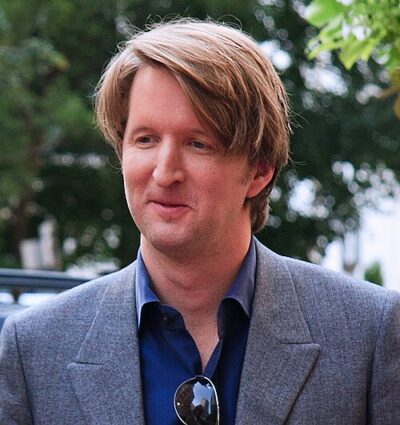
Tom Hooper
Tom Hooper is a British-Australian filmmaker. Born October 5, 1972, in London. Educated at University College, Oxford and Westminster School. Awards include Directors Guild of America Award, Academy Award for Best Director and European Film Award – People's Choice Award for Best European Film.
Facts
15 facts · 1 confirmed by two sources · 5 cited · 9 from one source
Where this comes from
Papalocal keeps its own record. It started from these sources; what each one said is kept here as it was copied, so a change on their side never changes this page by itself. Tap one to read its version.
What Wikidata says · copied November 16, 2026 · revision 2566914838
- Described as
- British-Australian filmmaker
- Born
- October 5, 1972 · 1 reference
- Born in
- London · 1 reference
- Citizen of
- United Kingdom
- Occupation
- film director · 1 reference; television director; screenwriter · 1 reference; film producer · 1 reference
- Education
- University College, Oxford; Westminster School; Highgate School
- Awards
- Directors Guild of America Award; Academy Award for Best Director (2011) · 1 reference; European Film Award – People's Choice Award for Best European Film (2011) · 1 reference; Primetime Emmy Award for Outstanding Directing for a Limited Series, Movie, or Dramatic Special (2006)
- Father
- Richard Hooper · 1 reference
- Wikipedias with a page
- 54
Wikidata item Q295912 (wikidata.org/wiki/Q295912), public domain (CC0). Copied November 16, 2026.
What Wikipedia says · copied November 16, 2026 · revision 1376340590
Thomas George Hooper (born 5 October 1972) is a British-Australian filmmaker. Known for his work in film and television he has received numerous accolades including an Academy Award, a BAFTA Award, and Primetime Emmy Award as well as a nomination for Golden Globe Award.
Hooper began making short films as a teenager and had his first professional short, Painted Faces, broadcast on Channel 4 in 1992. At Oxford University, he directed plays and television commercials. After graduating, he directed episodes of Quayside, Byker Grove, EastEnders, and Cold Feet on British television. In the 2000s, Hooper directed the major BBC costume dramas Love in a Cold Climate (2001) and Daniel Deronda (2002), as well as the 2003 revival of ITV's Prime Suspect series. He gained acclaim for directing the HBO projects Elizabeth I (2005), Longford (2006), and John Adams (2008), the former of which earned him the Primetime Emmy Award for Outstanding Directing for a Limited Series or Movie.
Hooper made his feature film debut with the British drama Red Dust (2004) followed by the sports drama The Damned United (2009). He directed the historical drama The King's Speech (2010) which earned him the Academy Award for Best Director. He followed up with the musical epic Les Misérables (2012), and the romantic drama The Danish Girl (2015), the latter of which was nominated for the BAFTA Award for Outstanding British Film. He directed the 2019 live-action adaptation of the musical Cats, for which he won three Golden Raspberry Awards for Worst Director, Worst Picture, and Worst Screenplay. That same year he directed two episodes of the HBO fantasy series His Dark Materials (2019).
- Born, in its opening lines
- October 5, 1972
From the Wikipedia article “Tom Hooper” (en.wikipedia.org/wiki/Tom_Hooper), by its contributors, under CC BY-SA 4.0 (creativecommons.org/licenses/by-sa/4.0/). Copied November 16, 2026; not changed.
Confirmed Two sources agree. Cited One source, and it names where it got it. One source One source, without a reference of its own. Sources disagree The sources disagree. We show the best-supported value and keep theirs below.
