
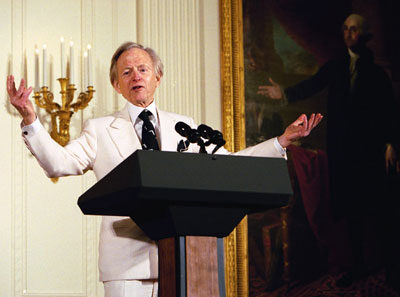
Tom Wolfe
Tom Wolfe was an American author and journalist. Born March 2, 1930, in Richmond. Died May 14, 2018, in Manhattan. Known for The Electric Kool-Aid Acid Test, The Right Stuff and A Man in Full. Educated at Yale University and Washington and Lee University. Awards include National Humanities Medal, National Book Award for Nonfiction and Dos Passos Prize.
Facts
43 facts · 2 confirmed by two sources · 13 cited · 28 from one source
Where this comes from
Papalocal keeps its own record. It started from these sources; what each one said is kept here as it was copied, so a change on their side never changes this page by itself. Tap one to read its version.
What Wikidata says · copied November 13, 2026 · revision 2567335809
- Described as
- American author and journalist (1930–2018)
- Other names
- Thomas Kennerly "Tom" Wolfe, Jr., Thomas Kennerly, Jr. Wolfe, Thomas Kennerly Wolfe
- Born
- March 2, 1930 · 7 references
- Died
- May 14, 2018 · 6 references
- Born in
- Richmond · 1 reference
- Died in
- Manhattan · 1 reference
- Buried in
- Hollywood Cemetery · 1 reference
- Name at birth
- Thomas Kennerly Wolfe Jr.
- Citizen of
- United States · 2 references
- Occupation
- journalist · 2 references; novelist · 1 reference; reporter; essayist; non-fiction writer · 1 reference; screenwriter; writer · 4 references; prose writer
- Political party
- Republican Party
- Education
- Yale University; Washington and Lee University; St. Christopher's School (–1949)
- Member of
- American Academy of Arts and Letters; American Academy of Arts and Sciences
- Known for
- The Electric Kool-Aid Acid Test; The Right Stuff; A Man in Full; Radical Chic & Mau-Mauing the Flak Catchers; The Bonfire of the Vanities; Back to Blood
- Awards
- National Humanities Medal (2001) · 1 reference; National Book Award for Nonfiction (1980) · 1 reference; Dos Passos Prize (1984); St. Louis Literary Award (1990); Jefferson Lecture (2006); Wilbur Cross Medal (1990) · 1 reference; Carl Sandburg Literary Award (2008) · 1 reference; National Book Award (2010) · 1 reference; Amateur Cartoonist Extraordinary Award (1992) · 1 reference
- Field
- literature · 1 reference; opinion journalism · 1 reference
- Children
- Alexandra Wolfe
- Religion
- atheism
- Lived in
- Virginia; New York City (1962–)
- Website
- http://www.tomwolfe.com/
- Wikipedias with a page
- 50
Wikidata item Q216195 (wikidata.org/wiki/Q216195), public domain (CC0). Copied November 13, 2026.
What Wikipedia says · copied November 13, 2026 · revision 1384428273
Thomas Kennerly Wolfe Jr. (March 2, 1930 – May 14, 2018) was an American author and journalist widely known for his association with New Journalism, a style of news writing and journalism developed in the 1960s and 1970s that incorporated literary techniques. Much of Wolfe's work is satirical and centers on the counterculture of the 1960s and issues related to class, social status, and the lifestyles of the economic and intellectual elites of New York City.
Wolfe began his career as a regional newspaper reporter in the 1950s, achieving national prominence in the 1960s following the publication of such best-selling books as The Electric Kool-Aid Acid Test (an account of Ken Kesey and the Merry Pranksters) and two collections of articles and essays, The Kandy-Kolored Tangerine-Flake Streamline Baby and Radical Chic & Mau-Mauing the Flak Catchers. In 1979, he published the influential book The Right Stuff about the Mercury Seven astronauts, which was made into a 1983 film of the same name directed by Philip Kaufman.
His first novel, The Bonfire of the Vanities, published in 1987, was met with critical acclaim and also became a commercial success. Its adaptation as a motion picture of the same name, directed by Brian De Palma was a critical and commercial failure.
- Born, in its opening lines
- March 2, 1930
- Died, in its opening lines
- May 14, 2018
From the Wikipedia article “Tom Wolfe” (en.wikipedia.org/wiki/Tom_Wolfe), by its contributors, under CC BY-SA 4.0 (creativecommons.org/licenses/by-sa/4.0/). Copied November 13, 2026; not changed.
Confirmed Two sources agree. Cited One source, and it names where it got it. One source One source, without a reference of its own. Sources disagree The sources disagree. We show the best-supported value and keep theirs below.
