
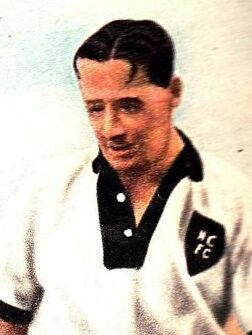
Tommy Lawton
Tommy Lawton was an English association footballer. Born October 6, 1919, in Bolton. Died November 6, 1996, in Nottingham. Teams include Burnley F.C. (1935–1936), Brentford F.C. (1951–1953) and Notts County F.C. (1947–1951). Awards include English Football Hall of Fame.
Facts
24 facts · 2 confirmed by two sources · 1 cited · 21 from one source
Where this comes from
Papalocal keeps its own record. It started from these sources; what each one said is kept here as it was copied, so a change on their side never changes this page by itself. Tap one to read its version.
What Wikidata says · copied November 18, 2026 · revision 2555278163
- Described as
- English association footballer (1919-1996)
- Other names
- Thomas Lawton
- Born
- October 6, 1919
- Died
- November 6, 1996
- Born in
- Bolton
- Died in
- Nottingham
- Cause of death
- pneumonia
- Name at birth
- Thomas Lawton
- Citizen of
- United Kingdom; United Kingdom of Great Britain and Ireland (–1927)
- Occupation
- association football player; cricketer; association football coach · 1 reference; autobiographer · 1 reference
- Teams
- Burnley F.C. (1935–1936); Brentford F.C. (1951–1953); Notts County F.C. (1947–1951); Chelsea F.C. (1945–1947); Everton F.C. (1936–1939); Arsenal F.C. (1953–1955); England men's national association football team (1938–1948); The Football League XI
- Sport
- association football; cricket · 1 reference
- Awards
- English Football Hall of Fame
- Military branch
- British Army
- Wikipedias with a page
- 21
Wikidata item Q726272 (wikidata.org/wiki/Q726272), public domain (CC0). Copied November 18, 2026.
What Wikipedia says · copied November 18, 2026 · revision 1381998564
Thomas Lawton (6 October 1919 – 6 November 1996) was an English football player and manager.
Born in Farnworth and raised in Bolton, he played amateur football at Rossendale United, before he turned professional at Burnley on his 17th birthday. He also played cricket for Burnley Cricket Club before his potential as a footballer won him a £6,500 move to Everton in January 1937. He went on to finish as the First Division's top-scorer in 1938 and 1939, helping Everton to finish as champions of the Football League in the latter campaign. League football was then suspended for seven full seasons due to the outbreak of World War II, during which time he scored 24 goals in 23 appearances for England whilst guesting for Everton and some other clubs. In November 1945, he moved to Chelsea for £14,000 and scored a club-record 26 goals in 34 league games in the 1946–47 season.
In November 1947, he made a surprise move to Third Division South club Notts County for a British record transfer fee of £20,000. He helped the club to win promotion as champions in 1949–50 before he moved on to Brentford in March 1952 for a club record £16,000. In January 1953, Brentford appointed him player-manager, though he would only remain in charge for nine months. He joined Arsenal as a player in November 1953 for £10,000, where he saw out the remainder of his playing career. Despite losing much of his best years to the war, he scored 260 goals in 433 league and cup competitions in 14 full seasons in the Football League.
He had a promising start to his managerial career by leading Kettering Town to the Southern League title in 1956–57, but then only had two more seasons as manager, getting relegated with Notts County in 1957–58 and then relegated with Kettering Town in 1963–64. During the 1970s, he struggled with debt and related legal problems, which were reported in the media as an example of a celebrated person falling from grace.
He scored 22 goals in his 23 England appearances over a ten-year international career from 1938 to 1948, including four against Portugal in May 1947. He helped England to win two British Home Championship titles outright (1946–47 and 1947–48) and to share the Championship in 1938–39. He fell out of international contention at the age of 28 due to his contempt for manager Walter Winterbottom, his decision to drop out of the First Division, and the emergence of Jackie Milburn and Nat Lofthouse. In addition to his England caps, he also represented The Football League XI and played in a special Great Britain game against Europe in 1947. He married twice and had two children and one step-child. His ashes are held in the National Football Museum, and he was inducted into the English Football Hall of Fame in 2003.
- Born, in its opening lines
- October 6, 1919
- Died, in its opening lines
- November 6, 1996
From the Wikipedia article “Tommy Lawton” (en.wikipedia.org/wiki/Tommy_Lawton), by its contributors, under CC BY-SA 4.0 (creativecommons.org/licenses/by-sa/4.0/). Copied November 18, 2026; not changed.
Confirmed Two sources agree. Cited One source, and it names where it got it. One source One source, without a reference of its own. Sources disagree The sources disagree. We show the best-supported value and keep theirs below.
