
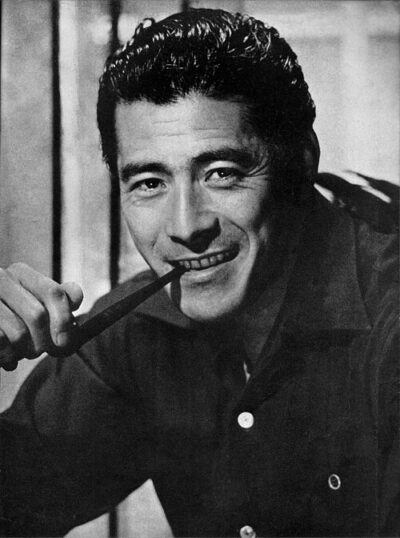
Toshirō Mifune
Toshirō Mifune was a Japanese actor. Born April 1, 1920, in Qingdao. Died December 24, 1997, in Mitaka. Known for Snow Trail, Drunken Angel and Stray Dog. Awards include Medal with Purple Ribbon, Blue Ribbon Awards for Best Actor (3 times) and Blue Ribbon Awards for Best Supporting Actor.
Facts
36 facts · 2 confirmed by two sources · 5 cited · 28 from one source · 1 where the sources disagree
What’s different
- Cause of death: we show multiple organ dysfunction syndrome (Sources disagree). Wikidata also lists pancreatic cancer
Where this comes from
Papalocal keeps its own record. It started from these sources; what each one said is kept here as it was copied, so a change on their side never changes this page by itself. Tap one to read its version.
What Wikidata says · copied November 16, 2026 · revision 2569045788
- Described as
- Japanese actor (1920–1997)
- Other names
- Toshiro Mifune, Toshirô Mifune, Toshirou Mifune, Mifune Toshiro
- Born
- April 1, 1920 · 9 references
- Died
- December 24, 1997 · 8 references
- Born in
- Qingdao · 3 references
- Died in
- Mitaka
- Buried in
- Kawasaki
- Cause of death
- multiple organ dysfunction syndrome; pancreatic cancer
- Citizen of
- Japan
- Occupation
- actor · 1 reference; film producer · 1 reference; film actor; film director · 1 reference; television actor; director · 1 reference
- Known for
- Snow Trail; Drunken Angel; Stray Dog; Rashomon; Seven Samurai; Samurai I: Musashi Miyamoto
- Awards
- Medal with Purple Ribbon (1986); Blue Ribbon Awards for Best Actor (3 times) (1952, 1962, 1966); Blue Ribbon Awards for Best Supporting Actor (1988); star on Hollywood Walk of Fame · 1 reference; Golden Arrow Award; Volpi Cup for Best Actor (2 times) (1961, 1965); Chevalier des Arts et des Lettres (1989) · 1 reference; Mainichi Film Award for Best Actor; Order of the Sacred Treasure, 3rd class (1993)
- Spouse
- Sachiko Yoshimine (1950–1995)
- Children
- Shirō Mifune; Mika Mifune
- Military branch
- Imperial Japanese Air Force · 1 reference
- Lived in
- Japan
- Nickname
- The Wolf; The Shogun
- Website
- http://www.mifuneproductions.co.jp/
- Wikipedias with a page
- 125
Wikidata item Q37001 (wikidata.org/wiki/Q37001), public domain (CC0). Copied November 16, 2026.
What Wikipedia says · copied November 16, 2026 · revision 1382725920
Toshiro Mifune (三船 敏郎, Mifune Toshirō; 1 April 1920 – 24 December 1997) was a Japanese actor and producer. The recipient of numerous awards and accolades over a lengthy career, he is widely considered one of the greatest actors of all time. Noted for his commanding screen presence in the Japanese film industry, he typically played hypermasculine or heroic characters.
Although he amassed more than 180 screen credits, Mifune is best known for his 16 collaborations with director Akira Kurosawa. These collaborations included Kurosawa's critically acclaimed jidaigeki films such as Rashomon (1950), for which Mifune won the San Marco Golden Lion at the Venice Film Festival, Seven Samurai (1954), Throne of Blood (1957), The Hidden Fortress (1958), and Yojimbo (1961), for which Mifune won the Volpi Cup for Best Actor at the Venice Film Festival and was recognised at the Blue Ribbon Awards as Best Actor. He also portrayed Miyamoto Musashi in Hiroshi Inagaki's Samurai Trilogy (1954–1956), Lord Toranaga in the NBC television miniseries Shōgun, and Admiral Isoroku Yamamoto in three different films.
In 1962, he established Mifune Productions, achieving success with large-scale works including The Sands of Kurobe (1968) and Samurai Banners (1969). He also starred in his directorial debut Legacy of the 500,000 (1963). Following his performance in the 1965 film Red Beard, which won him the Best Actor at the Venice Film Festival for a second time, Mifune turned to roles abroad. He starred in films such as Ánimas Trujano (1962), for which he won another Blue Ribbon Award for Best Actor, Grand Prix (1966), which was his Hollywood debut, Hell in the Pacific (1968), Red Sun (1971), Paper Tiger (1975), Midway (1976), and Steven Spielberg's 1941 (1979).
Mifune died of organ failure on 24 December 1997. In 1999, he was inducted into the Martial Arts History Museum Hall of Fame. He is the subject of the feature-length documentary, Mifune: The Last Samurai (2015), about his life and his films. In 2016, his name was inscribed on the Hollywood Walk of Fame.
- Born, in its opening lines
- April 1, 1920
- Died, in its opening lines
- December 24, 1997
From the Wikipedia article “Toshiro Mifune” (en.wikipedia.org/wiki/Toshiro_Mifune), by its contributors, under CC BY-SA 4.0 (creativecommons.org/licenses/by-sa/4.0/). Copied November 16, 2026; not changed.
Confirmed Two sources agree. Cited One source, and it names where it got it. One source One source, without a reference of its own. Sources disagree The sources disagree. We show the best-supported value and keep theirs below.
