
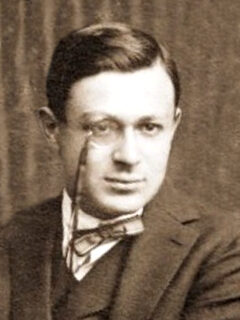
Tristan Tzara
Tristan Tzara was a Romanian-French poet. Born April 16, 1896, in Moinești. Died December 24, 1963, in 7th arrondissement of Paris. Known for Handkerchief of Clouds.
Facts
26 facts · 0 confirmed by two sources · 9 cited · 14 from one source · 3 where the sources disagree
What’s different
- Born: we show April 16, 1896 (Sources disagree). Wikipedia says April 28, 1896
- Died: we show December 24, 1963 (Sources disagree). Wikipedia says December 25, 1963
- Born in: we show Moinești (Sources disagree). Wikidata also lists Bacău
Where this comes from
Papalocal keeps its own record. It started from these sources; what each one said is kept here as it was copied, so a change on their side never changes this page by itself. Tap one to read its version.
What Wikidata says · copied November 16, 2026 · revision 2568929106
- Described as
- Romanian-French poet (1896–1963)
- Other names
- Tristan Ruia, Rosenstock Tristan Samuel, Tr. Tzara, S. Samyro, Tristan Samuel Rosenstock, Samuel Rosenstock, Tristan, Samy Rosenstock
- Born
- April 16, 1896 · 10 references
- Died
- December 24, 1963 · 5 references
- Born in
- Moinești · 2 references; Bacău · 1 reference
- Died in
- 7th arrondissement of Paris · 1 reference
- Buried in
- Montparnasse Cemetery
- Name at birth
- Samuel Rosenstock · 1 reference
- Citizen of
- Romania; France (1947–) · 2 references
- Occupation
- art collector; poet · 1 reference; writer · 3 references; diplomat; film director; translator; playwright; essayist
- Political party
- French Communist Party · 1 reference
- Genre
- poetry; polemical lampoon
- Known for
- Handkerchief of Clouds
- Field
- poetry · 1 reference; drama · 1 reference; Dada · 1 reference; essay · 1 reference
- Spouse
- Greta Knutson (1925–1942)
- Children
- Christophe Tzara · 1 reference
- Wikipedias with a page
- 85
Wikidata item Q16409 (wikidata.org/wiki/Q16409), public domain (CC0). Copied November 16, 2026.
What Wikipedia says · copied November 16, 2026 · revision 1385303191
Tristan Tzara (; French: [tʁistɑ̃ dzaʁa]; Romanian: [trisˈtan ˈt͡sara]; born Samuel or Samy Rosenstock, also known as S. Samyro; 28 April [O.S. 16 April] 1896 – 25 December 1963) was a Romanian and French avant-garde poet, essayist and performance artist. Also active as a journalist, playwright, literary and art critic, composer and film director, he was known best for being one of the founders and central figures of the anti-establishment Dada movement. Under the influence of Adrian Maniu, the adolescent Tzara became interested in Symbolism and co-founded the magazine Simbolul with Ion Vinea (with whom he also wrote experimental poetry) and painter Marcel Janco.
During World War I, after briefly collaborating on Vinea's Chemarea, he joined Janco in Switzerland. There, Tzara's shows at the Cabaret Voltaire and Zunfthaus zur Waag, as well as his poetry and art manifestos, became a main feature of early Dadaism. His work represented Dada's nihilistic side, in contrast with the more moderate approach favored by Hugo Ball.
After moving to Paris in 1919, Tzara, by then one of the "presidents of Dada", joined the staff of Littérature magazine, which marked the first step in the movement's evolution toward Surrealism. He was involved in the major polemics which led to Dada's split, defending his principles against André Breton and Francis Picabia, and, in Romania, against the eclectic modernism of Vinea and Janco. This personal vision on art defined his Dadaist plays The Gas Heart (1921) and Handkerchief of Clouds (1924). A forerunner of automatist techniques, Tzara eventually aligned himself with Breton's Surrealism, and under its influence wrote his celebrated utopian poem "The Approximate Man".
During the final part of his career, Tzara combined his humanist and anti-fascist perspective with a communist vision, joining the Republicans in the Spanish Civil War and the French Resistance during World War II, and serving a term in the National Assembly. Having spoken in favor of liberalization in the People's Republic of Hungary just before the Revolution of 1956, he distanced himself from the French Communist Party, of which he was by then a member. In 1960, he was among the intellectuals who protested against French actions in the Algerian War.
Tristan Tzara was an influential author and performer, whose contribution is credited with having created a connection from Cubism and Futurism to the Beat Generation, Situationism and various currents in rock music. A friend and collaborator of numerous modernist figures, Tzara was in a relationship from 1917 to 1922 with Maja Kruscek, before marrying the Swedish artist and poet Greta Knutson in 1925.
- Born, in its opening lines
- April 28, 1896
- Died, in its opening lines
- December 25, 1963
From the Wikipedia article “Tristan Tzara” (en.wikipedia.org/wiki/Tristan_Tzara), by its contributors, under CC BY-SA 4.0 (creativecommons.org/licenses/by-sa/4.0/). Copied November 16, 2026; not changed.
Confirmed Two sources agree. Cited One source, and it names where it got it. One source One source, without a reference of its own. Sources disagree The sources disagree. We show the best-supported value and keep theirs below.
