
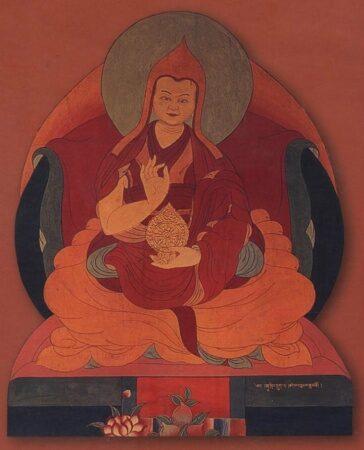
Tsangyang Gyatso
Tsangyang Gyatso was a sixth Dalai Lama of Tibet. Born March 1, 1683, in Tawang. Died November 15, 1706, in Qinghai. Positions held include Dalai Lama.
Facts
16 facts · 0 confirmed by two sources · 8 cited · 8 from one source
Where this comes from
Papalocal keeps its own record. It started from these sources; what each one said is kept here as it was copied, so a change on their side never changes this page by itself. Tap one to read its version.
What Wikidata says · copied November 16, 2026 · revision 2568899429
- Described as
- sixth Dalai Lama of Tibet (1683-1706)
- Other names
- 6th Dalai Lama, Ceyangjiacuo, Luobucangrenqingceyangjiacuo, Luobucangrenqingcangyangjiacuo, Cangyangjiacuo, Cangyang Gyaco
- Born
- March 1, 1683
- Died
- November 15, 1706
- Born in
- Tawang
- Died in
- Qinghai
- Citizen of
- Qing dynasty · 1 reference
- Occupation
- poet; writer · 1 reference; cleric · 1 reference
- Positions held
- Dalai Lama
- Field
- belletristic literature · 1 reference; poetry · 1 reference; song · 1 reference
- Father
- Lama Tashi Tenzin · 1 reference
- Mother
- Tsewang Lhamo · 1 reference
- Religion
- Tibetan Buddhism; Gelug
- Wikipedias with a page
- 46
Wikidata item Q25251 (wikidata.org/wiki/Q25251), public domain (CC0). Copied November 16, 2026.
What Wikipedia says · copied November 16, 2026 · revision 1379580790
The 6th Dalai Lama, Tsangyang Gyatso (Tibetan: ཚངས་དབྱངས་རྒྱ་མཚོ, Wylie: tshangs-dbyangs rgya-mtsho) (1 March 1683 – after 1706) was recognized as the 6th Dalai Lama after a delay of many years, permitting the Potala Palace to be completed. He was an unconventional Dalai Lama that preferred a Nyingma school yogi's life to that of an ordained monk. He was later kidnapped and deposed by the Koshut Lhazang Khan.
The death of the 5th Dalai Lama remained concealed for many years by his Kalon, in order to complete the building of the Potala Palace. The 6th Dalai Lama was born in southern Tibet, known as "Monyul", at Urgelling Monastery, which is in modern-day Tawang district, Arunachal Pradesh, India. He was officially located at the age of either 13 or 14.
As a youth, he showed high levels of intelligence with unconventional views. Later and while living as a lay practitioner and a yogi, he grew his hair long, dressed as a regular Tibetan, and was said to also drink alcohol and openly accept women as companions. He was said to be a popular Dalai Lama in Lhasa's Shol neighborhood located at the base of the Potala.
During a power struggle between Mongolians and Qing China in Tibet and Lhasa, the Dalai Lama's Kalon (regent) was killed by the Koshut Lhazang Khan. The 6th Dalai Lama was kidnapped and deposed by Mongolian forces. He disappeared and was either killed or somehow escaped and survived.
The 6th Dalai Lama is also well known for his poems and songs that continue to be popular not only in modern-day Tibet but also among Tibetan speaking communities in Nepal, India and all across China.
From the Wikipedia article “6th Dalai Lama” (en.wikipedia.org/wiki/6th_Dalai_Lama), by its contributors, under CC BY-SA 4.0 (creativecommons.org/licenses/by-sa/4.0/). Copied November 16, 2026; not changed.
Confirmed Two sources agree. Cited One source, and it names where it got it. One source One source, without a reference of its own. Sources disagree The sources disagree. We show the best-supported value and keep theirs below.
