
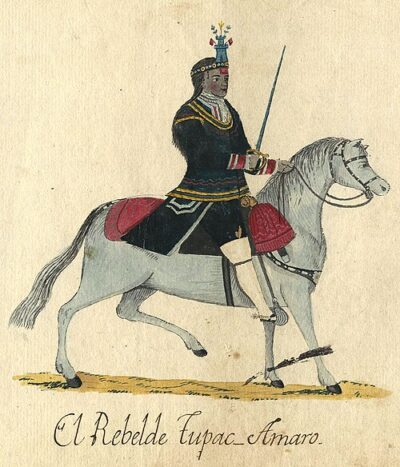
Túpac Amaru II
Túpac Amaru II was a leader of a large Andean uprising against the Spanish in Peru. Born March 10, 1738, in Tinta. Died May 18, 1781, in Cusco. Educated at Saint Francis Borgia School and National University of San Marcos.
Facts
19 facts · 1 confirmed by two sources · 3 cited · 14 from one source · 1 where the sources disagree
What’s different
- Born: we show March 10, 1738 (Sources disagree). Wikipedia says c. 1742
Where this comes from
Papalocal keeps its own record. It started from these sources; what each one said is kept here as it was copied, so a change on their side never changes this page by itself. Tap one to read its version.
What Wikidata says · copied November 16, 2026 · revision 2558266210
- Described as
- leader of a large Andean uprising against the Spanish in Peru (1738-1781)
- Other names
- José Gabriel Tupac-Amaru, José Gabriel Condorcanqui Noguera, José Gabriel Túpac Amaru, Tupac Amaru II, José Gabriel Condorcanqui
- Born
- March 10, 1738 · 1 reference
- Died
- May 18, 1781 · 3 references
- Born in
- Tinta · 1 reference
- Died in
- Cusco · 3 references
- Cause of death
- decapitation
- Name at birth
- José Gabriel Condorcanqui Noguera
- Citizen of
- Viceroyalty of Peru
- Occupation
- politician; revolutionary; indigenous leader; rebel · 2 references
- Education
- Saint Francis Borgia School; National University of San Marcos
- Spouse
- Micaela Bastidas (1758–)
- Children
- Fernando Túpac Amaru Bastidas
- Father
- Miguel Condorcanqui
- Mother
- Carmen Rosa Noguera Valenzuela
- Siblings
- Juan Bautista Túpac Amaru
- Lived in
- Cusco
- Wikipedias with a page
- 50
Wikidata item Q315937 (wikidata.org/wiki/Q315937), public domain (CC0). Copied November 16, 2026.
What Wikipedia says · copied November 16, 2026 · revision 1376981453
Túpac Amaru II (born José Gabriel Condorcanqui Noguera or José Gabriel Túpac Amaru, c. 1742 – May 18, 1781) was an Indigenous cacique who led a large Andean rebellion against the Spanish in Peru as self-proclaimed Sapa Inca of the new Inca Empire. He was later elevated to a mythical status in the Peruvian struggle for independence and indigenous rights movement, as well as an inspiration to myriad causes in Spanish America and beyond.
Of noble birth, he was a direct descendant of Túpac Amaru, the last Inca of Vilcabamba. He was educated in Cusco and inherited the curacazgo (chieftainship) of Surimana, Pampamarca, and Tungasuca after his father's death. He also amassed a fortune through muleteering, transporting goods and minerals in Upper Peru. As a curaca recognized by the colonial administration, he interceded between his communities and the colonial authorities, submitting petitions to alleviate the burdens of the indigenous tribute and the mining mita. His requests and demands for exemption were ignored in Tinta, Cuzco, and Lima. Consequently, on 4 November, 1780, after executing the corregidor Antonio de Arriaga, accused of repeated abuses, he began a rebellion seeking to restore justice for the Andean peoples. The rebellion spread through various regions of the Viceroyalty of Peru, extending to Upper Peru and the Viceroyalty of the Río de la Plata.
The movement of Túpac Amaru II was not initially an independence uprising but a rebellion against the abuses of the administrative and economic system imposed by colonial institutions, especially after the Bourbon Reforms. Its main objective was the abolition of oppressive practices such as the mining mita, the forced distribution of goods, the obrajes (textile workshops) and others, which primarily benefited Spaniards and Creoles at the expense of the indigenous population. On 16 November, 1780, Túpac Amaru II decreed the abolition of slavery for Black people for the first time in Spanish America. He was executed after the end of the rebellion in 1781.
Although Túpac Amaru II was not a precursor to independence in the modern sense, his 1780 rebellion has been the subject of multiple political reinterpretations. Over time, various governments and ideological movements, mainly within the nationalist or left-wing political spectrum, especially during the regime of Juan Velasco Alvarado (1968-1975), have turned him into a symbol of social justice. In contemporary Peru, Túpac Amaru II is invoked as a symbol of resistance.
- Born, in its opening lines
- c. 1742
- Died, in its opening lines
- May 18, 1781
From the Wikipedia article “Túpac Amaru II” (en.wikipedia.org/wiki/Túpac_Amaru_II), by its contributors, under CC BY-SA 4.0 (creativecommons.org/licenses/by-sa/4.0/). Copied November 16, 2026; not changed.
Confirmed Two sources agree. Cited One source, and it names where it got it. One source One source, without a reference of its own. Sources disagree The sources disagree. We show the best-supported value and keep theirs below.
