
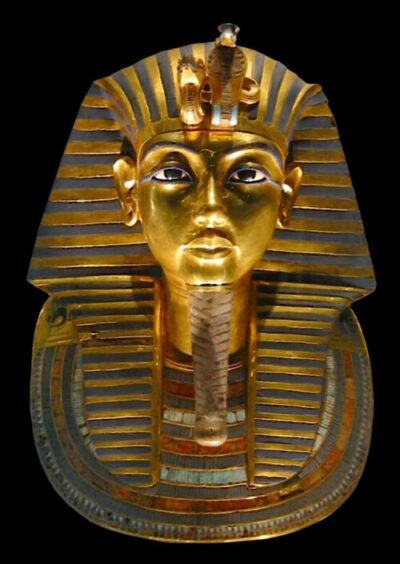
Tutankhamun
Tutankhamun was the 14th century BCE (18th dynasty) Egyptian pharaoh. Born 1324 BC, in Amarna. Died 1343 BC, in Thebes. Positions held include pharaoh (-1333–-1324).
Facts
25 facts · 0 confirmed by two sources · 6 cited · 19 from one source
Where this comes from
Papalocal keeps its own record. It started from these sources; what each one said is kept here as it was copied, so a change on their side never changes this page by itself. Tap one to read its version.
What Wikidata says · copied November 16, 2026 · revision 2569276715
- Described as
- 14th century BCE (18th dynasty) Egyptian pharaoh
- Other names
- Tutenkhamen, Tutankhaten, Tutankhamen, Tutenkhamon, King Tut
- Born
- 1324 BC · 1 reference
- Died
- 1343 BC
- Born in
- Amarna
- Died in
- Thebes · 1 reference
- Buried in
- tomb of Tutankhamun
- Cause of death
- malaria
- Name at birth
- Tutankamon · 1 reference
- Citizen of
- Ancient Egypt
- Occupation
- ruler
- Positions held
- pharaoh (-1333–-1324) · 1 reference
- Spouse
- Ankhesenamun
- Children
- 317a mummy; 317b mummy
- Father
- Akhenaten
- Mother
- The Younger Lady
- Siblings
- Ankhesenpaaten Tasherit; Meritaten Tasherit; Meketaten; Ankhesenamun; Neferneferuaten Tasherit; Neferneferure; Setepenre; Meritaten
- Lived in
- Amarna · 1 reference; Thebes · 1 reference
- Wikipedias with a page
- 114
Wikidata item Q12154 (wikidata.org/wiki/Q12154), public domain (CC0). Copied November 16, 2026.
What Wikipedia says · copied November 16, 2026 · revision 1385686481
Tutankhamun or Tutankhamen (Ancient Egyptian: twt-ꜥnḫ-jmn; c. 1342 BC – c. 1323 BC), was the third to last pharaoh of the Eighteenth Dynasty of ancient Egypt, who ruled c. 1332 – 1323 BC, dying at about the age of 19. Born Tutankhaten, his administration restored the traditional polytheistic form of ancient Egyptian religion, undoing a previous shift to the religion known as Atenism. Tutankhamun's tomb door proclaims his devotion to the ancient Egyptian gods.
His endowments and restorations of cults were recorded on the Restoration Stela. The cult of the god Amun at Thebes was restored to prominence, and the royal couple changed their names to "Tutankhamun" and "Ankhesenamun", replacing the -aten suffix. He also moved the royal court from Akhenaten's capital, Amarna, back to Memphis almost immediately on his accession to the kingship. He reestablished diplomatic relations with the Mitanni and carried out military campaigns in Nubia and the Near East. Tutankhamun was one of only a few kings known to be worshipped as a deity during their lifetime. He likely began construction of a royal tomb in the Valley of the Kings and an accompanying mortuary temple, but both were unfinished at the time of his death.
In 2012, it was suggested he died from a combination of malaria and a leg fracture. Since his royal tomb was incomplete, he was instead buried in a small non-royal tomb adapted for the purpose. He was succeeded by Ay, who had held titles such as Fan-bearer on the Right Side of the King. After a very brief reign, Ay was succeeded by Horemheb, who had been the commander-in-chief of Tutankhamun's armed forces. Under Horemheb, the restoration of the traditional ancient Egyptian religion was completed; Ay and Tutankhamun's constructions were usurped, and earlier Amarna Period rulers were erased.
Tutankhamun's tomb was discovered in 1922 by excavators led by Howard Carter and his patron, George Herbert, 5th Earl of Carnarvon. Although it had clearly been raided and robbed in ancient times, it retained much of its original contents, including the king's undisturbed mummy. The discovery received worldwide press coverage; with over 5,000 artifacts, it gave rise to renewed public interest in ancient Egypt, for which Tutankhamun's mask, preserved at the Egyptian Museum, remains a popular symbol. Before it was relocated to the Grand Egyptian Museum in 2025, some of his treasures have traveled worldwide, with unprecedented response; the Egyptian government allowed tours of the tomb beginning in 1961. The deaths of some individuals who were involved in the excavation have been popularly attributed to the "curse of the pharaohs" due to the similarity of their circumstances. Since the discovery of his tomb, he has been referred to colloquially as "King Tut".
From the Wikipedia article “Tutankhamun” (en.wikipedia.org/wiki/Tutankhamun), by its contributors, under CC BY-SA 4.0 (creativecommons.org/licenses/by-sa/4.0/). Copied November 16, 2026; not changed.
Confirmed Two sources agree. Cited One source, and it names where it got it. One source One source, without a reference of its own. Sources disagree The sources disagree. We show the best-supported value and keep theirs below.
