
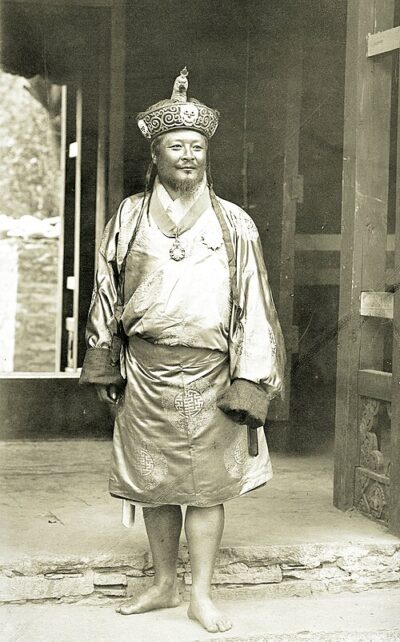
Ugyen Wangchuck
Ugyen Wangchuck was a king of Bhutan. Born June 11, 1862, in Bumthang District. Died August 21, 1926, in Bumthang District. Positions held include King of Bhutan (1907–1926). Awards include Order of the Star of India and Order of the Indian Empire.
Facts
15 facts · 1 confirmed by two sources · 0 cited · 13 from one source · 1 where the sources disagree
What’s different
- Died: we show August 21, 1926 (Sources disagree). Wikipedia says August 26, 1926
Where this comes from
Papalocal keeps its own record. It started from these sources; what each one said is kept here as it was copied, so a change on their side never changes this page by itself. Tap one to read its version.
What Wikidata says · copied November 16, 2026 · revision 2563647921
- Described as
- king of Bhutan (1862-1926)
- Born
- June 11, 1862
- Died
- August 21, 1926
- Born in
- Bumthang District
- Died in
- Bumthang District
- Citizen of
- Bhutan
- Occupation
- politician; king
- Positions held
- King of Bhutan (1907–1926)
- Awards
- Order of the Star of India · 1 reference; Order of the Indian Empire · 1 reference
- Spouse
- Ashi · 1 reference; Tsundue Pema Lhamo
- Children
- Jigme Wangchuck · 1 reference
- Father
- Jigme Namgyal
- Religion
- Buddhism
- Wikipedias with a page
- 41
Wikidata item Q333866 (wikidata.org/wiki/Q333866), public domain (CC0). Copied November 16, 2026.
What Wikipedia says · copied November 16, 2026 · revision 1370869607
Gongsar Ugyen Wangchuck (Dzongkha: ཨོ་རྒྱན་དབང་ཕྱུག, Wylie: o rgyan dbang phyug; 11 June 1862 – 26 August 1926) was the founder and first king of Bhutan, reigning from 17 December 1907 until his death in 1926. In his lifetime, he made efforts to unite the fledgling country.
- Born, in its opening lines
- June 11, 1862
- Died, in its opening lines
- August 26, 1926
From the Wikipedia article “Ugyen Wangchuck” (en.wikipedia.org/wiki/Ugyen_Wangchuck), by its contributors, under CC BY-SA 4.0 (creativecommons.org/licenses/by-sa/4.0/). Copied November 16, 2026; not changed.
Confirmed Two sources agree. Cited One source, and it names where it got it. One source One source, without a reference of its own. Sources disagree The sources disagree. We show the best-supported value and keep theirs below.
