
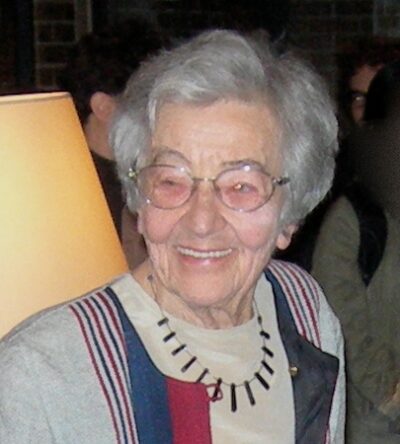
Ursula Franklin
Ursula Franklin was a Canadian metallurgist, research physicist, author, and educator. Born September 16, 1921, in Munich. Died July 22, 2016, in Toronto. Educated at University of Toronto and Technische Universität Berlin. Awards include Companion of the Order of Canada, Pearson Medal of Peace and Governor General's Awards.
Facts
28 facts · 2 confirmed by two sources · 10 cited · 16 from one source
Where this comes from
Papalocal keeps its own record. It started from these sources; what each one said is kept here as it was copied, so a change on their side never changes this page by itself. Tap one to read its version.
What Wikidata says · copied November 15, 2026 · revision 2568853432
- Described as
- Canadian metallurgist, research physicist, author, and educator (1921–2016)
- Other names
- Ursula Martius Franklin
- Born
- September 16, 1921 · 2 references
- Died
- July 22, 2016 · 2 references
- Born in
- Munich · 1 reference
- Died in
- Toronto · 1 reference
- Citizen of
- Canada; Germany
- Occupation
- physicist · 1 reference; metallurgist; university teacher · 1 reference; women's rights activist; engineer; peace activist · 2 references
- Worked for
- University of Toronto
- Education
- University of Toronto; Technische Universität Berlin
- Member of
- Royal Society of Canada
- Awards
- Companion of the Order of Canada (1992) · 1 reference; Pearson Medal of Peace (2001) · 1 reference; Governor General's Awards (1991); Order of Ontario; Fellow of the Royal Society of Canada; Honorary doctor of the University of Ottawa; honorary doctorate of Concordia University; honorary doctorate from the University of British Columbia; Governor General's Award in Commemoration of the Persons Case (1991) · 1 reference; Sir John William Dawson Medal (1991) · 1 reference
- Field
- physics
- Religion
- Quakers · 1 reference
- Wikipedias with a page
- 34
Wikidata item Q77729 (wikidata.org/wiki/Q77729), public domain (CC0). Copied November 15, 2026.
What Wikipedia says · copied November 15, 2026 · revision 1377810541
Ursula Martius Franklin (16 September 1921 – 22 July 2016) was a Canadian metallurgist, activist, research physicist, author, and educator who taught at the University of Toronto for more than 40 years. Franklin is best known for her writings on the political and social effects of technology. She was the author of The Real World of Technology, which is based on her 1989 Massey Lectures; The Ursula Franklin Reader: Pacifism as a Map, a collection of her papers, interviews, and talks; and Ursula Franklin Speaks: Thoughts and Afterthoughts, containing 22 of her speeches and five interviews between 1986 and 2012. Franklin was a practising Quaker and actively worked on behalf of pacifist and feminist causes. She wrote and spoke extensively about the futility of war and the connection between peace and social justice. Franklin received numerous honours and awards, including the Governor General's Award in Commemoration of the Persons Case for promoting the equality of girls and women in Canada and the Pearson Medal of Peace for her work in advancing human rights. In 2012, she was inducted into the Canadian Science and Engineering Hall of Fame. A Toronto high school, Ursula Franklin Academy, as well as Ursula Franklin Street on the University of Toronto's St. George campus, have been named in her honor.
For Franklin, technology was much more than machines, gadgets or electronic transmitters. It was a comprehensive system that includes methods, procedures, organization, "and most of all, a mindset". She distinguished between holistic technologies used by craft workers or artisans and prescriptive ones associated with a division of labour in large-scale production. Holistic technologies allow artisans to control their own work from start to finish. Prescriptive technologies organize work as a sequence of steps requiring supervision by bosses or managers. Franklin argued that the dominance of prescriptive technologies in modern society discourages critical thinking and promotes "a culture of compliance".
For some, Franklin belongs in the intellectual tradition of Harold Innis and Jacques Ellul who warn about technology's tendency to suppress freedom and endanger civilization. Franklin herself acknowledged her debt to Ellul as well as to several other thinkers including Lewis Mumford, C. B. Macpherson, E. F. Schumacher, and Vandana Shiva. She recognized that this list had few women. In addition to the philosophy of technology, she believed that science was "severely impoverished because women are discouraged from taking part in the exploration of knowledge".
- Born, in its opening lines
- September 16, 1921
- Died, in its opening lines
- July 22, 2016
From the Wikipedia article “Ursula Franklin” (en.wikipedia.org/wiki/Ursula_Franklin), by its contributors, under CC BY-SA 4.0 (creativecommons.org/licenses/by-sa/4.0/). Copied November 15, 2026; not changed.
Confirmed Two sources agree. Cited One source, and it names where it got it. One source One source, without a reference of its own. Sources disagree The sources disagree. We show the best-supported value and keep theirs below.
