
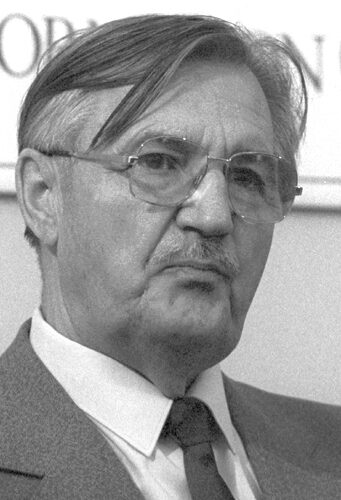
Valentin Varennikov
Valentin Varennikov was a Soviet general and Russian politician. Born December 15, 1923, in Krasnodar. Died May 6, 2009, in Moscow. Positions held include deputy of the Supreme Soviet of the Soviet Union and member of the State Duma (2003–2007). Educated at Military Academy of the General Staff of the Armed Forces of Russia. Awards include Zhukov Medal, Medal "For the Victory over Germany in the Great Patriotic War 1941–1945" and Order of the Red Banner.
Facts
36 facts · 2 confirmed by two sources · 4 cited · 30 from one source
Where this comes from
Papalocal keeps its own record. It started from these sources; what each one said is kept here as it was copied, so a change on their side never changes this page by itself. Tap one to read its version.
What Wikidata says · copied November 17, 2026 · revision 2567103369
- Described as
- Soviet general and Russian politician (1923-2009)
- Other names
- Valentin Ivanovich Varennikov
- Born
- December 15, 1923 · 2 references
- Died
- May 6, 2009 · 2 references
- Born in
- Krasnodar · 1 reference
- Died in
- Moscow · 1 reference
- Buried in
- Troyekurovskoye cemetery
- Citizen of
- Soviet Union; Russia
- Occupation
- politician · 1 reference; military personnel · 1 reference; Chernobyl liquidator
- Positions held
- deputy of the Supreme Soviet of the Soviet Union; member of the State Duma (2003–2007) · 1 reference
- Political party
- Communist Party of the Russian Federation; Communist Party of the Soviet Union; Rodina
- Education
- Military Academy of the General Staff of the Armed Forces of Russia
- Member of
- 4th State Duma of the Russian Federation; 2nd State Duma of the Russian Federation
- Awards
- Zhukov Medal; Medal "For the Victory over Germany in the Great Patriotic War 1941–1945"; Order of the Red Banner; Order of Lenin; Order of the Red Star; Hero of the Soviet Union; Order of the October Revolution; Order of the Patriotic War, 1st class; Order of the Patriotic War, 2nd class; Jubilee medal «10 years of the Withdrawal of Soviet Troops from Afghanistan»; Order of Kutuzov, 1st class; Medal "For Battle Merit"; Medal "For the Defence of Stalingrad"; Medal "For the Liberation of Warsaw"; Medal "For Strengthening of Brotherhood in Arms"
- Military branch
- Soviet Army · 1 reference
- Military rank
- general of the army; general · 1 reference
- Wikipedias with a page
- 24
Wikidata item Q710007 (wikidata.org/wiki/Q710007), public domain (CC0). Copied November 17, 2026.
What Wikipedia says · copied November 17, 2026 · revision 1385280507
Valentin Ivanovich Varennikov (Russian: Валентин Иванович Варенников, December 15, 1923 – May 6, 2009) was a Soviet army general and Russian politician. A veteran of the Second World War, he led the honor guard that received the Victory Banner at the 1945 Moscow Victory Parade, and he later directed Soviet military operations in Afghanistan and became commander-in-chief of the Soviet Ground Forces in 1989. He was one of the most active supporters of the August 1991 coup attempt against Mikhail Gorbachev, and he was the only defendant in the case to refuse an amnesty and insist on a trial, at which he was acquitted in 1994. He later served two terms in the State Duma.
- Born, in its opening lines
- December 15, 1923
- Died, in its opening lines
- May 6, 2009
From the Wikipedia article “Valentin Varennikov” (en.wikipedia.org/wiki/Valentin_Varennikov), by its contributors, under CC BY-SA 4.0 (creativecommons.org/licenses/by-sa/4.0/). Copied November 17, 2026; not changed.
Confirmed Two sources agree. Cited One source, and it names where it got it. One source One source, without a reference of its own. Sources disagree The sources disagree. We show the best-supported value and keep theirs below.
