
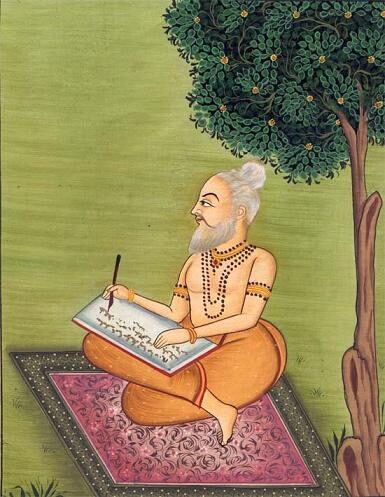
Valmiki
Valmiki was a Celebrated as the harbinger-poet in Sanskrit literature and the author of the epic Ramayana. Known for Ramayana.
Facts
4 facts · 0 confirmed by two sources · 0 cited · 4 from one source
Where this comes from
Papalocal keeps its own record. It started from these sources; what each one said is kept here as it was copied, so a change on their side never changes this page by itself. Tap one to read its version.
What Wikidata says · copied November 16, 2026 · revision 2567787080
- Described as
- Celebrated as the harbinger-poet in Sanskrit literature and the author of the epic Ramayana
- Other names
- Sage, Epic Poet, ऋषि, महाकवि
- Occupation
- poet; writer
- Known for
- Ramayana
- Religion
- Hinduism
- Wikipedias with a page
- 80
Wikidata item Q715607 (wikidata.org/wiki/Q715607), public domain (CC0). Copied November 16, 2026.
What Wikipedia says · copied November 16, 2026 · revision 1362344782
Valmiki (; Sanskrit: वाल्मीकि, romanized: Vālmīki, lit. 'from an anthill', [ʋɑːlmiːki]) was a legendary poet and Hindu maharishi (sage) who is celebrated as the traditional author of the smriti epic Ramayana, one of Hinduism's two Itihasas, based on the attribution in the text itself. He is revered as Ādi Kavi (Sanskrit: आदिकवि), the first poet, author of Ramayana, the first epic poem.
The Ramayana, originally written by Valmiki, consists of 24,000 shlokas and seven cantos (kaṇḍas). The Ramayana is composed of about 480,002 words, being a quarter of the length of the full text of the Mahabharata or about four times the length of the Iliad. The Ramayana tells the story of a prince, Rama of the city of Ayodhya in the Kingdom of Kosala, whose wife Sita is abducted by Ravana, the demon-king (Rakshasa) of Lanka. The scholars' estimates for the earliest stage of the text ranging from the 8th to 4th centuries BCE, and later stages extending up to the 3rd century CE, although original date of composition is unknown. As with many traditional epics, it has gone through a process of interpolations and redactions, making it impossible to date accurately.
British satirist Aubrey Menen says that Valmiki was "recognized as a literary genius," and thus was considered, "an outlaw," presumably because of his "philosophic scepticism," as part of an "Indian Enlightenment" period. Valmiki is also quoted as being the contemporary of Rama. Menen claims Valmiki is "the first author in all history to bring himself into his own composition."
From the Wikipedia article “Valmiki” (en.wikipedia.org/wiki/Valmiki), by its contributors, under CC BY-SA 4.0 (creativecommons.org/licenses/by-sa/4.0/). Copied November 16, 2026; not changed.
Confirmed Two sources agree. Cited One source, and it names where it got it. One source One source, without a reference of its own. Sources disagree The sources disagree. We show the best-supported value and keep theirs below.
