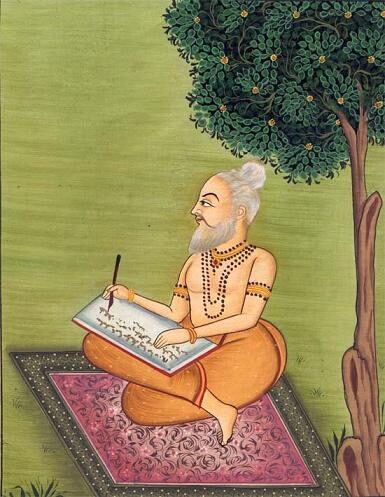
Ramayana
Ramayana is An ancient Hindu epic composed by Valmiki which narrates the life story of Lord Rama.
- Written by
- Valmiki
- Genre
- epic poem
All 5 facts, and where they come from
Facts
5 facts · 0 confirmed by two sources · 0 cited · 5 from one source
Where this comes from
Papalocal keeps its own record. It started from these sources; what each one said is kept here as it was copied, so a change on their side never changes this page by itself. Tap one to read its version.
What Wikidata says · copied November 17, 2026 · revision 2566961598
- Described as
- An ancient Hindu epic composed by Valmiki which narrates the life story of Lord Rama.
- Other names
- Râmâyana, Valmiki Ramayana
- What it is
- national epic; literary work
- Written by
- Valmiki
- Genre
- epic poem · 1 reference
- Language
- Sanskrit
- Wikipedias with a page
- 138
Wikidata item Q37293 (wikidata.org/wiki/Q37293), public domain (CC0). Copied 2026-11-17.
What Wikipedia says · copied November 17, 2026 · revision 1386206031
The Ramayana (; Sanskrit: रामायणम्, romanized: Rāmāyaṇam), also known as the Valmiki Ramayana, as traditionally attributed to Valmiki, is a Hindu smriti epic poem (also described as a Sanskrit epic) from ancient India. It is one of the two important epics of Hinduism known as the Itihasas, the other being the Mahabharata, narratives of past events (purāvṛtta), interspersed with teachings on the goals of human life. The epic narrates the life and journey of Rama, the seventh avatar of the Hindu deity Vishnu, who was the prince of Ayodhya. It is one of the largest ancient epics in world literature and consists of nearly 24,000 shlokas (verses), divided into seven kāṇḍa (chapters), where each shloka is a couplet (two individual lines).
The Ramayana chronicles the life story of Rama, who was born to King Dasaratha and his first wife Kausalya in Ayodhya, the capital of Kosala kingdom. The epic follows his fourteen-year exile to the forest urged by his father, on the request of Rama's stepmother Kaikeyi; his travels across the forests in the Indian subcontinent with his wife Sita and brother Lakshmana; the kidnapping of Sita by Ravana, the king of Lanka; meeting with Vānaras, where Hanuman becomes Rama's biggest devotee; winning the battle against Ravaṇa; and Rama's eventual return to Ayodhya along with Sita to be crowned king amidst jubilation and celebration.
Scholarly estimates for the primary (oral) stage of the text range from the 8th–5th to 5th–4th century BCE, "although the legends constituting it go back farther in time" and later stages extend up to the 3rd century CE. There are two major regional recensions, the northern (N) and the southern (S), which inherited a common oral source from the original composition by Valmiki but evolved profound verbal differences because oral transmission continued along two separate regional pathways for a long period before they were eventually fixed in writing. There are also many other versions of the Ramayana in Indian languages, including Buddhist and Jain adaptations.
The Ramayana strongly influenced the later Sanskrit poetry and Hindu life and culture. Its main figures were central to the cultural consciousness of many nations, both Hindu and Buddhist. Its most significant moral influence was the importance of virtue, in the life of a citizen and in the aspirational ideals guiding the functioning of a state (from Sanskrit: रामराज्य, romanized: Rāmarājya, a utopian state where Rama is king) or a society.
From the Wikipedia article “Ramayana” (en.wikipedia.org/wiki/Ramayana), by its contributors, under CC BY-SA 4.0 (creativecommons.org/licenses/by-sa/4.0/). Copied 2026-11-17; not changed.
Confirmed Two sources agree. Cited One source, and it names where it got it. One source One source, without a reference of its own. Sources disagree The sources disagree. We show the best-supported value and keep theirs below.
Picture: Wikimedia Commons: Battle at Lanka, Ramayana, Udaipur, 1649-53.jpg · See Commons file page