
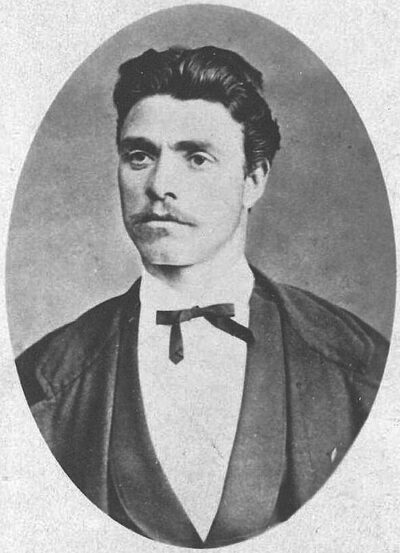
Vasil Levski
Vasil Levski was a Bulgarian revolutionary. Born July 18, 1837, in Karlovo. Died February 18, 1873, in Sofia.
Facts
15 facts · 2 confirmed by two sources · 2 cited · 11 from one source
Where this comes from
Papalocal keeps its own record. It started from these sources; what each one said is kept here as it was copied, so a change on their side never changes this page by itself. Tap one to read its version.
What Wikidata says · copied November 16, 2026 · revision 2562929803
- Described as
- Bulgarian revolutionary (1837–1873)
- Other names
- Vasil Ivanov Kunchev, Vassil Levski
- Born
- July 18, 1837 · 1 reference
- Died
- February 18, 1873 · 1 reference
- Born in
- Karlovo
- Died in
- Sofia · 1 reference
- Buried in
- tomb of Vasil Levski
- Cause of death
- hanging to death
- Name at birth
- Васил Иванов Кунчев
- Citizen of
- Ottoman Empire
- Occupation
- revolutionary · 3 references; cleric; political activist
- Father
- Ivan Kunchev Ivanov
- Mother
- Gina Kuncheva
- Religion
- Eastern Orthodox Church; Eastern Orthodoxy
- Wikipedias with a page
- 54
Wikidata item Q318461 (wikidata.org/wiki/Q318461), public domain (CC0). Copied November 16, 2026.
What Wikipedia says · copied November 16, 2026 · revision 1384843787
Vasil Levski (Bulgarian: Васил Левски, spelled in old Bulgarian orthography as Василъ Львскій, pronounced [vɐˈsiɫ ˈlɛfski]), born Vasil Ivanov Kunchev (Васил Иванов Кунчев; 18 July 1837 – 18 February 1873), was a Bulgarian revolutionary who is, today, a national hero of Bulgaria. Dubbed the Apostle of Freedom, Levski ideologised and strategised a revolutionary movement to liberate Bulgaria from Ottoman rule. Levski found the Internal Revolutionary Organisation, and sought to foment a nationwide uprising through a network of secret regional committees.
Born in the Sub-Balkan town of Karlovo to middle-class parents, Levski became an Orthodox monk before emigrating to join the two Bulgarian Legions in Serbia and other Bulgarian revolutionary groups. Abroad, he acquired the nickname Levski ("Lionlike"). After working as a teacher in Bulgarian lands, he propagated his views and developed the concept of his Bulgaria-based revolutionary organisation, an innovative idea that superseded the foreign-based detachment strategy of the past. In Romania, Levski helped institute the Bulgarian Revolutionary Central Committee, composed of Bulgarian expatriates. During his tours of Bulgaria, Levski established a wide network of insurrectionary committees. Ottoman authorities, however, captured him at an inn near Lovech and executed him by hanging in Sofia.
Levski looked beyond the act of liberation and envisioned a Bulgarian republic of ethnic and religious equality, largely reflecting the liberal ideas of the French Revolution and contemporary Western society. He said, "We will be free in complete liberty where the Bulgarian lives: in Bulgaria, Thrace, Macedonia; people of whatever ethnicity live in this heaven of ours, they will be equal in rights to the Bulgarian in everything." Levski held that all religious and ethnic groups live in a free Bulgaria enjoy equal rights. He is commemorated with monuments in Bulgaria and Serbia, and numerous national institutions bear his name. In 2007, he topped a nationwide television poll as the all-time greatest Bulgarian.
- Born, in its opening lines
- July 18, 1837
- Died, in its opening lines
- February 18, 1873
From the Wikipedia article “Vasil Levski” (en.wikipedia.org/wiki/Vasil_Levski), by its contributors, under CC BY-SA 4.0 (creativecommons.org/licenses/by-sa/4.0/). Copied November 16, 2026; not changed.
Confirmed Two sources agree. Cited One source, and it names where it got it. One source One source, without a reference of its own. Sources disagree The sources disagree. We show the best-supported value and keep theirs below.
