
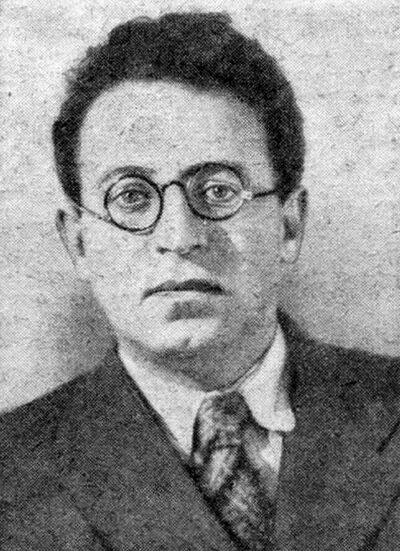
Vasily Grossman
Vasily Grossman was a Russian Soviet writer and journalist. Born December 12, 1905, in Berdychiv. Died September 14, 1964, in Moscow. Known for Life and Fate. Educated at Lomonosov Moscow State University. Awards include Medal "For the Victory over Germany in the Great Patriotic War 1941–1945", Order of the Red Banner and Order of the Red Star.
Facts
26 facts · 2 confirmed by two sources · 5 cited · 19 from one source
What’s different
- Born: we show December 12, 1905 (Confirmed). Wikidata also lists November 29, 1905
Where this comes from
Papalocal keeps its own record. It started from these sources; what each one said is kept here as it was copied, so a change on their side never changes this page by itself. Tap one to read its version.
What Wikidata says · copied November 16, 2026 · revision 2565601109
- Described as
- Russian Soviet writer and journalist (1905-1964)
- Other names
- Vasily Semyonovich Grossman, Wassilij Grossmann
- Born
- November 29, 1905 · 2 references; December 12, 1905 · 2 references
- Died
- September 14, 1964 · 7 references
- Born in
- Berdychiv · 2 references
- Died in
- Moscow · 3 references
- Buried in
- Troyekurovskoye cemetery
- Cause of death
- cancer
- Name at birth
- Иосиф Соломонович Гроссман
- Citizen of
- Russian Empire; Soviet Union
- Occupation
- war correspondent; writer · 4 references; novelist; prose writer · 1 reference; engineer · 2 references; reporter · 1 reference
- Education
- Lomonosov Moscow State University
- Member of
- USSR Union of Writers
- Known for
- Life and Fate
- Awards
- Medal "For the Victory over Germany in the Great Patriotic War 1941–1945"; Order of the Red Banner; Order of the Red Star; Order of the Red Banner of Labour; Medal "For the Defence of Stalingrad"; Medal "For the Liberation of Warsaw"; Medal "For the Capture of Berlin"
- Children
- Yekaterina Vasilyevna Korotkova
- Wikipedias with a page
- 53
Wikidata item Q313767 (wikidata.org/wiki/Q313767), public domain (CC0). Copied November 16, 2026.
What Wikipedia says · copied November 16, 2026 · revision 1382426901
Vasily Semyonovich Grossman (Russian: Васи́лий Семёнович Гро́ссман; 12 December [O.S. 29 November] 1905 – 14 September 1964) was a Soviet writer and journalist. Born to a Jewish family in Ukraine, then part of the Russian Empire, Grossman trained as a chemical engineer at Moscow State University, earning the nickname Vasya-khimik ("Vasya the Chemist") because of his diligence as a student. Upon graduation, he took a job in Stalino (now Donetsk) in the Donets Basin. In the 1930s he changed careers and began writing full-time, publishing a number of short stories and several novels.
At the outbreak of the Second World War, Grossman was engaged as a war correspondent by the Red Army newspaper Krasnaya Zvezda; he wrote first-hand accounts of the battles of Moscow, Stalingrad, Kursk, and Berlin. Grossman's eyewitness reports of a Nazi extermination camp, following the discovery of Treblinka, were among the earliest accounts of a Nazi death camp by a reporter.
There is some dispute over the extent of the state repression Grossman endured after the war. While he was never arrested, his two major literary works (Life and Fate and Everything Flows) were censored by Nikita Khrushchev's government as anti-Soviet. At the time of Grossman's death from kidney cancer in 1964, these books remained unreleased. Copies were eventually smuggled out of the Soviet Union by a network of dissidents, including Andrei Sakharov and Vladimir Voinovich, and first published in the West in 1980, before appearing in the Soviet Union in 1988.
- Born, in its opening lines
- December 12, 1905
- Died, in its opening lines
- September 14, 1964
From the Wikipedia article “Vasily Grossman” (en.wikipedia.org/wiki/Vasily_Grossman), by its contributors, under CC BY-SA 4.0 (creativecommons.org/licenses/by-sa/4.0/). Copied November 16, 2026; not changed.
Confirmed Two sources agree. Cited One source, and it names where it got it. One source One source, without a reference of its own. Sources disagree The sources disagree. We show the best-supported value and keep theirs below.
