
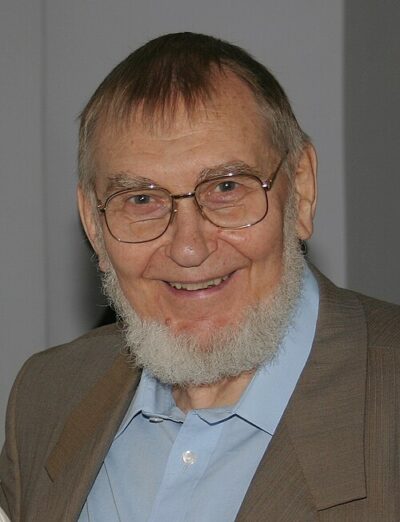
Veljo Tormis
Veljo Tormis was an Estonian composer. Born August 7, 1930, in Aru. Died January 21, 2017, in Tallinn. Educated at Moscow Conservatory. Awards include USSR State Prize, Recipient of the Order of the National Coat of Arms, 1st Class and Order of the National Coat of Arms, 3rd Class.
Facts
34 facts · 2 confirmed by two sources · 4 cited · 28 from one source
Where this comes from
Papalocal keeps its own record. It started from these sources; what each one said is kept here as it was copied, so a change on their side never changes this page by itself. Tap one to read its version.
What Wikidata says · copied November 17, 2026 · revision 2567372240
- Described as
- Estonian composer (1930–2017)
- Born
- August 7, 1930 · 3 references
- Died
- January 21, 2017 · 4 references
- Born in
- Aru
- Died in
- Tallinn · 1 reference
- Citizen of
- Estonia; Soviet Union
- Occupation
- composer · 2 references; film score composer; music educator; folklorist; music teacher · 1 reference; university teacher; music arranger · 1 reference
- Worked for
- University of Tartu
- Education
- Moscow Conservatory
- Genre
- opera; choral music
- Instrument
- pipe organ · 1 reference
- Awards
- USSR State Prize (1974); Recipient of the Order of the National Coat of Arms, 1st Class (2010); Order of the National Coat of Arms, 3rd Class (1996); Merited Art Worker of Estonian SSR (1967); People's Artist of the Estonian SSR (1975); People's Artist of the USSR (1987); National Identity Award (2005); Black Nights Prize (2015); Coat of Arms of Tallinn (2000); Order of Friendship of Peoples; Order of the Three Stars, 3rd Class
- Field
- film score
- Spouse
- Lea Tormis
- Children
- Tõnu Tormis
- Father
- Riho Tormis
- Website
- http://www.veljotormis.com
- Wikipedias with a page
- 26
Wikidata item Q461923 (wikidata.org/wiki/Q461923), public domain (CC0). Copied November 17, 2026.
What Wikipedia says · copied November 17, 2026 · revision 1351014080
Veljo Tormis (7 August 1930 – 21 January 2017) was an Estonian composer, regarded as one of the great contemporary choral composers and one of the most important composers of the 20th century in Estonia. Internationally, his fame arises chiefly from his extensive body of choral music, which exceeds 500 individual choral songs, most of it a cappella. The great majority of these pieces are based on traditional ancient Estonian folksongs (regilaulud), either textually, melodically, or merely stylistically.
His composition most often performed outside Estonia, Curse Upon Iron (Raua needmine, 1972), invokes ancient Shamanistic traditions to construct an allegory about the evils of war. Some of his works were banned by the Soviet government, but because folk music was fundamental to his style most of his compositions were accepted by the censors.
More recently, Tormis' works have been performed and recorded by Tõnu Kaljuste with the Estonian Philharmonic Chamber Choir, and others. In the 1990s, Tormis began to receive commissions from some a cappella groups as the King's Singers and the Hilliard Ensemble.
Tormis famously said of his settings of traditional melodies and verse: "It is not I who makes use of folk music, it is folk music that makes use of me." His work demonstrates his conviction that traditional Estonian and other Balto-Finnic music represents a treasure which must be guarded and nourished, and that culture may be kept alive through the medium of song.
- Born, in its opening lines
- August 7, 1930
- Died, in its opening lines
- January 21, 2017
From the Wikipedia article “Veljo Tormis” (en.wikipedia.org/wiki/Veljo_Tormis), by its contributors, under CC BY-SA 4.0 (creativecommons.org/licenses/by-sa/4.0/). Copied November 17, 2026; not changed.
Confirmed Two sources agree. Cited One source, and it names where it got it. One source One source, without a reference of its own. Sources disagree The sources disagree. We show the best-supported value and keep theirs below.
