
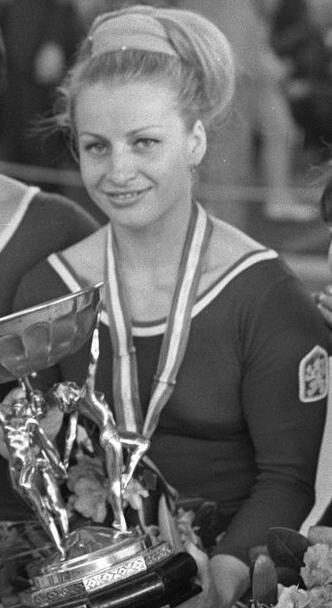
Věra Čáslavská
Věra Čáslavská was a Czechoslovak sports official, artistic gymnast and coach. Born May 3, 1942, in Prague. Died August 30, 2016, in Prague. Awards include Czech Medal of Merit, Gratias Agit and Order of the Rising Sun.
Facts
25 facts · 2 confirmed by two sources · 13 cited · 10 from one source
Where this comes from
Papalocal keeps its own record. It started from these sources; what each one said is kept here as it was copied, so a change on their side never changes this page by itself. Tap one to read its version.
What Wikidata says · copied November 16, 2026 · revision 2562611798
- Described as
- Czechoslovak sports official, artistic gymnast and coach (1942–2016)
- Other names
- Vera Caslavska
- Born
- May 3, 1942 · 13 references
- Died
- August 30, 2016 · 11 references
- Born in
- Prague · 7 references
- Died in
- Prague · 3 references
- Buried in
- Černošice
- Cause of death
- pancreatic cancer
- Citizen of
- Czechoslovakia · 1 reference; Czech Republic
- Occupation
- artistic gymnast · 1 reference; athlete · 2 references; politician · 1 reference
- Member of
- International Olympic Committee
- Sport
- artistic gymnastics
- Awards
- Czech Medal of Merit (1995); Gratias Agit (2016); Order of the Rising Sun (2010); International Gymnastics Hall of Fame (1998) · 1 reference; Silver Olympic Order (1991) · 1 reference; Grand Officer of the Order of the White Lion (2026) · 1 reference
- Field
- gymnastics · 1 reference; physical education · 1 reference; sport · 1 reference
- Spouse
- Josef Odložil (1968–) · 2 references
- Children
- Martin Odložil
- Height
- 1.60 m (5 ft 3 in)
- Wikipedias with a page
- 49
Wikidata item Q229503 (wikidata.org/wiki/Q229503), public domain (CC0). Copied November 16, 2026.
What Wikipedia says · copied November 16, 2026 · revision 1384431306
Věra Čáslavská (Czech pronunciation: [ˈvjɛra ˈtʃaːslafskaː]; 3 May 1942 – 30 August 2016) was a Czechoslovak artistic gymnast and Czech sports official. She won a total of 22 international titles between 1959 and 1968 including seven Olympic gold medals, four world titles and eleven European championships. Čáslavská is the most decorated Czech gymnast in history and is one of only three female gymnasts, along with the Soviet Larisa Latynina and American Simone Biles, to win the all-around gold medal at two Olympics. She remains the only gymnast, male or female, to have won an Olympic gold medal in each individual event. She was also the first gymnast to achieve a perfect 10 at a major competition in the post-1952 era. She held the record for the most individual gold medals (with 7) among all female athletes (not only gymnasts) in Olympic history as well until it was surpassed by swimmer Katie Ledecky in 2024 after 56 years.
In addition to her gymnastics success, Čáslavská was known for her outspoken support of the Czechoslovak democratization movement and her opposition to the 1968 Soviet-led invasion of Czechoslovakia. At the 1968 Olympics in Mexico City, she took this protest to the world stage by quietly looking down and away while the Soviet national anthem was played during the medal ceremonies for the balance beam and floor exercise event finals. While Čáslavská's actions were applauded by her compatriots, they resulted in her becoming a persona non grata in the new regime. She was forced into retirement and for many years was denied the right to travel, work and attend sporting events.
Čáslavská's situation improved in the 1980s after the intervention of members of the International Olympic Committee, and following the Velvet Revolution her status got better significantly. During the 1990s she held several positions of honor, including a term as president of the Czech Olympic Committee.
- Born, in its opening lines
- May 3, 1942
- Died, in its opening lines
- August 30, 2016
From the Wikipedia article “Věra Čáslavská” (en.wikipedia.org/wiki/Věra_Čáslavská), by its contributors, under CC BY-SA 4.0 (creativecommons.org/licenses/by-sa/4.0/). Copied November 16, 2026; not changed.
Confirmed Two sources agree. Cited One source, and it names where it got it. One source One source, without a reference of its own. Sources disagree The sources disagree. We show the best-supported value and keep theirs below.
