
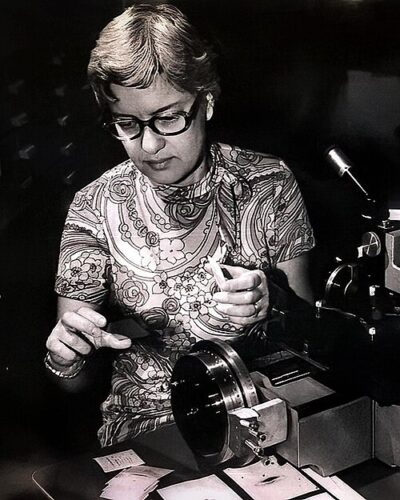
Vera Rubin
Vera Rubin was an American astronomer and physicist. Born July 23, 1928, in Philadelphia. Died December 25, 2016, in Princeton. Educated at Georgetown University and Cornell University. Awards include National Medal of Science, Gruber Prize in Cosmology and Henry Norris Russell Lectureship.





Facts
39 facts · 2 confirmed by two sources · 22 cited · 15 from one source
Where this comes from
Papalocal keeps its own record. It started from these sources; what each one said is kept here as it was copied, so a change on their side never changes this page by itself. Tap one to read its version.
What Wikidata says · copied November 13, 2026 · revision 2566806475
- Described as
- American astronomer and physicist (1928-2016)
- Other names
- Vera Cooper Rubin, Vera C. Rubin, Vera Cooper, Vera Florence Cooper Rubin
- Born
- July 23, 1928 · 6 references
- Died
- December 25, 2016 · 5 references
- Born in
- Philadelphia · 2 references
- Died in
- Princeton · 2 references
- Name at birth
- Vera Florence Cooper
- Citizen of
- United States · 1 reference
- Occupation
- physicist · 1 reference; astronomer · 1 reference; scientist · 1 reference
- Worked for
- Georgetown University
- Education
- Georgetown University · 1 reference; Cornell University; Vassar College
- Member of
- Pontifical Academy of Sciences · 1 reference; National Academy of Sciences (1981–) · 1 reference; American Academy of Arts and Sciences; American Philosophical Society (1995–); International Astronomical Union · 1 reference; American Association for the Advancement of Science · 1 reference; National Science Board (1996–2002) · 1 reference
- Awards
- National Medal of Science (1993); Gruber Prize in Cosmology (2002) · 1 reference; Henry Norris Russell Lectureship (1994); Gold Medal of the Royal Astronomical Society (1996); Bruce Medal (2003) · 1 reference; Weizmann Women & Science Award (1996); James Craig Watson Medal (2004) · 1 reference; Richtmyer Memorial Lecture Award (2008) · 1 reference; Dickson Prize in Science (1994); Women in Space Science Award (2009); Clarivate Citation Laureates (2008) · 1 reference; John Scott Award (2001) · 1 reference
- Field
- astronomy · 1 reference; astrophysics · 1 reference; cosmology · 1 reference; dark matter · 1 reference
- Spouse
- Robert Joshua Rubin (1948–2008) · 1 reference
- Children
- Karl Rubin; Judith Young
- Wikipedias with a page
- 73
Wikidata item Q234888 (wikidata.org/wiki/Q234888), public domain (CC0). Copied November 13, 2026.
What Wikipedia says · copied November 13, 2026 · revision 1383248679
Vera Florence Cooper Rubin (; July 23, 1928 – December 25, 2016) was an American astronomer who pioneered work on galaxy rotation rates. She uncovered the discrepancy between the predicted and observed angular motion of galaxies by studying galactic rotation curves, the first evidence for the galaxy rotation problem, one key piece of evidence for dark matter. Measurements by other astronomers using 21 centimeter hydrogen line radio telescopes clinched the case.
Honored during her lifetime for her work, she received the Bruce Medal, the Gold Medal of the Royal Astronomical Society, and the National Medal of Science, among others. The Vera C. Rubin Observatory in Chile is named in her honor. Her legacy is described by The New York Times as "ushering in a Copernican-scale change" in cosmological theory. Prominent theoretical physicist Lisa Randall and others have argued that Rubin was neglected for the Nobel Prize.
Rubin spent her life advocating for women in science, and mentored aspiring female astronomers.
- Born, in its opening lines
- July 23, 1928
- Died, in its opening lines
- December 25, 2016
From the Wikipedia article “Vera Rubin” (en.wikipedia.org/wiki/Vera_Rubin), by its contributors, under CC BY-SA 4.0 (creativecommons.org/licenses/by-sa/4.0/). Copied November 13, 2026; not changed.
Confirmed Two sources agree. Cited One source, and it names where it got it. One source One source, without a reference of its own. Sources disagree The sources disagree. We show the best-supported value and keep theirs below.
