
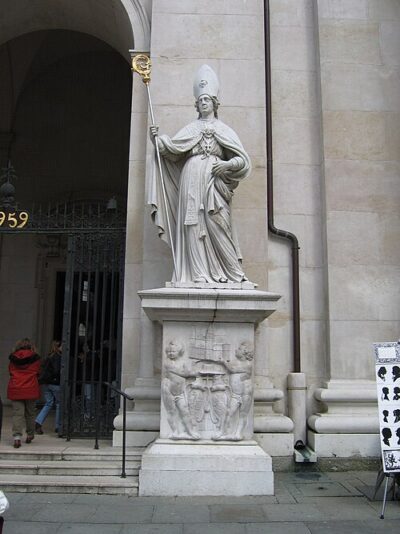
Vergilius of Salzburg
Vergilius of Salzburg was an Irish churchman, astronomer, bishop of Salzburg. Born 700, in Ireland. Died November 27, 784, in Salzburg. Positions held include bishop and abbot.
Facts
15 facts · 2 confirmed by two sources · 5 cited · 8 from one source
Where this comes from
Papalocal keeps its own record. It started from these sources; what each one said is kept here as it was copied, so a change on their side never changes this page by itself. Tap one to read its version.
What Wikidata says · copied November 17, 2026 · revision 2567363323
- Described as
- Irish churchman, astronomer, bishop of Salzburg
- Other names
- Saint Virgil, St Virgil, Virgil of Salzburg, Virgilius van Salzburg
- Born
- 700
- Died
- November 27, 784 · 2 references
- Born in
- Ireland
- Died in
- Salzburg · 1 reference
- Occupation
- mathematician; astronomer; Catholic priest; Catholic bishop; missionary · 1 reference; bishop · 1 reference; mendicant · 1 reference
- Positions held
- bishop · 1 reference; abbot · 1 reference
- Field
- geometry
- Religion
- Catholic Church
- Wikipedias with a page
- 26
Wikidata item Q561251 (wikidata.org/wiki/Q561251), public domain (CC0). Copied November 17, 2026.
What Wikipedia says · copied November 17, 2026 · revision 1385558645
Virgil (c. 700– 27 November 784), also spelled Vergil, Vergilius, Virgilius, Feirgil or Fearghal, was an Irish priest and early astronomer. He left Ireland around 745, intending to visit the Holy Land; but, like many of his countrymen, he settled in Francia. Virgil served as abbot of Aghaboe, bishop of Ossory and later bishop of Salzburg. He was called "the Apostle of Carinthia" and "the geometer".
- Born, in its opening lines
- c. 700
- Died, in its opening lines
- November 27, 784
From the Wikipedia article “Virgil of Salzburg” (en.wikipedia.org/wiki/Virgil_of_Salzburg), by its contributors, under CC BY-SA 4.0 (creativecommons.org/licenses/by-sa/4.0/). Copied November 17, 2026; not changed.
Confirmed Two sources agree. Cited One source, and it names where it got it. One source One source, without a reference of its own. Sources disagree The sources disagree. We show the best-supported value and keep theirs below.
