
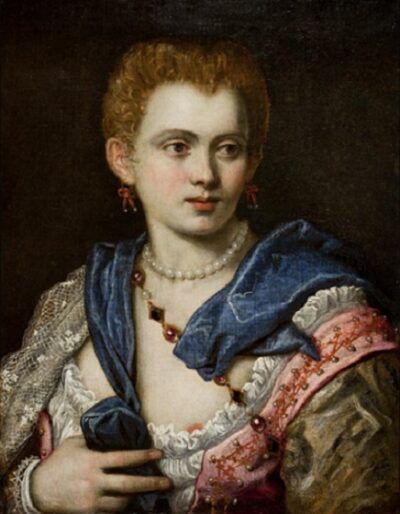
Veronica Franco
Veronica Franco was an Italian poet and courtesan. Born March 25, 1546, in Venice. Died July 22, 1591, in Venice.
Facts
10 facts · 2 confirmed by two sources · 4 cited · 4 from one source
Where this comes from
Papalocal keeps its own record. It started from these sources; what each one said is kept here as it was copied, so a change on their side never changes this page by itself. Tap one to read its version.
What Wikidata says · copied November 16, 2026 · revision 2568983722
- Described as
- Italian poet and courtesan (1546-1591)
- Born
- March 25, 1546 · 1 reference
- Died
- July 22, 1591
- Born in
- Venice · 1 reference
- Died in
- Venice · 1 reference
- Citizen of
- Republic of Venice
- Occupation
- poet; model; writer · 1 reference; courtesan · 1 reference
- Field
- poetry
- Wikipedias with a page
- 29
Wikidata item Q257493 (wikidata.org/wiki/Q257493), public domain (CC0). Copied November 16, 2026.
What Wikipedia says · copied November 16, 2026 · revision 1385673934
Veronica Franco (c. 1546–1591) was an Italian poet and courtesan in 16th-century Venice. She is known for her notable clientele, feminist advocacy, literary contributions, and philanthropy. Her humanist education and cultural contributions influenced the roles of courtesans in the late Venetian Renaissance.
In her notable works, Capitoli in Terze rime and Lettere familiari a diversi ("Familiar Letters to Various People"), Franco uses perceived virtue, reason, and fairness to advise male patricians and other associates. She exercised greater autonomy in her authorship than any other traditional Venetian woman due to her established reputation and influence.
- Born, in its opening lines
- 1546
- Died, in its opening lines
- 1591
From the Wikipedia article “Veronica Franco” (en.wikipedia.org/wiki/Veronica_Franco), by its contributors, under CC BY-SA 4.0 (creativecommons.org/licenses/by-sa/4.0/). Copied November 16, 2026; not changed.
Confirmed Two sources agree. Cited One source, and it names where it got it. One source One source, without a reference of its own. Sources disagree The sources disagree. We show the best-supported value and keep theirs below.
