
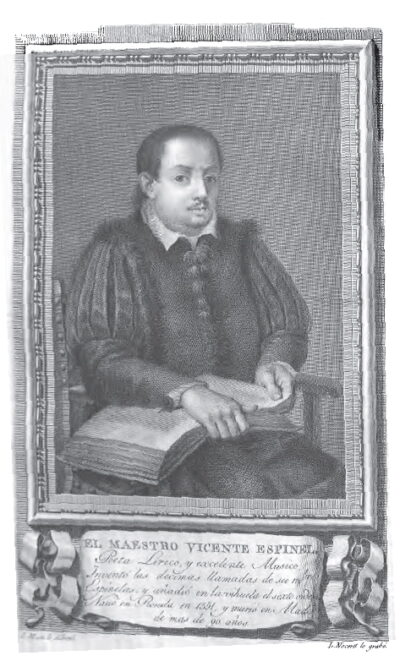
Vicente Espinel was a Spanish writer. Born December 28, 1550, in Ronda. Died February 4, 1624, in Madrid. Educated at University of Salamanca.
Facts
17 facts · 2 confirmed by two sources · 4 cited · 11 from one source
What’s different
- Died: we show February 4, 1624 (Confirmed). Wikidata also lists 1634
Where this comes from
Papalocal keeps its own record. It started from these sources; what each one said is kept here as it was copied, so a change on their side never changes this page by itself. Tap one to read its version.
What Wikidata says · copied November 18, 2026 · revision 2567489657
- Described as
- Spanish writer
- Other names
- Vincent de Espinel, Vicente Gómez Martínez-Espinel
- Born
- December 28, 1550
- Died
- February 4, 1624 · 4 references; 1634 · 1 reference
- Born in
- Ronda · 1 reference
- Died in
- Madrid · 1 reference
- Name at birth
- Vicente Gómez Martínez-Espinel
- Citizen of
- Spain
- Occupation
- poet; guitarist; composer · 1 reference; writer · 1 reference; translator · 1 reference; Catholic priest · 1 reference
- Education
- University of Salamanca
- Genre
- sound poetry; theatre
- Instrument
- guitar · 1 reference
- Religion
- Catholic Church
- Wikipedias with a page
- 23
Wikidata item Q520504 (wikidata.org/wiki/Q520504), public domain (CC0). Copied November 18, 2026.
What Wikipedia says · copied November 18, 2026 · revision 1269305070
Vicente Gómez Martínez-Espinel (Spanish pronunciation: [biˈθente espiˈnel]; 28 December 1550 – 4 February 1624) was a Spanish writer and musician of the Siglo de Oro. He is credited with the creation of the modern poetic form of the décima, composed of ten octameters, named espinela in Spanish after him.
- Born, in its opening lines
- December 28, 1550
- Died, in its opening lines
- February 4, 1624
From the Wikipedia article “Vicente Espinel” (en.wikipedia.org/wiki/Vicente_Espinel), by its contributors, under CC BY-SA 4.0 (creativecommons.org/licenses/by-sa/4.0/). Copied November 18, 2026; not changed.
Confirmed Two sources agree. Cited One source, and it names where it got it. One source One source, without a reference of its own. Sources disagree The sources disagree. We show the best-supported value and keep theirs below.
