
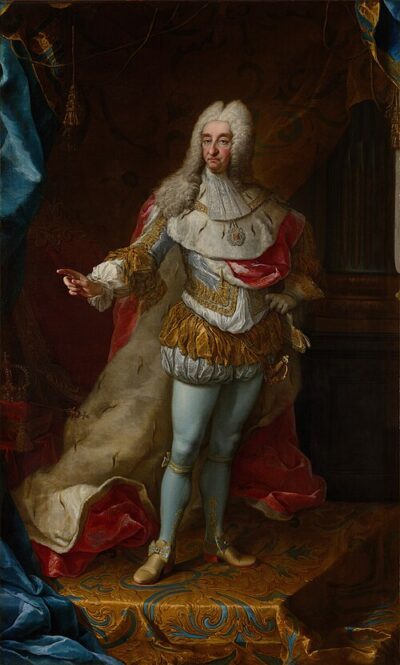
Victor Amadeus II of Savoy
Victor Amadeus II of Savoy was a Duke of Savoy and King of Sardinia. Born May 14, 1666, in Turin. Died October 31, 1732, in Moncalieri. Positions held include King of Sardinia and Duke of Savoy (1720–1730), King of Sicily (1713–1720) and Duke of Savoy (1675–1730). Awards include Grand Master of the Order of the Most Holy Annunciation.
Facts
28 facts · 2 confirmed by two sources · 9 cited · 16 from one source · 1 where the sources disagree
What’s different
- Died in: we show Moncalieri (Sources disagree). Wikidata also lists Rivoli
Where this comes from
Papalocal keeps its own record. It started from these sources; what each one said is kept here as it was copied, so a change on their side never changes this page by itself. Tap one to read its version.
What Wikidata says · copied November 16, 2026 · revision 2565545939
- Described as
- Duke of Savoy and King of Sardinia (1666–1732)
- Other names
- Vittorio Amedeo II, Victor Amadeus II
- Born
- May 14, 1666 · 5 references
- Died
- October 31, 1732 · 5 references
- Born in
- Turin · 1 reference
- Died in
- Moncalieri · 1 reference; Rivoli · 1 reference
- Buried in
- Basilica of Superga
- Cause of death
- stroke
- Occupation
- politician
- Positions held
- King of Sardinia and Duke of Savoy (1720–1730); King of Sicily (1713–1720); Duke of Savoy (1675–1730)
- Awards
- Grand Master of the Order of the Most Holy Annunciation
- Field
- politics · 1 reference; governance · 1 reference; military affairs · 1 reference
- Spouse
- Anne Marie d'Orléans (1684–) · 2 references; Anna Canalis di Cumiana (1729–) · 2 references
- Children
- Marie Adélaïde of Savoy · 1 reference; Maria Luisa of Savoy; Maria Vittoria of Savoy; Victor Amadeus, Prince of Piedmont; Carlo Emanuele III of Sardinia; Vittorio Francesco, Marquis of Susa; Maria Anna di Savoia, Principessa di Savoia · 1 reference; Emanuele Filiberto di Savoia, Duc de Chablais · 1 reference
- Father
- Charles Emmanuel II of Savoy
- Mother
- Marie Jeanne of Savoy
- Religion
- Catholicism
- Military rank
- generalissimo
- Wikipedias with a page
- 51
Wikidata item Q209579 (wikidata.org/wiki/Q209579), public domain (CC0). Copied November 16, 2026.
What Wikipedia says · copied November 16, 2026 · revision 1383309873
Victor Amadeus II (Italian: Vittorio Amedeo Francesco, Arpitan: Victor-Amèdê, French: Victor-Amédée; 14 May 1666 – 31 October 1732) was the head of the House of Savoy and ruler of the Savoyard states from 12 June 1675 until his abdication in 1730. He was the first of his house to acquire a royal crown, ruling first as King of Sicily (1713–1720) and then as King of Sardinia (1720–1730). Among his other titles were Duke of Savoy, Duke of Montferrat, Prince of Piedmont, Marquis of Saluzzo and Duke of Aosta, Maurienne and Nice.
Louis XIV arranged his marriage in order to maintain French influence in Savoy, but Victor Amadeus soon broke away from the influence of France. At his father's death in 1675, his mother, Marie Jeanne Baptiste of Nemours, was regent in the name of her nine-year-old son and would remain in de facto power until 1684 when Victor Amadeus banished her further involvement in the state. Having fought in the War of the Spanish Succession, he was rewarded with the Kingdom of Sicily in 1713, but he was forced to exchange this title for the poorer Kingdom of Sardinia in 1720.
Reigning for over 55 years, he is the longest-reigning monarch in Savoyard history, surpassing Charles Emmanuel I. Victor Amadeus left a considerable cultural influence in Turin, remodeling the Royal Palace of Turin, Palace of Venaria, Palazzina di caccia of Stupinigi, as well as building the Basilica of Superga where he rests.
- Born, in its opening lines
- May 14, 1666
- Died, in its opening lines
- October 31, 1732
From the Wikipedia article “Victor Amadeus II” (en.wikipedia.org/wiki/Victor_Amadeus_II), by its contributors, under CC BY-SA 4.0 (creativecommons.org/licenses/by-sa/4.0/). Copied November 16, 2026; not changed.
Confirmed Two sources agree. Cited One source, and it names where it got it. One source One source, without a reference of its own. Sources disagree The sources disagree. We show the best-supported value and keep theirs below.
