
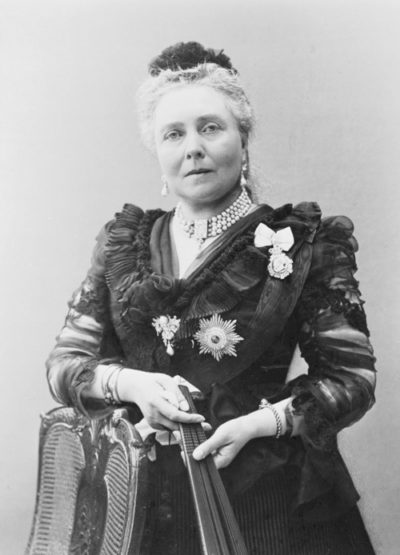
Victoria, Princess Royal
Victoria, Princess Royal was a British princess (1840-1901), Empress of Germany and Queen consort of Prussia from March to June 1888. Born November 21, 1840, in London. Died August 5, 1901, in Schlosshotel Kronberg. Positions held include Princess Royal (1841–1901). Awards include Order of the Black Eagle, Order of Louise and Decoration of the Royal Red Cross.
Facts
36 facts · 2 confirmed by two sources · 14 cited · 19 from one source · 1 where the sources disagree
What’s different
- Born in: we show London (Sources disagree). Wikidata also lists Buckingham Palace
Where this comes from
Papalocal keeps its own record. It started from these sources; what each one said is kept here as it was copied, so a change on their side never changes this page by itself. Tap one to read its version.
What Wikidata says · copied November 16, 2026 · revision 2569118593
- Described as
- British princess (1840-1901), Empress of Germany and Queen consort of Prussia from March to June 1888
- Other names
- Empress Frederick, Princess Victoria, Princess Victoria Adelaide Mary Louise, Victoria Adelaide Mary Louise, Victoria, Empress of Germany, Victoria, Empress Frederick of Germany, Empress Frederick of Germany, Victoria, Empress consort of Germany, Victoria, Crown Princess of Prussia, Victoria, Queen of Prussia and Empress of Germany, Empress Victoria of Germany, Empress Friedrich
- Born
- November 21, 1840 · 14 references
- Died
- August 5, 1901 · 14 references
- Born in
- Buckingham Palace; London · 1 reference
- Died in
- Schlosshotel Kronberg
- Buried in
- Church of Peace
- Cause of death
- breast cancer
- Name at birth
- Victoria Adelaide Mary Louisa
- Citizen of
- Kingdom of Prussia; German Reich; United Kingdom of Great Britain and Ireland
- Occupation
- painter · 1 reference; sculptor · 1 reference; draftsperson · 1 reference
- Positions held
- Princess Royal (1841–1901)
- Awards
- Order of the Black Eagle; Order of Louise; Decoration of the Royal Red Cross · 1 reference
- Spouse
- Frederick III, German Emperor (1858–1888) · 2 references
- Children
- Wilhelm II · 1 reference; Princess Charlotte of Prussia · 1 reference; Prince Henry of Prussia; Prince Sigismund of Prussia; Princess Viktoria of Prussia · 1 reference; Prince Waldemar of Prussia; Sophia of Prussia; Princess Margaret of Prussia
- Father
- Prince Albert of Saxe-Coburg and Gotha · 1 reference
- Mother
- Victoria · 1 reference
- Siblings
- Princess Alice of the United Kingdom · 1 reference; Princess Beatrice of the United Kingdom; Princess Helena of the United Kingdom; Princess Louise, Duchess of Argyll · 1 reference; Alfred, Duke of Saxe-Coburg and Gotha · 1 reference; Prince Leopold, Duke of Albany; Prince Arthur, Duke of Connaught and Strathearn · 1 reference; Edward VII · 1 reference
- Wikipedias with a page
- 54
Wikidata item Q116728 (wikidata.org/wiki/Q116728), public domain (CC0). Copied November 16, 2026.
What Wikipedia says · copied November 16, 2026 · revision 1385806121
Victoria, Princess Royal (Victoria Adelaide Mary Louisa; 21 November 1840 – 5 August 1901) was German Empress and Queen of Prussia as the wife of Frederick III, German Emperor. She was the eldest child of Queen Victoria of the United Kingdom and Prince Albert of Saxe-Coburg and Gotha and was created Princess Royal in 1841. As the eldest child of the British monarch, she was briefly heir presumptive until the birth of her younger brother, the future Edward VII. She was the mother of Wilhelm II, the last German Emperor.
Educated by her father in a politically liberal environment, Victoria was married at the age of 17 to Prince Frederick of Prussia, with whom she then had eight children. Victoria shared with Frederick her liberal views and hopes that Prussia and the later German Empire should become a constitutional monarchy, based on the British model. Criticised for this attitude and for her English origins, Victoria suffered ostracism by the Hohenzollerns and the Berlin court. This isolation increased after the rise to power of Chancellor Otto von Bismarck, one of her staunchest political opponents, in 1862.
Victoria was empress for only a few months, during which she had opportunity to influence the policy of the German Empire. Frederick III died in 1888, only 99 days after his accession, from laryngeal cancer. He was succeeded by their son Wilhelm II, who had much more conservative views than his parents. After her husband's death, she became widely known as Empress Frederick (German: Kaiserin Friedrich). The dowager empress then settled in Kronberg im Taunus in Hesse, where she built a castle which she named Friedrichshof, in honour of her late husband. Increasingly isolated after the weddings of her younger daughters, she died of breast cancer in August 1901, less than seven months after the death of her mother, Queen Victoria, in January 1901.
The correspondence between Victoria and her parents has been preserved almost completely: 3,777 letters from British Queen Victoria to her eldest daughter, and about 4,000 letters from the German Empress to her parents, are preserved and catalogued. These give a detailed insight into life at the Prussian court between 1858 and 1900.
- Born, in its opening lines
- November 21, 1840
- Died, in its opening lines
- August 5, 1901
From the Wikipedia article “Victoria, Princess Royal” (en.wikipedia.org/wiki/Victoria,_Princess_Royal), by its contributors, under CC BY-SA 4.0 (creativecommons.org/licenses/by-sa/4.0/). Copied November 16, 2026; not changed.
Confirmed Two sources agree. Cited One source, and it names where it got it. One source One source, without a reference of its own. Sources disagree The sources disagree. We show the best-supported value and keep theirs below.
