
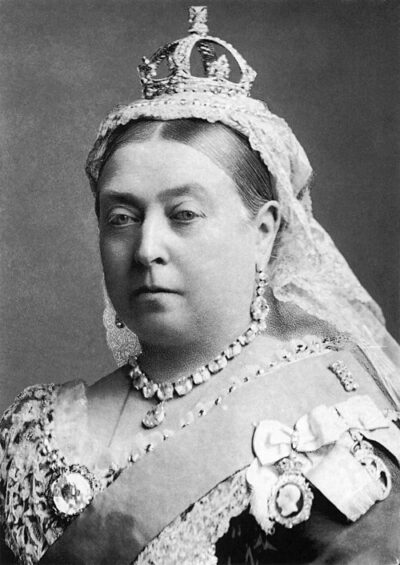
Victoria
Victoria was a Queen of the United Kingdom from 1837 to 1901. Born May 24, 1819, in Kensington Palace. Died January 22, 1901, in Osborne House. Positions held include monarch of the United Kingdom of Great Britain and Ireland (1837–1901), Emperor of India (1876–1901) and monarch of Canada (1867–1901). Educated at Windlesham House School. Awards include Knight of the Garter, Order of the Thistle and Order of St Patrick.
Facts
55 facts · 2 confirmed by two sources · 20 cited · 32 from one source · 1 where the sources disagree
What’s different
- Buried in: we show Windsor (Sources disagree). Wikidata also lists The Royal Mausoleum
Where this comes from
Papalocal keeps its own record. It started from these sources; what each one said is kept here as it was copied, so a change on their side never changes this page by itself. Tap one to read its version.
What Wikidata says · copied November 16, 2026 · revision 2567536985
- Described as
- Queen of the United Kingdom from 1837 to 1901 (1819–1901)
- Other names
- Victoria, Queen of Great Britain, Alexandrina Victoria von Hannover, Princess Victoria of Kent, Queen of Great Britain Victoria, Queen Victoria, Victoria Hanover, Queen Victoria, Queen of the United Kingdom, Victoria Alexandrina, Alexandrina Hanover, Victoria I., Alexandrina Victoria
- Born
- May 24, 1819 · 11 references
- Died
- January 22, 1901 · 10 references
- Born in
- Kensington Palace · 3 references
- Died in
- Osborne House · 1 reference
- Buried in
- The Royal Mausoleum; Windsor · 1 reference
- Cause of death
- cerebral hemorrhage
- Name at birth
- Princess Alexandrina Victoria of Kent
- Citizen of
- United Kingdom of Great Britain and Ireland
- Occupation
- monarch; painter · 1 reference; writer · 1 reference; diarist · 1 reference
- Positions held
- monarch of the United Kingdom of Great Britain and Ireland (1837–1901) · 1 reference; Emperor of India (1876–1901); monarch of Canada (1867–1901)
- Education
- Windlesham House School
- Member of
- Royal Society of London (1838–); Victoria of the United Kingdom and Prince Albert
- Awards
- Knight of the Garter (1837); Order of the Thistle; Order of St Patrick; Order of the Star of India; Order of the Indian Empire; Order of Merit; Order of Saint John; Order of Solomon; Order of Prince Danilo I; Order of the Black Eagle; Order of Queen Maria Luisa; Order of Saint Catherine; Albert Medal (1887) · 1 reference; Order of the Bath · 1 reference; Order of Saint Michael and Saint George · 1 reference
- Spouse
- Prince Albert of Saxe-Coburg and Gotha (1840–1861) · 3 references
- Children
- Victoria, Princess Royal · 1 reference; Edward VII · 1 reference; Princess Alice of the United Kingdom · 1 reference; Alfred, Duke of Saxe-Coburg and Gotha · 1 reference; Princess Helena of the United Kingdom · 1 reference; Princess Louise, Duchess of Argyll · 2 references; Prince Arthur, Duke of Connaught and Strathearn · 1 reference; Prince Leopold, Duke of Albany · 1 reference; Princess Beatrice of the United Kingdom · 1 reference
- Father
- Prince Edward, Duke of Kent and Strathearn · 2 references
- Mother
- Princess Victoria of Saxe-Coburg-Saalfeld · 2 references
- Siblings
- Adelaide Dubus; Edward Schencker Scheener; Prince Karl, 3rd Prince of Leiningen; Feodora of Leiningen
- Religion
- Anglicanism
- Lived in
- Kensington Palace; Buckingham Palace; Osborne House; Windsor Castle
- Height
- 1.42 m (4 ft 8 in) · 1 reference
- Wikipedias with a page
- 177
Wikidata item Q9439 (wikidata.org/wiki/Q9439), public domain (CC0). Copied November 16, 2026.
What Wikipedia says · copied November 16, 2026 · revision 1383765159
Victoria (Alexandrina Victoria; 24 May 1819 – 22 January 1901) was Queen of the United Kingdom of Great Britain and Ireland from 20 June 1837 until her death in 1901. Her reign of 63 years and 216 days, which was longer than those of any of her predecessors, constituted the Victorian era, a period of industrial, political, scientific, and military change within the United Kingdom marked by a great expansion of the British Empire. In 1876, the British parliament voted to grant her the additional title of Empress of India.
Victoria was the daughter of Prince Edward, Duke of Kent and Strathearn, who was the fourth son of King George III. After the deaths of her father and grandfather in 1820, she was raised under close supervision by her mother, Princess Victoria of Saxe-Coburg-Saalfeld, and her comptroller, John Conroy. She inherited the throne aged 18 after her father's three elder brothers died without surviving legitimate issue. Victoria attempted privately to influence government policy and ministerial appointments; publicly, she became a national icon who was identified with strict standards of personal morality.
Victoria married her maternal first cousin, Prince Albert of Saxe-Coburg and Gotha, in 1840. Their nine children married into royal and noble families across the continent, earning Victoria the sobriquet "grandmother of Europe". After Albert's death in 1861, Victoria plunged into deep mourning and avoided public appearances. As a result of her seclusion, British republicanism temporarily gained strength, but in the latter half of her reign, her popularity recovered. Her Golden and Diamond jubilees were times of public celebration. Victoria died at Osborne House on the Isle of Wight, at the age of 81. The last British monarch of the House of Hanover, she was succeeded by her son Edward VII.
- Born, in its opening lines
- May 24, 1819
- Died, in its opening lines
- January 22, 1901
From the Wikipedia article “Queen Victoria” (en.wikipedia.org/wiki/Queen_Victoria), by its contributors, under CC BY-SA 4.0 (creativecommons.org/licenses/by-sa/4.0/). Copied November 16, 2026; not changed.
Confirmed Two sources agree. Cited One source, and it names where it got it. One source One source, without a reference of its own. Sources disagree The sources disagree. We show the best-supported value and keep theirs below.
