
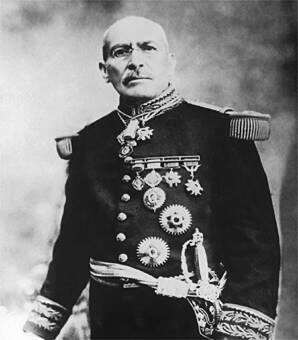
Victoriano Huerta
Victoriano Huerta was a Mexican military officer and 35th President of Mexico. Born December 22, 1854, in Colotlán. Died January 13, 1916, in El Paso. Positions held include President of Mexico (1913–1914), Secretary of Foreign Affairs of Mexico and foreign minister. Educated at Heroico Colegio Militar.
Facts
19 facts · 1 confirmed by two sources · 5 cited · 12 from one source · 1 where the sources disagree
What’s different
- Born: we show December 22, 1854 (Sources disagree). Wikidata also lists December 22, 1850
Where this comes from
Papalocal keeps its own record. It started from these sources; what each one said is kept here as it was copied, so a change on their side never changes this page by itself. Tap one to read its version.
What Wikidata says · copied November 16, 2026 · revision 2569539845
- Described as
- Mexican military officer and 35th President of Mexico (1850-1916)
- Other names
- José Victoriano Huerta Márquez, Jose Victoriano Huerta Marquez, Huerta, Victoriano
- Born
- December 22, 1850; December 22, 1854 · 1 reference
- Died
- January 13, 1916
- Born in
- Colotlán · 1 reference
- Died in
- El Paso · 1 reference
- Buried in
- Evergreen Cemetery
- Cause of death
- liver cirrhosis · 1 reference
- Citizen of
- Mexico
- Occupation
- politician; diplomat; military personnel
- Positions held
- President of Mexico (1913–1914); Secretary of Foreign Affairs of Mexico; foreign minister; president · 1 reference
- Education
- Heroico Colegio Militar
- Spouse
- Emilia Águila Moya · 1 reference
- Religion
- Catholicism
- Military branch
- Mexican Army · 1 reference
- Military rank
- general · 1 reference
- Wikipedias with a page
- 45
Wikidata item Q299168 (wikidata.org/wiki/Q299168), public domain (CC0). Copied November 16, 2026.
What Wikipedia says · copied November 16, 2026 · revision 1384587010
José Victoriano Huerta Márquez (Spanish pronunciation: [biɣtoˈɾjano ˈweɾta]; 23 December 1850 – 13 January 1916) was a Mexican general, statesman, engineer, and dictator who served as the 39th President of Mexico from 1913 to 1914 and came to power by coup against the democratically elected government of Francisco I. Madero with the aid of other Mexican generals and the U.S. Ambassador to Mexico. Establishing a military dictatorship, his violent seizure of power set off a new wave of armed conflict in the Mexican Revolution.
After a military career under President and dictator Porfirio Díaz and Interim President Francisco León de la Barra, Huerta became a high-ranking officer during the presidency of Madero during the first phase of the Mexican Revolution (1911–13). In February 1913, Huerta joined a conspiracy against Madero, who entrusted him to control a revolt in Mexico City. The Ten Tragic Days – actually fifteen days – saw the forced resignation of Madero and his vice president and their murders. The coup was backed by the German Empire as well as the United States under the Taft administration. But the succeeding Wilson administration refused to recognize the new regime which had come to power by coup. The U.S. allowed arms sales to rebel forces. Many foreign powers did recognize the regime, including Britain and Germany, but withdrew further support when revolutionary forces started to show military success against the regime; their continuing support of him threatened their own relationships with the U.S. government.
Huerta's government resisted the U.S. incursion into the port of Veracruz that violated Mexico's sovereignty. Even Huerta's opponents agreed with his stance. The Constitutionalist Army, the forces of the northern coalition opposing Huerta, defeated the Federal Army, winning a decisive victory at the Battle of Zacatecas. Huerta was forced to resign in July 1914 and flee the country to Spain, only 17 months into his presidency, after the Federal Army collapsed. While attempting to intrigue with German spies in the U.S. during World War I, Huerta was arrested in 1915 and died in U.S. custody.
His supporters were known as Huertistas during the Mexican Revolution. He is still vilified as a traitor by modern-day Mexicans, who generally refer to him as El Chacal ('The Jackal') or El Usurpador ('The Usurper').
- Born, in its opening lines
- December 23, 1850
- Died, in its opening lines
- January 13, 1916
From the Wikipedia article “Victoriano Huerta” (en.wikipedia.org/wiki/Victoriano_Huerta), by its contributors, under CC BY-SA 4.0 (creativecommons.org/licenses/by-sa/4.0/). Copied November 16, 2026; not changed.
Confirmed Two sources agree. Cited One source, and it names where it got it. One source One source, without a reference of its own. Sources disagree The sources disagree. We show the best-supported value and keep theirs below.
