
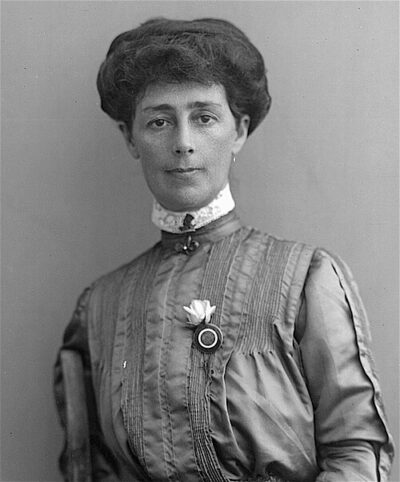
Vida Goldstein
Vida Goldstein was an Australian feminist politician. Born April 13, 1869, in Portland. Died August 15, 1949, in South Yarra. Known for Women's Political Association of Victoria, Women's Peace Army and Australian Woman's Sphere. Educated at Presbyterian Ladies' College. Awards include Victorian Honour Roll of Women.
Facts
22 facts · 2 confirmed by two sources · 10 cited · 10 from one source
Where this comes from
Papalocal keeps its own record. It started from these sources; what each one said is kept here as it was copied, so a change on their side never changes this page by itself. Tap one to read its version.
What Wikidata says · copied November 18, 2026 · revision 2524937862
- Described as
- Australian feminist politician (1869–1949)
- Other names
- Vida Jane Mary Goldstein, Vida Jane Goldstein
- Born
- April 13, 1869 · 1 reference
- Died
- August 15, 1949 · 2 references
- Born in
- Portland · 1 reference
- Died in
- South Yarra
- Buried in
- Springvale Botanical Cemetery · 1 reference
- Cause of death
- cancer
- Citizen of
- Australia
- Occupation
- journalist · 1 reference; women's rights activist · 1 reference; politician · 1 reference; suffragette
- Worked for
- United Council for State Suffrage; Women's Political Association of Victoria; Women's Peace Army · 1 reference
- Education
- Presbyterian Ladies' College · 1 reference
- Known for
- Women's Political Association of Victoria; Women's Peace Army; Australian Woman's Sphere
- Awards
- Victorian Honour Roll of Women (2001) · 1 reference
- Father
- Jacob Robert Yannasch Goldstein · 1 reference
- Mother
- Isabella Goldstein · 1 reference
- Religion
- Christian Science
- Wikipedias with a page
- 23
Wikidata item Q7927635 (wikidata.org/wiki/Q7927635), public domain (CC0). Copied November 18, 2026.
What Wikipedia says · copied November 18, 2026 · revision 1356031317
Vida Jane Mary Goldstein (pron. ) (13 April 1869 – 15 August 1949) was an Australian suffragist and social reformer. She was one of four female candidates at the 1903 federal election, the first at which women were eligible to stand. Goldstein was known both for her public speaking and as an editor of pro-suffrage publications. Despite her efforts campaigning for women's suffrage in Victoria, it was the last Australian state to implement equal voting rights, with women not granted the right to vote until 1908.
In 1903, Goldstein unsuccessfully contested the Senate as an independent, winning 16.8 percent of the vote. She was one of the first four women to stand for federal parliament, along with Selina Anderson, Nellie Martel, and Mary Moore-Bentley. Goldstein ran for parliament a further four times, and despite never winning an election won back her deposit on all but one occasion. She stood on left-wing platforms, and some of her more radical views alienated both the general public and some of her associates in the women's movement.
After women's suffrage was achieved, Goldstein remained prominent as a campaigner for women's rights and various other social reforms. She was an ardent pacifist during World War I, and helped found the Women's Peace Army, an anti-war organisation. Goldstein maintained a lower profile in later life, devoting most of her time to the Christian Science movement. Her death passed largely unnoticed, and it was not until the late 20th century that her contributions were brought to the attention of the general public.
- Born, in its opening lines
- April 13, 1869
- Died, in its opening lines
- August 15, 1949
From the Wikipedia article “Vida Goldstein” (en.wikipedia.org/wiki/Vida_Goldstein), by its contributors, under CC BY-SA 4.0 (creativecommons.org/licenses/by-sa/4.0/). Copied November 18, 2026; not changed.
Confirmed Two sources agree. Cited One source, and it names where it got it. One source One source, without a reference of its own. Sources disagree The sources disagree. We show the best-supported value and keep theirs below.
