
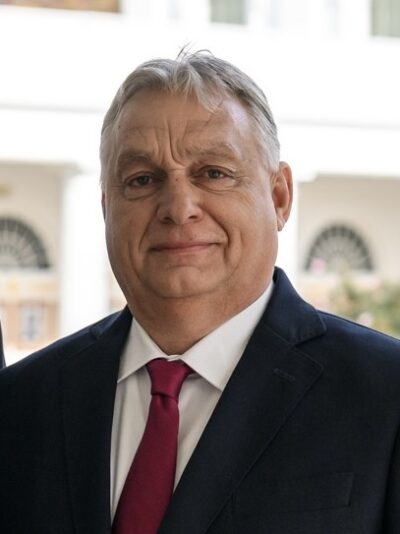
Viktor Orbán
Viktor Orbán is a Prime Minister of Hungary (1998–2002; 2010–2026). Born May 31, 1963, in Székesfehérvár. Positions held include Prime Minister of Hungary (2 times) (1998–2026), member of the National Assembly of Hungary (1990–2026) and party leader (1993–2000). Educated at Teleki Blanka high school and junior high school and Eötvös Loránd University. Awards include Knight Grand Cross of the Order of St. Gregory the Great, St. Stephen Prize and Grand Cross of the National Order of Merit.


Facts
48 facts · 1 confirmed by two sources · 21 cited · 26 from one source
Where this comes from
Papalocal keeps its own record. It started from these sources; what each one said is kept here as it was copied, so a change on their side never changes this page by itself. Tap one to read its version.
What Wikidata says · copied November 16, 2026 · revision 2568220440
- Described as
- Prime Minister of Hungary (1998–2002; 2010–2026) (born 1963)
- Other names
- Victor Orban, Viktor Orban, Victor Orbán, Orbán Viktor, Viktor Mihaly Orban, Viktor Mihály Orbán
- Born
- May 31, 1963 · 4 references
- Born in
- Székesfehérvár
- Name at birth
- Orbán Viktor Mihály · 1 reference
- Citizen of
- Hungary · 2 references
- Occupation
- politician · 1 reference; jurist · 1 reference; association football player · 1 reference; sociologist · 1 reference; head of government · 1 reference
- Positions held
- Prime Minister of Hungary (2 times) (1998–2026) · 2 references; member of the National Assembly of Hungary (1990–2026) · 1 reference; party leader (1993–2000) · 1 reference
- Political party
- Fidesz (1988–) · 2 references
- Education
- Teleki Blanka high school and junior high school (1977–1981); Eötvös Loránd University (1981–1987); Pembroke College (1989–1990) · 1 reference
- Teams
- Budapesti EAC
- Sport
- association football · 1 reference
- Awards
- Knight Grand Cross of the Order of St. Gregory the Great (2004) · 1 reference; St. Stephen Prize (2002) · 1 reference; Grand Cross of the National Order of Merit (2001) · 1 reference; Franz Josef Strauss Award (2001) · 1 reference; Order of St. Sava (2022) · 1 reference; Order of the Republic of Serbia (2022) · 1 reference; Order 8-September (2013) · 1 reference; Hungarian Order of Merit · 1 reference; Order of St. Gregory the Great · 1 reference; Order of the Lithuanian Grand Duke Gediminas · 1 reference; Dostyk Order of grade I · 1 reference; Order of Glory and Honor · 1 reference; Order of the Republika Srpska · 1 reference; Royal Order of Cambodia · 1 reference; Supreme Order of Turkic World (2024) · 1 reference
- Field
- politics; law
- Spouse
- Anikó Lévai (1986–) · 1 reference
- Children
- Ráhel Orbán; Gáspár Orbán; Sára Orbán; Róza Orbán; Flóra Orbán
- Father
- Győző Bálint Orbán
- Mother
- Erzsébet Sípos
- Siblings
- Győző Orbán; Áron Orbán
- Religion
- Reformed Christianity · 1 reference
- Website
- https://miniszterelnok.hu; https://miniszterelnok.hu/en
- Wikipedias with a page
- 117
Wikidata item Q57641 (wikidata.org/wiki/Q57641), public domain (CC0). Copied November 16, 2026.
What Wikipedia says · copied November 16, 2026 · revision 1384547064
Viktor Mihály Orbán (born 31 May 1963) is a Hungarian lawyer and politician who served as the prime minister of Hungary from 1998 to 2002 and from 2010 to 2026. He has also been the president of Fidesz, which has been variously characterised as a Christian nationalist, illiberal, and far-right political party. He has served as its president since 2003, and previously from 1993 to 2000.
Orbán was first elected to the National Assembly in 1990 and led Fidesz's parliamentary group until 1993. During his first term as prime minister and head of the conservative coalition government from 1998 to 2002, inflation and the fiscal deficit shrank, and Hungary joined NATO. After losing re-election, Orbán led the opposition party from 2002 to 2010. He was re-elected as prime minister in 2010, and then in 2014, 2018, and 2022, winning supermajorities in all four elections. On 29 November 2020, he became the country's longest-serving prime minister.
Starting from its return in 2010, Orbán's government enacted a series of constitutional and institutional changes, including the 2013 amendments to the Constitution of Hungary, reforms to the judiciary affecting the administration of courts, and the creation of regulatory bodies overseeing media. Organizations such as the European Commission and Freedom House have described these developments as weakening judicial independence and media pluralism, and enabling democratic backsliding. His government has also faced allegations of corruption involving the allocation of public contracts and EU funds. In March 2019, Fidesz was suspended from the European Union's Christian Democratic party, the European People's Party (EPP). In March 2021, Fidesz left the EPP over a dispute over new rule-of-law language in the latter's bylaws. Orbán lost the 2026 parliamentary election, which saw record turnout, to Péter Magyar's Tisza Party in a landslide. Orbán subsequently announced that he would both remain as leader of Fidesz and refuse to take his seat in the new parliament, which subsequently adopted a constitutional amendment barring Orbán from returning to the prime ministry by imposing a two-term limit on the position.
In foreign and social policy, Orbán opposed aspects of European Union migration and asylum policy, and supported domestic legislation restricting LGBTQ rights in Hungary, including same-sex marriage, same-sex adoption and LGBTQ-inclusive education. While advocating Christian nationalism and describing his political model as an "illiberal state", he promoted soft Euroscepticism, opposition to liberal democracy, and closer economic and political ties with countries including China, Russia, and Turkey. Orbán approved Finland and Sweden's NATO membership applications despite delays in processing them but opposed Ukraine's accession to both the European Union and NATO. His government faced allegations of enriching elites associated with the administration, and was characterized as a kleptocracy. Analysts and institutions variously characterized Hungary under his leadership as a hybrid regime, dominant-party system, or mafia state.
- Born, in its opening lines
- May 31, 1963
From the Wikipedia article “Viktor Orbán” (en.wikipedia.org/wiki/Viktor_Orbán), by its contributors, under CC BY-SA 4.0 (creativecommons.org/licenses/by-sa/4.0/). Copied November 16, 2026; not changed.
Confirmed Two sources agree. Cited One source, and it names where it got it. One source One source, without a reference of its own. Sources disagree The sources disagree. We show the best-supported value and keep theirs below.
