
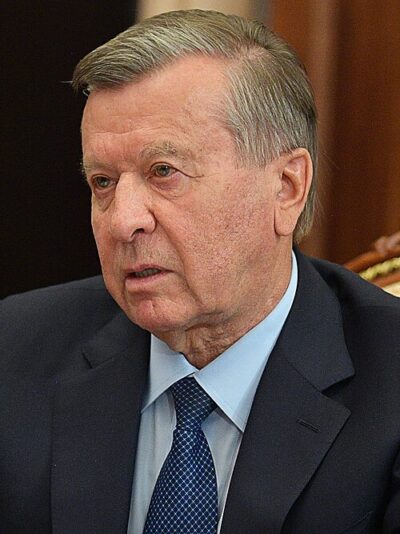
Viktor Zubkov
Viktor Zubkov is a Russian politician and businessman. Born September 15, 1941, in Arbat. Positions held include Deputy Chairman of the Government of the Russian Federation (2008–2012), Prime Minister of Russia (2007–2008) and First Deputy Chairman of the Government of the Russian Federation (2008–). Educated at Saint Petersburg State Agrarian University. Awards include Order of the Badge of Honour, Order "For Merit to the Fatherland", 1st class and Order "For Merit to the Fatherland", 2nd class.
Facts
31 facts · 1 confirmed by two sources · 1 cited · 29 from one source
Where this comes from
Papalocal keeps its own record. It started from these sources; what each one said is kept here as it was copied, so a change on their side never changes this page by itself. Tap one to read its version.
What Wikidata says · copied November 16, 2026 · revision 2562794743
- Described as
- Russian politician and businessman
- Other names
- Viktor Aleksejevič Zubkov
- Born
- September 15, 1941 · 1 reference
- Born in
- Arbat
- Citizen of
- Soviet Union; Russia
- Occupation
- politician · 1 reference; entrepreneur; economist
- Positions held
- Deputy Chairman of the Government of the Russian Federation (2008–2012); Prime Minister of Russia (2007–2008); First Deputy Chairman of the Government of the Russian Federation (2008–) · 1 reference
- Political party
- United Russia (2001–) · 1 reference; Communist Party of the Soviet Union (1967–1991) · 1 reference; Our Home – Russia (1995–2001) · 1 reference
- Worked for
- Gazprom
- Education
- Saint Petersburg State Agrarian University (–1965)
- Awards
- Order of the Badge of Honour; Order "For Merit to the Fatherland", 1st class; Order "For Merit to the Fatherland", 2nd class; Order "For Merit to the Fatherland", 3rd class; Order "For Merit to the Fatherland", 4th class; Order of the Red Banner of Labour; Medal "Veteran of Labour"; Order of Alexander Nevsky (2015) · 1 reference; Grand Cross of the Order of Merit of Hungary; Weapons of Honour; Honored Economists of the Russian Federation; Russian Federation Government Certificate of Honour; honorary citizen of Volgograd; Order of Holy Prince Daniel of Moscow; weapon of honor
- Religion
- Russian Orthodox Church
- Wikipedias with a page
- 57
Wikidata item Q147425 (wikidata.org/wiki/Q147425), public domain (CC0). Copied November 16, 2026.
What Wikipedia says · copied November 16, 2026 · revision 1380575147
Viktor Alekseyevich Zubkov (Russian: Виктор Алексеевич Зубков, IPA: [ˈvʲiktər ɐlʲɪkˈsʲejɪvʲɪdʑ zʊpˈkof]; born 15 September 1941) is a Russian civil servant, politician and businessman who served as the 36th Prime Minister of Russia from September 2007 to May 2008. He was Vladimir Putin's First Deputy Prime Minister during the presidency of Dmitry Medvedev.
A civil servant who held various positions in the Leningrad Oblast under the Soviet regime, he later served as advisor to Cabinet Ministers. Zubkov was a financial crime investigator until he was nominated on 12 September 2007 by President Vladimir Putin to replace Prime Minister Mikhail Fradkov, who had resigned earlier that day. The nomination was approved in the Duma on 14 September 2007. On 7 May 2008 Zubkov's cabinet was automatically dismissed. This procedure, following an inauguration of the President of Russia is required by the Russian Constitution. After Putin became prime minister, Zubkov was appointed First Deputy Prime Minister of Russia.
He has the federal state civilian service rank of 1st class Active State Councillor of the Russian Federation.
Now in his 80's Zubkov is still the current chairman of the board of directors of Gazprom, Russia's largest corporation and one of the largest oil and natural gas companies in the world.
- Born, in its opening lines
- September 15, 1941
From the Wikipedia article “Viktor Zubkov” (en.wikipedia.org/wiki/Viktor_Zubkov), by its contributors, under CC BY-SA 4.0 (creativecommons.org/licenses/by-sa/4.0/). Copied November 16, 2026; not changed.
Confirmed Two sources agree. Cited One source, and it names where it got it. One source One source, without a reference of its own. Sources disagree The sources disagree. We show the best-supported value and keep theirs below.
