
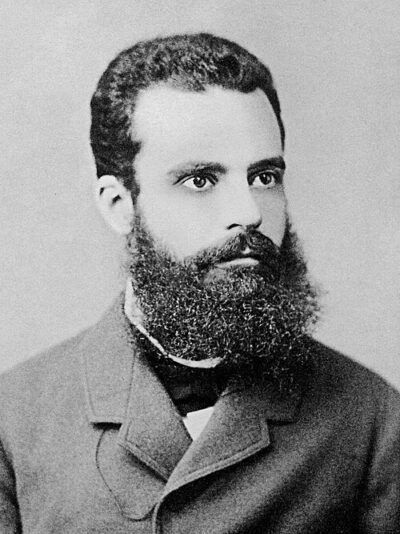
Vilfredo Pareto
Vilfredo Pareto was an Italian economist and sociologist. Born July 15, 1848, in Paris. Died August 19, 1923, in Céligny. Known for The Mind and Society. Educated at Polytechnic University of Turin.
Facts
26 facts · 2 confirmed by two sources · 8 cited · 16 from one source
Where this comes from
Papalocal keeps its own record. It started from these sources; what each one said is kept here as it was copied, so a change on their side never changes this page by itself. Tap one to read its version.
What Wikidata says · copied November 16, 2026 · revision 2560203005
- Described as
- Italian economist and sociologist (1848-1923)
- Other names
- Vilfredo Federico Damaso Pareto, Wilfried Fritz Pareto, Pareto
- Born
- July 15, 1848 · 10 references
- Died
- August 19, 1923 · 6 references
- Born in
- Paris · 3 references
- Died in
- Céligny · 3 references
- Buried in
- New cemetery of Céligny · 1 reference
- Citizen of
- Kingdom of Italy; France
- Occupation
- economist · 1 reference; philosopher; sociologist · 1 reference; university teacher; engineer; mathematician · 1 reference
- Worked for
- University of Lausanne; Sapienza University of Rome · 1 reference; University of Genoa · 1 reference
- Education
- Polytechnic University of Turin
- Member of
- Academy of Sciences of Turin (1918–) · 1 reference
- Known for
- The Mind and Society
- Field
- economics; sociology
- Spouse
- Alessandrina Bakunina (1889–1902) · 2 references; Jeanne Regis · 1 reference
- Father
- Raffaele Pareto
- Mother
- Marie Métenier
- Religion
- Catholicism · 1 reference
- Wikipedias with a page
- 84
Wikidata item Q11031 (wikidata.org/wiki/Q11031), public domain (CC0). Copied November 16, 2026.
What Wikipedia says · copied November 16, 2026 · revision 1384489878
Vilfredo Federico Damaso Pareto (; Italian: [paˈreːto]; born Wilfried Fritz Pareto; 15 July 1848 – 19 August 1923) was an Italian polymath, whose areas of interest included sociology, civil engineering, economics, political science, and philosophy. He made several important contributions to economics, particularly in the study of income distribution and in the analysis of individuals' choices, and was one of the minds behind the Lausanne School of economics. He was also responsible for popularising the use of the term elite in social analysis and contributed to elite theory. He has been described as "one of the last Renaissance scholars. Trained in physics and mathematics, he became a polymath whose genius radiated into nearly all other major fields of knowledge."
He introduced the concept of Pareto efficiency and helped develop the field of microeconomics. He was also the first to claim that income follows a Pareto distribution, which is a power law probability distribution. The Pareto principle was named after him, and it was built on his observations that 80% of the wealth in Italy belonged to about 20% of the population. He also contributed to the fields of mathematics and sociology.
- Born, in its opening lines
- July 15, 1848
- Died, in its opening lines
- August 19, 1923
From the Wikipedia article “Vilfredo Pareto” (en.wikipedia.org/wiki/Vilfredo_Pareto), by its contributors, under CC BY-SA 4.0 (creativecommons.org/licenses/by-sa/4.0/). Copied November 16, 2026; not changed.
Confirmed Two sources agree. Cited One source, and it names where it got it. One source One source, without a reference of its own. Sources disagree The sources disagree. We show the best-supported value and keep theirs below.
