
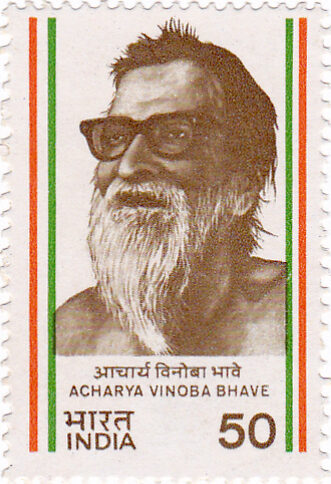
Vinoba Bhave
Vinoba Bhave was an Indian advocate of nonviolence and human rights. Born September 11, 1895, in Raigad district. Died November 15, 1982, in Wardha. Educated at Maharaja Sayajirao University of Baroda. Awards include Ramon Magsaysay Award and Bharat Ratna.
Facts
19 facts · 2 confirmed by two sources · 5 cited · 12 from one source
Where this comes from
Papalocal keeps its own record. It started from these sources; what each one said is kept here as it was copied, so a change on their side never changes this page by itself. Tap one to read its version.
What Wikidata says · copied November 16, 2026 · revision 2559035546
- Described as
- Indian advocate of nonviolence and human rights (1895-1982)
- Other names
- Vinayak Narahari Bhave, Acharya Vinoba
- Born
- September 11, 1895 · 6 references
- Died
- November 15, 1982 · 6 references
- Born in
- Raigad district
- Died in
- Wardha
- Citizen of
- British Raj (–1947); India (1950–); Dominion of India (1947–1950) · 1 reference
- Occupation
- philosopher; politician · 1 reference; writer · 3 references; human rights defender; social reformer · 2 references
- Education
- Maharaja Sayajirao University of Baroda
- Awards
- Ramon Magsaysay Award (1958); Bharat Ratna (1983)
- Field
- philosophy; nonviolence · 1 reference; human rights · 1 reference
- Religion
- Hinduism
- Wikipedias with a page
- 45
Wikidata item Q13021 (wikidata.org/wiki/Q13021), public domain (CC0). Copied November 16, 2026.
What Wikipedia says · copied November 16, 2026 · revision 1374183522
Vinayak Narahar Bhave, also known as Vinoba Bhave (; 11 September 1895 – 15 November 1982), was an Indian philosopher and an advocate of nonviolence and human rights. Often called Acharya (teacher in Sanskrit), he is best known for the Bhoodan land reform movement, and is considered as the spiritual successor of Mahatma Gandhi.
Bhave was born in Gagoji, and was the eldest of five children and was brought up by his grandfather. Influenced by his mother's religious values, he developed an early interest in spiritual texts such as the Bhagavad Gita. After being inspired by Gandhi, he abandoned formal education and joined Gandhi's Sabarmati Ashram in 1916. He actively participated in various programmes promoting khadi, village industries, and sanitation.
Bhave became involved in the Indian independence movement, engaging in civil disobedience against the British Raj. He was imprisoned several times, and he spent his time in prison writing books and studying various Indian languages. In 1940, Gandhi recognised him as the first individual Satyāgrahi. Beyond the independence movement, Bhave pioneered social reforms, most notably the Bhoodan movement in 1951, where he persuaded large landowners to donate their land to the poor. He also founded the Brahma Vidya Mandir in 1959, promoting self-sufficiency, non-violence, and sustainable agriculture.
Bhave was a prolific writer and scholar, and he authored several books. He interpreted and translated several religious texts across multiple languages, including the Bhagavad Gita into the Marathi under the title Geetai. His teachings combined spiritual knowledge with non-violence, and practical service, and gained wide recognition and influence across India. In 1958, he was the first recipient of the international Ramon Magsaysay Award for community leadership. He was awarded the Bharat Ratna, India's highest civilian honour, in 1983.
- Born, in its opening lines
- September 11, 1895
- Died, in its opening lines
- November 15, 1982
From the Wikipedia article “Vinoba Bhave” (en.wikipedia.org/wiki/Vinoba_Bhave), by its contributors, under CC BY-SA 4.0 (creativecommons.org/licenses/by-sa/4.0/). Copied November 16, 2026; not changed.
Confirmed Two sources agree. Cited One source, and it names where it got it. One source One source, without a reference of its own. Sources disagree The sources disagree. We show the best-supported value and keep theirs below.
