
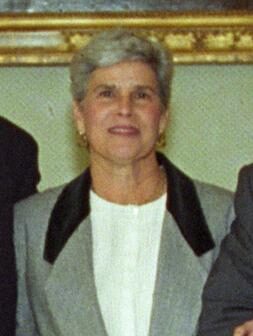
Violeta Barrios de Chamorro
Violeta Barrios de Chamorro was a Nicaraguan publisher of La Prensa and the first woman elected president of Nicaragua, in office from 1990 to 1997. Born October 18, 1929, in Rivas. Died June 14, 2025, in San José. Positions held include President of Nicaragua (1990–1997) and Minister of Defence (Nicaragua). Educated at Our Lady of the Lake University and Blackstone College for Girls. Awards include Freedom Award, Giuseppe Motta Medal and Collar of the Order of Isabella the Catholic.
Facts
29 facts · 2 confirmed by two sources · 26 cited · 1 from one source
Where this comes from
Papalocal keeps its own record. It started from these sources; what each one said is kept here as it was copied, so a change on their side never changes this page by itself. Tap one to read its version.
What Wikidata says · copied November 16, 2026 · revision 2568063131
- Described as
- Nicaraguan publisher of La Prensa and the first woman elected president of Nicaragua, in office from 1990 to 1997 (1929–2025)
- Other names
- Violeta Chamorro, Violeta Barrios Torres de Chamorro, Violeta Barrios Torres, Violeta Barrios Torres Sacasa Hurtado
- Born
- October 18, 1929 · 6 references
- Died
- June 14, 2025 · 3 references
- Born in
- Rivas · 2 references
- Died in
- San José · 2 references
- Buried in
- General Cemetery of San José (2025–) · 1 reference
- Name at birth
- Violeta Barrios Torres · 1 reference
- Citizen of
- Nicaragua · 1 reference
- Occupation
- politician · 3 references; journalist · 1 reference; publisher · 1 reference; author · 1 reference
- Positions held
- President of Nicaragua (1990–1997) · 1 reference; Minister of Defence (Nicaragua) · 1 reference
- Political party
- National Opposition Union · 1 reference
- Worked for
- La Prensa · 1 reference
- Education
- Our Lady of the Lake University · 2 references; Blackstone College for Girls · 1 reference
- Member of
- Junta of National Reconstruction (1979–1980) · 1 reference
- Awards
- Freedom Award (1990) · 1 reference; Giuseppe Motta Medal (2005) · 1 reference; Collar of the Order of Isabella the Catholic (1991) · 1 reference; Luka Brajnović Prize (1998) · 1 reference
- Spouse
- Pedro Joaquín Chamorro Cardenal (1950–1978) · 2 references
- Children
- Cristiana Chamorro Barrios · 1 reference; Carlos Fernando Chamorro · 1 reference; Claudia Chamorro Barrios · 1 reference; Pedro Joaquín Chamorro Barrios · 1 reference
- Religion
- Catholic Church · 1 reference
- Lived in
- San José (2023–2025) · 1 reference
- Wikipedias with a page
- 60
Wikidata item Q114142 (wikidata.org/wiki/Q114142), public domain (CC0). Copied November 16, 2026.
What Wikipedia says · copied November 16, 2026 · revision 1384431894
Violeta Barrios Torres de Chamorro (Spanish pronunciation: [bjoˈleta ˈβarjos ˈtores de tʃaˈmoro]; 18 October 1929 – 14 June 2025) was a Nicaraguan politician who served as the president of Nicaragua from 1990 to 1997. She was the country's first female president. Previously, she was a member of the Junta of National Reconstruction from 1979 to 1980.
Her husband, Pedro Joaquín Chamorro Cardenal, was a journalist with his family's newspaper, La Prensa, which he later inherited. As a result of his anti-government stance, he was often jailed or exiled, forcing Chamorro to spend a decade following him abroad or visiting him in jail. When he was assassinated in 1978, Chamorro took over the newspaper. Pedro's murder strengthened the Nicaraguan Revolution and his image, as wielded by his widow, became a powerful symbol for the opposition forces.
Initially, when the Sandinistas were victorious over Anastasio Somoza Debayle, Chamorro fully supported them. She agreed to become part of the provisional government established under the Junta of National Reconstruction. However, when the Junta began moving in a more radical direction and signed agreements with the Soviet Union, Chamorro resigned on 19 April 1980 and returned to the newspaper.
Under her direction, La Prensa continued to criticize the government and its policies despite threats and government-forced shutdowns. When President Daniel Ortega announced that elections would be held in 1990, Chamorro was selected as the candidate for the opposition group known as the National Opposition Union (Spanish: Unión Nacional Opositora, UNO). This 14-party alliance ranged from conservatives and liberals to communists and because of ideological differences had difficulty in devising any political platform other than a promise to end the civil war. Despite polls indicating a victory for the incumbent Sandinista President Ortega, Chamorro won the election on 25 February 1990. Her election helped bring an end to the civil war through reconciliation and the demobilization and disarmament of forces belonging to the opposing factions. She was the first elected female head of state in the Americas. She was also the second woman to be elected in her own right as a head of government in the Americas, after Prime Minister Eugenia Charles of Dominica.
Chamorro was sworn into office on 25 April 1990. Chamorro's leadership covered six years marked by economic strife and social unrest, but she was able to compromise with rivals, maintain a constitutional regime, re-establish international banking relationships, and end the hyperinflation that had plagued the country for several years.
After leaving office on 10 January 1997, Chamorro worked on several international peace initiatives until poor health forced her to retire from public life.
- Born, in its opening lines
- October 18, 1929
- Died, in its opening lines
- June 14, 2025
From the Wikipedia article “Violeta Chamorro” (en.wikipedia.org/wiki/Violeta_Chamorro), by its contributors, under CC BY-SA 4.0 (creativecommons.org/licenses/by-sa/4.0/). Copied November 16, 2026; not changed.
Confirmed Two sources agree. Cited One source, and it names where it got it. One source One source, without a reference of its own. Sources disagree The sources disagree. We show the best-supported value and keep theirs below.
