
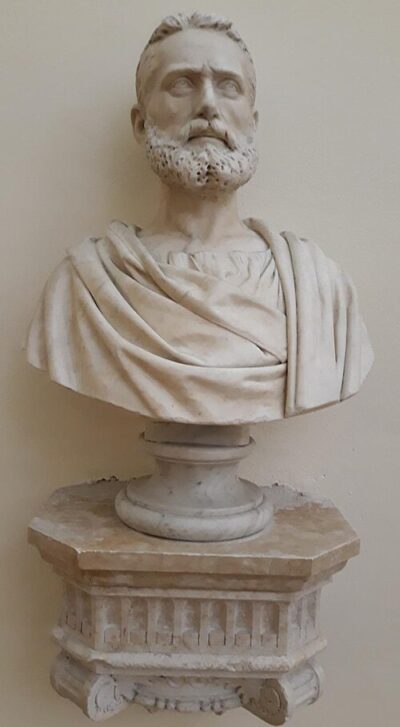
Vitruvius
Vitruvius was a Roman architect and engineer. Born 80 BC, in Roman Republic. Died 15 BC. Known for De architectura.
Facts
10 facts · 0 confirmed by two sources · 3 cited · 7 from one source
Where this comes from
Papalocal keeps its own record. It started from these sources; what each one said is kept here as it was copied, so a change on their side never changes this page by itself. Tap one to read its version.
What Wikidata says · copied November 16, 2026 · revision 2567601878
- Described as
- Roman architect and engineer
- Other names
- Marcus Vitruvius, Vitruvius Pollio, Marcus Vitruvius Pollio, Marcus Vitruvius Mamurra, Lucius Vitruvius Cordo
- Born
- 80 BC
- Died
- 15 BC
- Born in
- Roman Republic · 1 reference
- Name at birth
- Marcus Vitruvius Pollio
- Citizen of
- Ancient Rome
- Occupation
- architect · 2 references; writer · 1 reference; engineer · 2 references; artillerist
- Known for
- De architectura
- Wikipedias with a page
- 94
Wikidata item Q47163 (wikidata.org/wiki/Q47163), public domain (CC0). Copied November 16, 2026.
What Wikipedia says · copied November 16, 2026 · revision 1385555816
Vitruvius ( vi-TROO-vee-əs; Latin: [wɪˈtruːwi.ʊs]; c. 80–70 BC – after c. 15 BC) was a Roman architect and engineer during the 1st century BC, known for his multi-volume work titled De architectura. As the only treatise on architecture to survive from antiquity, it has been regarded since the Renaissance as the first book on architectural theory, as well as a major source on the canon of classical architecture. It is not clear to what extent his contemporaries regarded his book as original or important.
He states that all buildings should have three attributes: firmitas, utilitas, and venustas ("strength", "utility", and "beauty"), principles reflected in much Ancient Roman architecture. His discussion of perfect proportion in architecture and the human body led to the famous Renaissance drawing of the Vitruvian Man by Leonardo da Vinci.
Little is known about Vitruvius' life, but by his own description he served as an artilleryman, the third class of arms in the Roman military offices. He probably served as a senior officer of artillery in charge of doctores ballistarum (artillery experts) and libratores who actually operated the machines. As an army engineer he specialized in the construction of ballista and scorpio artillery war machines for sieges. It is possible that Vitruvius served with Julius Caesar's chief engineer Lucius Cornelius Balbus.
Vitruvius' De architectura was well-known and widely copied in the Middle Ages and survives in many dozens of manuscripts, though in 1414 it was "rediscovered" by the Florentine humanist Poggio Bracciolini in the library of Saint Gall Abbey. Leon Battista Alberti published it in his seminal treatise on architecture, De re aedificatoria (c. 1450). The first known Latin printed edition was by Fra Giovanni Sulpitius in Rome in 1486. Translations followed in Italian, French, English, German, Spanish, and several other languages. Though any original illustrations have been lost, the first illustrated edition was published in Venice in 1511 by Fra Giovanni Giocondo, with woodcut illustrations based on descriptions in the text. Bramante, Michelangelo, Palladio, Vignola and earlier architects are known to have studied the work of Vitruvius, and consequently it has had a significant impact on the architecture of many European countries.
From the Wikipedia article “Vitruvius” (en.wikipedia.org/wiki/Vitruvius), by its contributors, under CC BY-SA 4.0 (creativecommons.org/licenses/by-sa/4.0/). Copied November 16, 2026; not changed.
Confirmed Two sources agree. Cited One source, and it names where it got it. One source One source, without a reference of its own. Sources disagree The sources disagree. We show the best-supported value and keep theirs below.
