
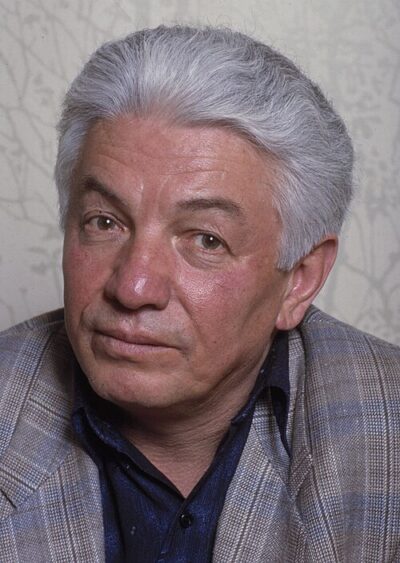
Vladimir Voinovich
Vladimir Voinovich was a Russian writer and Soviet dissident. Born September 26, 1932, in Dushanbe. Died July 27, 2018, in Moscow. Known for Moscow 2042 and The Life and Extraordinary Adventures of Private Ivan Chonkin. Awards include Dr. Friedrich Joseph Haass-Preis, Triumph and Andrei Sakharov Prize For Writer's Civic Courage.
Facts
37 facts · 2 confirmed by two sources · 18 cited · 17 from one source
Where this comes from
Papalocal keeps its own record. It started from these sources; what each one said is kept here as it was copied, so a change on their side never changes this page by itself. Tap one to read its version.
What Wikidata says · copied November 16, 2026 · revision 2568777874
- Described as
- Russian writer and Soviet dissident (1932–2018)
- Other names
- Vladimir Nikolajevitš Voinovitš, Vladimir Voynovich, Vladimir Nikolayevich Voinovich, Vladimir Nikolaevič Vojnovič
- Born
- September 26, 1932 · 8 references
- Died
- July 27, 2018 · 5 references
- Born in
- Dushanbe
- Died in
- Moscow · 1 reference
- Buried in
- Troyekurovskoye cemetery
- Cause of death
- myocardial infarction
- Citizen of
- Soviet Union; Germany; Russia · 1 reference
- Occupation
- poet · 2 references; writer · 2 references; science fiction writer; painter · 1 reference; playwright · 2 references; lyricist · 1 reference; dissident · 1 reference; prose writer · 1 reference
- Member of
- USSR Union of Writers; Serbian Academy of Sciences and Arts; Bavarian Academy of Fine Arts
- Genre
- prose; short novel; fairy tale
- Known for
- Moscow 2042; The Life and Extraordinary Adventures of Private Ivan Chonkin
- Awards
- Dr. Friedrich Joseph Haass-Preis (1999) · 1 reference; Triumph (1996); Andrei Sakharov Prize For Writer's Civic Courage (2002) · 1 reference; State Prize of the Russian Federation (2000) · 1 reference; Lev Kopelev Prize (2016) · 1 reference
- Field
- literature · 1 reference; opinion journalism · 1 reference; poetry · 1 reference; lyrics · 1 reference; painting · 1 reference
- Spouse
- Irina Danilovna Vojnovič · 1 reference
- Children
- Olga Woinowitsch · 1 reference
- Wikipedias with a page
- 36
Wikidata item Q454630 (wikidata.org/wiki/Q454630), public domain (CC0). Copied November 16, 2026.
What Wikipedia says · copied November 16, 2026 · revision 1372065612
Vladimir Nikolayevich Voinovich (Russian: Влади́мир Никола́евич Войно́вич; 26 September 1932 – 27 July 2018) was a Russian writer and former Soviet dissident, and the "first genuine comic writer" produced by the Soviet system. Among his most well-known works are the satirical epic The Life and Extraordinary Adventures of Private Ivan Chonkin and the dystopian Moscow 2042. He was forced into exile and stripped of his citizenship by Soviet authorities in 1980 but later rehabilitated and moved back to Moscow in 1990. After the fall of the Soviet Union, he continued to be an outspoken critic of Russian politics under the rule of Vladimir Putin.
- Born, in its opening lines
- September 26, 1932
- Died, in its opening lines
- July 27, 2018
From the Wikipedia article “Vladimir Voinovich” (en.wikipedia.org/wiki/Vladimir_Voinovich), by its contributors, under CC BY-SA 4.0 (creativecommons.org/licenses/by-sa/4.0/). Copied November 16, 2026; not changed.
Confirmed Two sources agree. Cited One source, and it names where it got it. One source One source, without a reference of its own. Sources disagree The sources disagree. We show the best-supported value and keep theirs below.
