
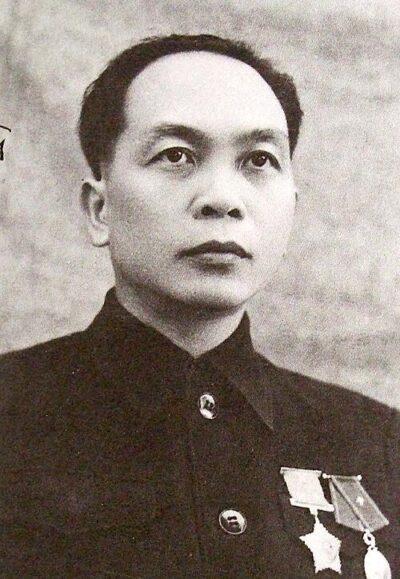
Võ Nguyên Giáp
Võ Nguyên Giáp was a Vietnamese general and communist politician. Born August 25, 1911, in Lộc Thủy. Died October 4, 2013, in Hanoi. Positions held include member of the National Assembly of Vietnam (1946–1987), Commander in Chief of the Vietnam People's Army (1946–1975) and Secretary of the Central Military Commission of the Communist Party of Vietnam (1946–1977). Educated at Vietnam National University and Lycée Albert Sarraut. Awards include Hero of the People's Armed Forces, Order of Hồ Chí Minh and Gold Star Order.
Facts
36 facts · 2 confirmed by two sources · 2 cited · 32 from one source
Where this comes from
Papalocal keeps its own record. It started from these sources; what each one said is kept here as it was copied, so a change on their side never changes this page by itself. Tap one to read its version.
What Wikidata says · copied November 16, 2026 · revision 2563185157
- Described as
- Vietnamese general and communist politician (1911–2013)
- Other names
- general Giap, Vo Nguyen Giap
- Born
- August 25, 1911 · 7 references
- Died
- October 4, 2013 · 8 references
- Born in
- Lộc Thủy
- Died in
- Hanoi
- Name at birth
- Võ Giáp
- Citizen of
- Vietnam
- Occupation
- military officer; journalist; writer; statesperson · 1 reference
- Positions held
- member of the National Assembly of Vietnam (1946–1987); Commander in Chief of the Vietnam People's Army (1946–1975); Secretary of the Central Military Commission of the Communist Party of Vietnam (1946–1977); Minister of National Defence of Vietnam (1946–1980)
- Political party
- Tân Việt Revolutionary Party (1924–); Communist Party of Vietnam (1931–)
- Worked for
- Office of Strategic Services
- Education
- Vietnam National University; Lycée Albert Sarraut
- Awards
- Hero of the People's Armed Forces; Order of Hồ Chí Minh; Gold Star Order; Military Exploit Order; Feat Order; Fatherland Defense Order; honorary doctor of the University of Calcutta; Military Exploit Order, 1st degree · 1 reference; Friendship Order · 1 reference
- Spouse
- Nguyễn Thị Quang Thái (1939–1944); Đặng Bích Hà (1946–)
- Father
- Võ Quang Nghiêm
- Religion
- irreligion
- Military branch
- Vietnamese Independence League · 1 reference; People's Army of Vietnam
- Military rank
- four-star rank; general · 1 reference
- Wikipedias with a page
- 84
Wikidata item Q179910 (wikidata.org/wiki/Q179910), public domain (CC0). Copied November 16, 2026.
What Wikipedia says · copied November 16, 2026 · revision 1381039382
Võ Nguyên Giáp (
chữ Hán: 武元甲, Vietnamese pronunciation: [vɔ̌ˀ ŋʷīən jǎːp]; 25 August 1911 – 4 October 2013) was a Vietnamese general, communist revolutionary and politician. Highly regarded as a military strategist, Giáp led Vietnamese communist military forces to victory in the decades-long Indochina wars. Giáp was the military commander of the Việt Minh and the People's Army from 1941 to 1972, minister of defense of the Democratic Republic of Vietnam (North Vietnam) and the Socialist Republic of Vietnam in 1946–1947 and from 1948 to 1980, and deputy prime minister from 1955 to 1991. He was a member of the Politburo of the Communist Party of Vietnam.
Born in Quảng Bình province to an affluent peasant family, Giáp began participating in anti-colonial political activity in 1925. Sources conflict as to whether he joined the Indochinese Communist Party in 1930, or not until 1940. Giáp rose to prominence during World War II as the military leader of the Việt Minh resistance against the Japanese occupation, and after the war led anti-colonial forces in the First Indochina War against the French. He won a decisive victory at the 1954 Battle of Dien Bien Phu, which ended the war. In the Vietnam War, Giáp led the PAVN against South Vietnam and the United States. Giáp was commander of the army during the 1968 Tet Offensive and 1972 Easter Offensive, after which he was succeeded by Văn Tiến Dũng, but remained defense minister through the U.S. withdrawal and final victory against South Vietnam in 1975. Giáp oversaw his final campaigns in the successful Vietnamese invasion of Cambodia in 1978 and the 1979 Sino-Vietnamese War. He resigned as defense minister in 1980 and left the Politburo in 1982. Giáp remained on the Central Committee and as deputy prime minister until 1991, and died in 2013 at age 102.
Giáp is widely regarded as a gifted military leader. During the First Indochina War, he transformed a disorganized band of rebels to a "fine light-infantry army" fielding cryptography, artillery and advanced logistics capable of challenging the larger, modernised French Far East Expeditionary Corps and Vietnamese National Army. Giáp, who in the 1930s had studied law and worked as a history teacher, had never received any military training prior to World War II. A highly effective logistician, he was the principal architect of the Ho Chi Minh trail, the logistical network from North to South Vietnam, through the kingdoms of Laos and Cambodia, which is recognised as one of the 20th century's great feats of military engineering.
Giáp is often credited with North Vietnam's military victory over the United States and South Vietnam. He was crucial to the transformation of the PAVN into "one of the largest, most formidable" mechanised and combined-arms fighting force capable of defeating the Army of the Republic of Vietnam (ARVN) in conventional warfare.
- Born, in its opening lines
- August 25, 1911
- Died, in its opening lines
- October 4, 2013
From the Wikipedia article “Võ Nguyên Giáp” (en.wikipedia.org/wiki/Võ_Nguyên_Giáp), by its contributors, under CC BY-SA 4.0 (creativecommons.org/licenses/by-sa/4.0/). Copied November 16, 2026; not changed.
Confirmed Two sources agree. Cited One source, and it names where it got it. One source One source, without a reference of its own. Sources disagree The sources disagree. We show the best-supported value and keep theirs below.
