
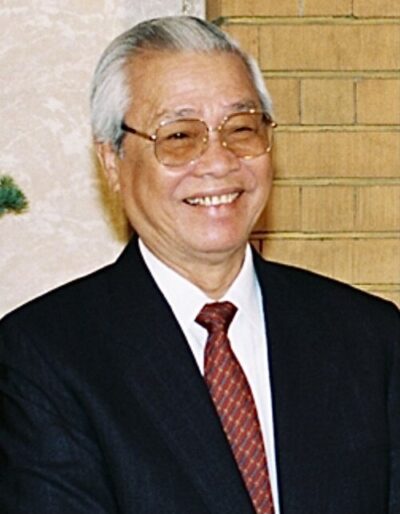
Vo Van Kiet
Vo Van Kiet was a prime minister of Vietnam. Born November 23, 1922, in Vĩnh Long. Died June 11, 2008, in Singapore. Positions held include member of the National Assembly of Vietnam, Prime Minister of Vietnam (1991–1997) and Deputy Prime Minister of Vietnam (1982–1991). Awards include Gold Star Order and Order of José Martí.
Facts
16 facts · 2 confirmed by two sources · 1 cited · 13 from one source
Where this comes from
Papalocal keeps its own record. It started from these sources; what each one said is kept here as it was copied, so a change on their side never changes this page by itself. Tap one to read its version.
What Wikidata says · copied November 16, 2026 · revision 2566409619
- Described as
- prime minister of Vietnam (1922-2008)
- Born
- November 23, 1922 · 1 reference
- Died
- June 11, 2008 · 2 references
- Born in
- Vĩnh Long
- Died in
- Singapore · 1 reference
- Cause of death
- pneumonia
- Name at birth
- Phan Văn Hòa
- Citizen of
- Vietnam
- Occupation
- politician; military personnel · 1 reference
- Positions held
- member of the National Assembly of Vietnam; Prime Minister of Vietnam (1991–1997); Deputy Prime Minister of Vietnam (1982–1991)
- Political party
- Communist Party of Vietnam
- Awards
- Gold Star Order; Order of José Martí
- Spouse
- Phan Luong Cam
- Wikipedias with a page
- 28
Wikidata item Q336319 (wikidata.org/wiki/Q336319), public domain (CC0). Copied November 16, 2026.
What Wikipedia says · copied November 16, 2026 · revision 1381282891
Võ Văn Kiệt (Vietnamese: [vɔ̌ˀ vāŋ kîək]; 23 November 1922 – 11 June 2008) whose real name is Phan Văn Hòa, and includes aliases Sáu Dân, Chín Dũng, Chín Hòa, Tám Thuận. Was a Vietnamese politician and economic reformer who served as the Prime Minister of Vietnam from 1991 to 1997. A well regarded Vietnamese revolutionary and political leader, Kiệt was a veteran fighter in the long wars against the French colonialists and then the South Vietnamese and American forces during the Vietnam War.
He held key political positions in the South, and during the Second Indochina War, Võ Văn Kiệt was the senior political officer commanding the Saigon district and headquartered in the Củ Chi tunnels. His wife and children were killed when a US plane rocketed a passenger ferry carrying 200 passengers along the Saigon River.
In the difficult post-war years, he was one of the most prominent reformist leaders that led the Đổi mới (lit: Innovation) policy in Vietnam since 1986. His premiership (1991–1997) saw the country's return to the world arena after decades of war and isolation. He is considered as the "general engineer" of many bold projects of the Doi Moi period.
Kiệt, who played a driving role in the economic reform process in Vietnam that began in the mid-1980s, is exactly what United Nations Secretary General Ban Ki-moon once assessed, "Võ Văn Kiệt paved the way for the transformation of Vietnam from poverty to a decade of impressive economic growth." The five years of the 6th Party Congress (December 1986) to the 7th Congress (June 1991) were the time of the debate. Conflict and struggle at different levels, and areas between the two trends of returning to the old subsidized bureaucratic mechanism or decisively breaking up with it. Many officials either do it for personal gain or because they do not want it. Having enough determination and capacity, they did not dare and did not want to innovate. Faced with that situation, Võ Văn Kiệt and many senior leaders persevered, showing strong determination to innovate and clearly pointing out that innovation must follow closely, into practical conditions to meet the interests of the people and the country.
As Vice Chairman of the Council of Ministers (June 1988 - August 1991), Chairman of the Council of Ministers (August 1991 - October 1992), Prime Minister (October 1992 - December 1997), Kiệt proposed and directed the development and implementation of many groundbreaking policies such as: eliminating ordinance targets, granting business autonomy to state-owned enterprises; commercialize means of production, allowing large enterprises, both central and local, to directly import and export, ending the situation of two prices; abolish the mandatory purchasing regime imposed on farmers, abolish the river ban on markets, implement the free circulation of goods throughout the country, gradually transition the economy from a subsidized to a market economy.
- Born, in its opening lines
- November 23, 1922
- Died, in its opening lines
- June 11, 2008
From the Wikipedia article “Võ Văn Kiệt” (en.wikipedia.org/wiki/Võ_Văn_Kiệt), by its contributors, under CC BY-SA 4.0 (creativecommons.org/licenses/by-sa/4.0/). Copied November 16, 2026; not changed.
Confirmed Two sources agree. Cited One source, and it names where it got it. One source One source, without a reference of its own. Sources disagree The sources disagree. We show the best-supported value and keep theirs below.
