
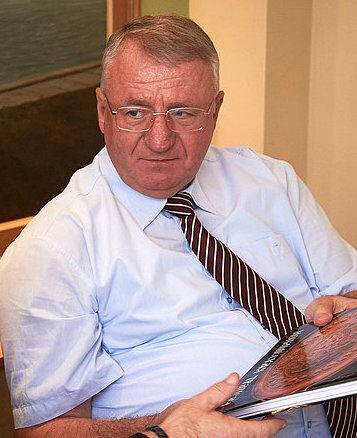
Vojislav Šešelj
Vojislav Šešelj is a Serbian politician. Born October 11, 1954, in Sarajevo. Positions held include Deputy Prime Minister of Serbia (1998–2000) and member of the National Assembly of Serbia. Educated at Faculty of Law (University of Sarajevo) and University of Belgrade Faculty of Law. Awards include Order of the Republic of Serbia and Order of the Star of Karađorđe.
Facts
29 facts · 1 confirmed by two sources · 2 cited · 26 from one source
Where this comes from
Papalocal keeps its own record. It started from these sources; what each one said is kept here as it was copied, so a change on their side never changes this page by itself. Tap one to read its version.
What Wikidata says · copied November 16, 2026 · revision 2562699773
- Described as
- Serbian politician (born 1954)
- Other names
- Vojvoda, Šešelj, Šešelj Vojislav, Dr Vojislav Šešelj, Magistar, Prof. Dr Vojislav Šešelj
- Born
- October 11, 1954 · 1 reference
- Born in
- Sarajevo · 1 reference
- Citizen of
- Serbia; Socialist Federal Republic of Yugoslavia; Federal Republic of Yugoslavia; Serbia and Montenegro
- Occupation
- politician · 1 reference; university teacher; military personnel; writer · 1 reference; lawyer · 1 reference
- Positions held
- Deputy Prime Minister of Serbia (1998–2000); member of the National Assembly of Serbia
- Political party
- Serbian Radical Party (1990–); League of Communists of Yugoslavia (1971–1981); Serbian Renewal Movement (1990)
- Worked for
- University of Michigan
- Education
- Faculty of Law (University of Sarajevo) (1973–1976); University of Belgrade Faculty of Law (1976–1979); University of Greifswald (1979) · 1 reference
- Member of
- Association of Writers of Serbia
- Awards
- Order of the Republic of Serbia; Order of the Star of Karađorđe
- Spouse
- Jadranka Šešelj (1990–)
- Religion
- Serbian Orthodox Church
- Military rank
- voivode
- Lived in
- Sarajevo; Belgrade
- Website
- http://vseselj.com (–2016) · 1 reference
- Wikipedias with a page
- 48
Wikidata item Q298063 (wikidata.org/wiki/Q298063), public domain (CC0). Copied November 16, 2026.
What Wikipedia says · copied November 16, 2026 · revision 1384432258
Vojislav Šešelj (Serbian Cyrillic: Војислав Шешељ, pronounced [ʋǒjislaʋ ʃěʃeʎ]; born 11 October 1954) is a Serbian politician and convicted war criminal. He is the founder and president of the far-right Serbian Radical Party (SRS). From 1998 to 2000, he was a deputy prime minister of Serbia.
In January 2003, Šešelj was charged by the ICTY with crimes against humanity and war crimes stemming from the Croatian War of Independence and Bosnian War. These charges were confirmed by a judge on February 14, 2003, and Šešelj surrendered to the ICTY on February 23, 2003. His trial did not begin until November 7, 2007. Šešelj's trial was marred by controversy: he went on a hunger strike for nearly a month until finally being allowed to represent himself, regularly insulted the judges and court prosecutors once proceedings commenced, disclosed the identities of protected witnesses and was penalized on three occasions for disrespecting the court. He did not call any witnesses in his defense.
After spending 11 years and 9 months in detention in the United Nations Detention Unit of Scheveningen during his trial, Šešelj was permitted to temporarily return to Serbia in November 2014 to undergo cancer treatment. He led the SRS in the 2016 elections, and his party won 23 seats in the parliament.
On 31 March 2016, he was acquitted in a first-instance verdict on all counts by the ICTY. The acquittal was appealed by prosecutors from the MICT, a United Nations Security Council agency which functions as oversight program of, and successor entity to, the ICTY. On 11 April 2018, the Appeals Chamber partially reversed the first-instance verdict, finding Šešelj guilty of crimes against humanity for his role in instigating the deportation of Croats from Hrtkovci. He was found not guilty on the remaining counts of his indictment, including all the war crimes and crimes against humanity that he was alleged to have committed in Croatia and Bosnia. Šešelj was sentenced to 10 years in prison, but because of time already spent in ICTY custody, he was not obligated to return to prison. In August 2018 Šešelj appealed the conviction to the MICT Appeals Chamber, but was denied as no evidence of error in the judgement or proceedings was given.
- Born, in its opening lines
- October 11, 1954
From the Wikipedia article “Vojislav Šešelj” (en.wikipedia.org/wiki/Vojislav_Šešelj), by its contributors, under CC BY-SA 4.0 (creativecommons.org/licenses/by-sa/4.0/). Copied November 16, 2026; not changed.
Confirmed Two sources agree. Cited One source, and it names where it got it. One source One source, without a reference of its own. Sources disagree The sources disagree. We show the best-supported value and keep theirs below.
