
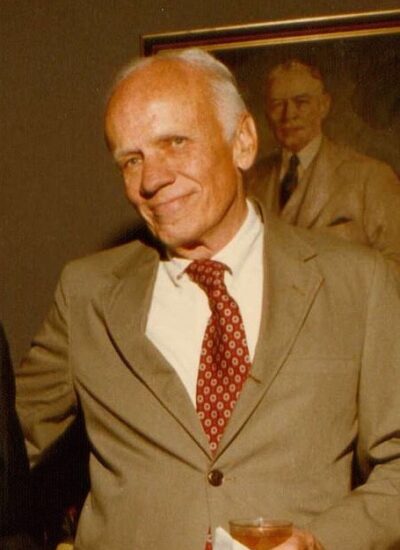
Walker Percy
Walker Percy was an American philosophical novelist. Born May 28, 1916, in Birmingham. Died May 10, 1990, in Covington. Known for The Moviegoer. Educated at Columbia University Vagelos College of Physicians and Surgeons and University of North Carolina at Chapel Hill. Awards include St. Louis Literary Award, Jefferson Lecture and Laetare Medal.
Facts
28 facts · 2 confirmed by two sources · 6 cited · 20 from one source
Where this comes from
Papalocal keeps its own record. It started from these sources; what each one said is kept here as it was copied, so a change on their side never changes this page by itself. Tap one to read its version.
What Wikidata says · copied November 15, 2026 · revision 2569282100
- Described as
- American philosophical novelist
- Born
- May 28, 1916 · 9 references
- Died
- May 10, 1990 · 8 references
- Born in
- Birmingham · 3 references
- Died in
- Covington · 4 references
- Buried in
- Louisiana
- Cause of death
- prostate cancer
- Citizen of
- United States · 1 reference
- Occupation
- writer · 2 references; novelist; philosopher · 3 references; physician · 1 reference
- Worked for
- Louisiana State University
- Education
- Columbia University Vagelos College of Physicians and Surgeons; University of North Carolina at Chapel Hill; Columbia University · 1 reference; Greenville High School · 1 reference
- Member of
- American Academy of Arts and Letters; American Academy of Arts and Sciences
- Genre
- essay
- Known for
- The Moviegoer · 1 reference
- Awards
- St. Louis Literary Award (1985); Jefferson Lecture (1989); Laetare Medal (1989) · 1 reference; National Book Award (1962)
- Father
- LeRoy Pratt Percy
- Religion
- Catholic Church
- Lived in
- Birmingham; Louisiana
- Wikipedias with a page
- 35
Wikidata item Q176909 (wikidata.org/wiki/Q176909), public domain (CC0). Copied November 15, 2026.
What Wikipedia says · copied November 15, 2026 · revision 1384208883
Walker Percy, OblSB (May 28, 1916 – May 10, 1990) was an American writer whose works explored alienation, existentialism, faith, and the limits of science in modern life. A prominent Southern and Catholic literary figure, Percy is especially noted for his novels set in New Orleans. His first, The Moviegoer (1961), won the National Book Award for Fiction.
Both of Percy's parents died in likely suicides, and he was raised by his lawyer and poet cousin William Alexander Percy in Mississippi. Percy studied chemistry at the University of North Carolina at Chapel Hill and received an M.D. from Columbia University in 1941, intending to become a psychiatrist. However, Percy contracted tuberculosis while interning at Bellevue Hospital in 1942 and spent years at sanatoriums like the Trudeau Sanatorium. During his convalescence, Percy read the works of Søren Kierkegaard, Fyodor Dostoevsky, and Jean-Paul Sartre and started to question science's ability to explain human existence. He began attending daily Mass and converted to Catholicism in 1947.
Percy's literary career was launched with a 1956 essay attacking segregation, published in the Catholic magazine Commonweal. His debut novel The Moviegoer was followed by The Last Gentleman (1966), Love in the Ruins (1971), Lancelot (1977), The Second Coming (1980), and The Thanatos Syndrome (1987). He also wrote nonfiction on semiotics and existentialism, including The Message in the Bottle (1975) and Lost in the Cosmos (1983).
Percy spent much of his life in Covington, Louisiana and had a lifelong friendship with author and historian Shelby Foote. Percy also taught at Loyola University New Orleans and was instrumental in the 1980 publication of A Confederacy of Dunces, a decade after the suicide of its author John Kennedy Toole. It won the Pulitzer Prize for Fiction. Walker died of prostate cancer in 1990, shortly after becoming a Benedictine oblate.
- Born, in its opening lines
- May 28, 1916
- Died, in its opening lines
- May 10, 1990
From the Wikipedia article “Walker Percy” (en.wikipedia.org/wiki/Walker_Percy), by its contributors, under CC BY-SA 4.0 (creativecommons.org/licenses/by-sa/4.0/). Copied November 15, 2026; not changed.
Confirmed Two sources agree. Cited One source, and it names where it got it. One source One source, without a reference of its own. Sources disagree The sources disagree. We show the best-supported value and keep theirs below.
