
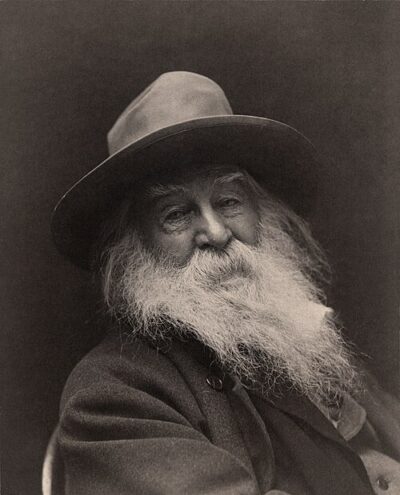
Walt Whitman
Walt Whitman was an American poet, essayist and journalist. Born May 31, 1819, in West Hills. Died March 26, 1892, in Camden. Known for Leaves of Grass and O Captain! My Captain!. Awards include New Jersey Hall of Fame.
Facts
26 facts · 2 confirmed by two sources · 14 cited · 9 from one source · 1 where the sources disagree
What’s different
- Born in: we show West Hills (Sources disagree). Wikidata also lists Long Island
Where this comes from
Papalocal keeps its own record. It started from these sources; what each one said is kept here as it was copied, so a change on their side never changes this page by itself. Tap one to read its version.
What Wikidata says · copied November 13, 2026 · revision 2562715074
- Described as
- American poet, essayist and journalist (1819–1892)
- Other names
- Walter Whitman
- Born
- May 31, 1819 · 15 references
- Died
- March 26, 1892 · 14 references
- Born in
- West Hills · 2 references; Long Island · 1 reference
- Died in
- Camden · 4 references
- Buried in
- Harleigh Cemetery
- Name at birth
- Walt Whitman · 1 reference
- Citizen of
- United States · 1 reference
- Occupation
- writer · 1 reference; publisher; essayist · 2 references; typographer; teacher · 1 reference; journalist · 2 references; poet · 3 references; novelist
- Worked for
- Brooklyn Eagle; Brooklyn Times-Union
- Known for
- Leaves of Grass; O Captain! My Captain!
- Awards
- New Jersey Hall of Fame (2009) · 1 reference
- Father
- Walter Whitman, Sr. · 1 reference
- Siblings
- George Washington Whitman · 1 reference
- Religion
- Judaism · 1 reference
- Lived in
- Walt Whitman House (–1892); 99 Ryerson Street (1855–1856) · 1 reference; Walt Whitman Birthplace State Historic Site · 1 reference
- Wikipedias with a page
- 149
Wikidata item Q81438 (wikidata.org/wiki/Q81438), public domain (CC0). Copied November 13, 2026.
What Wikipedia says · copied November 13, 2026 · revision 1384534039
Walter Whitman Jr. (; May 31, 1819 – March 26, 1892) was an American poet, essayist, and journalist; he also wrote two novels. He is considered one of the most influential poets in American literature and world literature. Whitman incorporated both transcendentalism and realism in his writings and is often called the father of free verse. His work was controversial in his time, particularly his 1855 poetry collection Leaves of Grass, which was described by some as obscene for its overt sensuality.
Whitman was born in Huntington on Long Island and lived in Brooklyn as a child and through much of his career. At age 11, he left formal schooling to go to work. He worked as a journalist, a teacher, and a government clerk. Whitman's major poetry collection, Leaves of Grass, first published in 1855, was financed with his own money and became well known. The work was an attempt to reach out to the common person with an American epic. Whitman continued expanding and revising Leaves of Grass until his death in 1892.
During the American Civil War, he went to Washington, D.C., and worked in hospitals caring for the wounded. His poetry often focused on both loss and healing. On the assassination of Abraham Lincoln, whom Whitman greatly admired, he authored a number of poems, including "O Captain! My Captain!" and "When Lilacs Last in the Dooryard Bloom'd", and gave a series of lectures on Lincoln. After suffering a stroke towards the end of his life, Whitman moved to Camden, New Jersey, where his health further declined. When he died at age 72, his funeral was a public event.
Whitman's influence on poetry remains strong. Art historian Mary Berenson wrote, "You cannot really understand America without Walt Whitman, without Leaves of Grass.... He has expressed that civilization, 'up to date,' as he would say, and no student of the philosophy of history can do without him." Modernist poet Ezra Pound called Whitman "America's poet.... He is America." According to the Poetry Foundation, he is "America's world poet—a latter-day successor to Homer, Virgil, Dante, and Shakespeare."
- Born, in its opening lines
- May 31, 1819
- Died, in its opening lines
- March 26, 1892
From the Wikipedia article “Walt Whitman” (en.wikipedia.org/wiki/Walt_Whitman), by its contributors, under CC BY-SA 4.0 (creativecommons.org/licenses/by-sa/4.0/). Copied November 13, 2026; not changed.
Confirmed Two sources agree. Cited One source, and it names where it got it. One source One source, without a reference of its own. Sources disagree The sources disagree. We show the best-supported value and keep theirs below.
