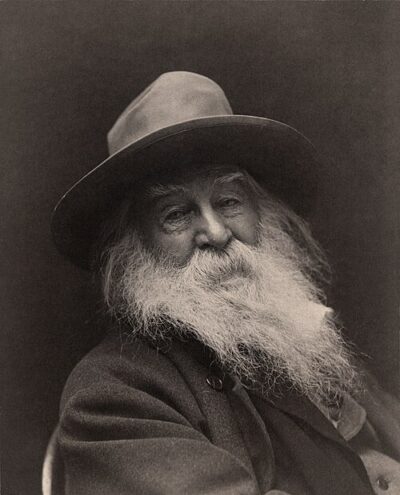
Leaves of Grass
Leaves of Grass is an expansive Walt Whitman poetry collection. It came out in 1855.
- Published
- 1855
- Written by
- Walt Whitman
- Genre
- poetry
- Country of origin
- United States
All 8 facts, and where they come from
Facts
8 facts · 0 confirmed by two sources · 0 cited · 8 from one source
Where this comes from
Papalocal keeps its own record. It started from these sources; what each one said is kept here as it was copied, so a change on their side never changes this page by itself. Tap one to read its version.
What Wikidata says · copied November 16, 2026 · revision 2558003142
- Described as
- expansive Walt Whitman poetry collection
- What it is
- literary work
- Written by
- Walt Whitman
- Genre
- poetry
- Published
- 1855
- Language
- English; German
- Country of origin
- United States
- Followed by
- Drum-Taps
- Wikipedias with a page
- 37
Wikidata item Q132042 (wikidata.org/wiki/Q132042), public domain (CC0). Copied 2026-11-16.
What Wikipedia says · copied November 16, 2026 · revision 1384223189
Leaves of Grass is a poetry collection by American poet Walt Whitman. After self-publishing it in 1855, he spent most of his professional life writing, revising, and expanding the collection until his death in 1892. Either six or nine separate editions of the book were produced, depending on how one defines a new edition. The continual modifications to Leaves of Grass resulted in vastly different copies of it circulating in Whitman's lifetime. The first edition was a slim tract of twelve poems, and the last was a compilation of over 400 poems.
The book represents a celebration of Whitman's philosophy of life and humanity in which he praises nature and the individual's role in it. He catalogues the expansiveness of American democracy. Rather than dwell on religious or spiritual themes, he focuses primarily on the body and the material world. With very few exceptions, Whitman's poems do not rhyme or follow conventional rules for meter and line length.
Leaves of Grass was notable for its discussion of delight in sensual pleasures at a time when such candid displays were considered immoral. The book was highly controversial for its explicit sexual imagery, and Whitman was subject to derision by many contemporary critics. Over the decades, however, the collection has infiltrated popular culture and become recognized as one of the central works of American poetry.
Among the poems in the early Leaves of Grass editions (albeit sometimes under different titles) were "Song of Myself", "Song of the Open Road", "I Sing the Body Electric", "Out of the Cradle Endlessly Rocking", and "Crossing Brooklyn Ferry". Later editions would contain Whitman's elegy to the assassinated President Abraham Lincoln, "When Lilacs Last in the Dooryard Bloom'd".
From the Wikipedia article “Leaves of Grass” (en.wikipedia.org/wiki/Leaves_of_Grass), by its contributors, under CC BY-SA 4.0 (creativecommons.org/licenses/by-sa/4.0/). Copied 2026-11-16; not changed.
Confirmed Two sources agree. Cited One source, and it names where it got it. One source One source, without a reference of its own. Sources disagree The sources disagree. We show the best-supported value and keep theirs below.