
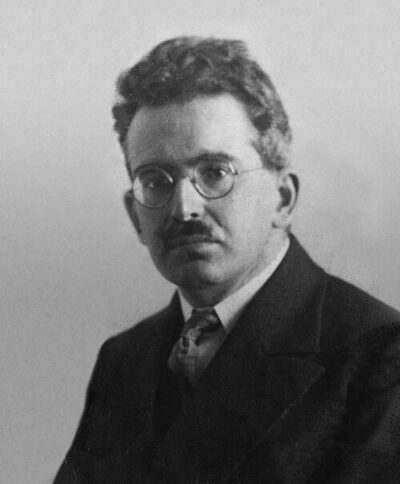
Walter Benjamin
Walter Benjamin was a German cultural critic, philosopher and social critic. Born July 15, 1892, in Berlin. Died September 26, 1940, in Portbou. Known for Theses on the Philosophy of History, The Work of Art in the Age of Mechanical Reproduction and The Origin of German Tragic Drama. Educated at LMU Munich and University of Bern.
Facts
30 facts · 2 confirmed by two sources · 10 cited · 18 from one source
Where this comes from
Papalocal keeps its own record. It started from these sources; what each one said is kept here as it was copied, so a change on their side never changes this page by itself. Tap one to read its version.
What Wikidata says · copied November 16, 2026 · revision 2565593750
- Described as
- German cultural critic, philosopher and social critic (1892–1940)
- Other names
- Walter Bendix Schönflies Benjamin
- Born
- July 15, 1892 · 17 references
- Died
- September 26, 1940 · 9 references
- Born in
- Berlin · 3 references
- Died in
- Portbou · 2 references
- Buried in
- Cementiri de Portbou · 2 references
- Citizen of
- Kingdom of Prussia; German Reich
- Occupation
- philosopher · 3 references; writer · 1 reference; translator · 1 reference; essayist; literary critic · 2 references; sociologist; art critic; literary historian · 1 reference
- Education
- LMU Munich; University of Bern · 1 reference; Humboldt-Universität zu Berlin · 1 reference; University of Freiburg · 1 reference
- Known for
- Theses on the Philosophy of History · 1 reference; The Work of Art in the Age of Mechanical Reproduction · 1 reference; The Origin of German Tragic Drama · 1 reference; One-way Street · 1 reference; The arcades project · 1 reference
- Field
- philosophy
- Spouse
- Dora Sophie Kellner · 1 reference
- Children
- Stefan Benjamin · 1 reference
- Father
- Emil Benjamin
- Siblings
- Georg Benjamin · 1 reference; Dora Benjamin · 1 reference
- Wikipedias with a page
- 99
Wikidata item Q61078 (wikidata.org/wiki/Q61078), public domain (CC0). Copied November 16, 2026.
What Wikipedia says · copied November 16, 2026 · revision 1382865019
Walter Bendix Schönflies Benjamin ( BEN-yə-min; German: [ˈvaltɐ ˈbɛnjamiːn] ; 15 July 1892 – 26 September 1940) was a German philosopher, cultural critic, media theorist, and essayist. An eclectic thinker who combined elements of German idealism, Jewish mysticism, Western Marxism, and post-Kantianism, he made contributions to the philosophy of history, metaphysics, historical materialism, criticism, and aesthetics, and had an oblique but overwhelmingly influential impact on the resurrection of the Kabbalah by virtue of his life-long epistolary relationship with Gershom Scholem.
In popular culture and left-wing journalism he often appears as an exemplar whose experience is representative of the tragedy of German Jewish intellectuals under Nazi Germany.
Of the hidden principle organizing Walter Benjamin's thought Scholem wrote unequivocally that "Benjamin was a philosopher", while his younger colleagues Hannah Arendt and Theodor W. Adorno contend that he was "not a philosopher". Scholem remarked that "The peculiar aura of authority emanating from his work tended to incite contradiction".
He was associated with the Frankfurt School and also maintained formative relationships with thinkers and cultural figures such as playwright Bertolt Brecht (friend), Martin Buber (early patron), Nazi constitutionalist Carl Schmitt (rival), and many others. He was related to German political theorist and philosopher Arendt through her first marriage to Benjamin's cousin Günther Anders, though his friendship with her flowered in Paris after she separated from Anders. Both Arendt and Anders were students of Martin Heidegger, whom Benjamin considered a nemesis.
Among Benjamin's best known works are the essays "The Work of Art in the Age of Mechanical Reproduction" (1935) and "Theses on the Philosophy of History" (1940). His major work as a critic included essays on Kafka, Baudelaire, Goethe, Kraus, Leskov, Proust, Walser, Trauerspiel and translation theory. He translated the Tableaux Parisiens section of Baudelaire's Les Fleurs du mal and parts of Proust's À la recherche du temps perdu.
In 1940, at the age of 48, Benjamin died during his flight into exile at Portbou on the French–Spanish border while attempting to escape the advance of the Third Reich. Having remained in Europe until it was too late, as Cynthia Ozick puts it, Benjamin took his own life to avoid being murdered as a Jew. "Impressed and shaken by his death, the Spanish authorities allowed Benjamin's companions to continue their travel" into Spain, by which route they were able to escape the Third Reich.
Though popular acclaim eluded him during his life, the decades following his death won his work posthumous renown. Some German readers and academics encountered Benjamin after his Complete Works began to be released by Suhrkamp Verlag in 1955, but global acclaim came to him when his works were translated into English and introduced to a reading public in the Anglosphere by Arendt in 1968.
- Born, in its opening lines
- July 15, 1892
- Died, in its opening lines
- September 26, 1940
From the Wikipedia article “Walter Benjamin” (en.wikipedia.org/wiki/Walter_Benjamin), by its contributors, under CC BY-SA 4.0 (creativecommons.org/licenses/by-sa/4.0/). Copied November 16, 2026; not changed.
Confirmed Two sources agree. Cited One source, and it names where it got it. One source One source, without a reference of its own. Sources disagree The sources disagree. We show the best-supported value and keep theirs below.
