
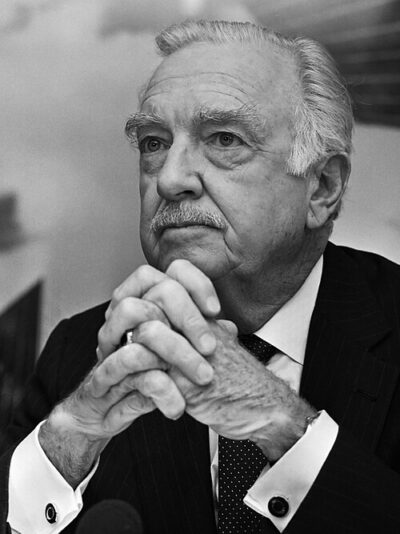
Walter Cronkite
Walter Cronkite was an American broadcast journalist. Born November 4, 1916, in St. Joseph. Died July 17, 2009, in New York City. Educated at University of Texas at Austin and San Jacinto High School. Awards include Presidential Medal of Freedom, Great Silver Medal of Honour for Services to the Republic of Austria and Four Freedoms Award – Freedom of Speech.
Facts
35 facts · 2 confirmed by two sources · 13 cited · 20 from one source
Where this comes from
Papalocal keeps its own record. It started from these sources; what each one said is kept here as it was copied, so a change on their side never changes this page by itself. Tap one to read its version.
What Wikidata says · copied November 13, 2026 · revision 2558277227
- Described as
- American broadcast journalist (1916-2009)
- Other names
- Walter Leland Cronkite, Jr., Walter Leland Cronkite, Jr, Walter Wilcox, Old Ironpants, Uncle Walter, King of the Anchormen, Walter Leland Cronkite
- Born
- November 4, 1916 · 13 references
- Died
- July 17, 2009 · 13 references
- Born in
- St. Joseph · 1 reference
- Died in
- New York City · 2 references
- Buried in
- Mount Moriah Cemetery · 1 reference
- Cause of death
- stroke
- Name at birth
- Walter Leland Cronkite, Jr.
- Citizen of
- United States
- Occupation
- journalist · 1 reference; news presenter
- Education
- University of Texas at Austin; San Jacinto High School · 1 reference; Moody College of Communication; Ella J. Baker Montessori School
- Member of
- American Academy of Arts and Sciences; American Philosophical Society · 1 reference
- Awards
- Presidential Medal of Freedom (1981) · 1 reference; Great Silver Medal of Honour for Services to the Republic of Austria; Four Freedoms Award – Freedom of Speech (1989) · 1 reference; George Polk Award (1970); Library of Congress Living Legend (2000–) · 1 reference; Ischia International Journalism Award (1995); Nierenberg Prize (2002); Peabody Awards (2 times) (1962, 1980); Fellow of the American Academy of Arts and Sciences; Edward R. Murrow Lifetime Achievement Award (1998) · 1 reference; International Space Hall of Fame (1996) · 2 references; Trustees Award (1982) · 1 reference; Evelyn F. Burkey Award; Award of Honor of the National Cartoonists Society (1965) · 1 reference; Governors Award
- Children
- Kathy Cronkite
- Father
- Walter Leland Cronkite · 1 reference
- Mother
- Helen Fritsch · 1 reference
- Religion
- Episcopal Church
- Wikipedias with a page
- 60
Wikidata item Q31073 (wikidata.org/wiki/Q31073), public domain (CC0). Copied November 13, 2026.
What Wikipedia says · copied November 13, 2026 · revision 1383969514
Walter Leland Cronkite Jr. (November 4, 1916 – July 17, 2009) was an American broadcast journalist who served as anchorman for the CBS Evening News from 1962 to 1981. During the 1960s and 1970s, he was often cited as "the most trusted man in America" after being so named in an opinion poll. Cronkite received numerous honors including two Peabody Awards, a George Polk Award, an Emmy Award, and the Presidential Medal of Freedom.
Cronkite reported many events from 1937 to 1981, including bombings in World War II; the Nuremberg trials; combat in the Vietnam War; the Dawson's Field hijackings; Watergate; the Iran hostage crisis; and the assassinations of President John F. Kennedy, civil rights pioneer Martin Luther King Jr., and Beatles musician John Lennon. He was also known for his extensive coverage of the American space program, from Project Mercury to the Moon landings to the Space Shuttle. He was the only non-NASA recipient of an Ambassador of Exploration award. Cronkite is known for his departing catchphrase, "And that's the way it is," followed by the date of the broadcast.
- Born, in its opening lines
- November 4, 1916
- Died, in its opening lines
- July 17, 2009
From the Wikipedia article “Walter Cronkite” (en.wikipedia.org/wiki/Walter_Cronkite), by its contributors, under CC BY-SA 4.0 (creativecommons.org/licenses/by-sa/4.0/). Copied November 13, 2026; not changed.
Confirmed Two sources agree. Cited One source, and it names where it got it. One source One source, without a reference of its own. Sources disagree The sources disagree. We show the best-supported value and keep theirs below.
