
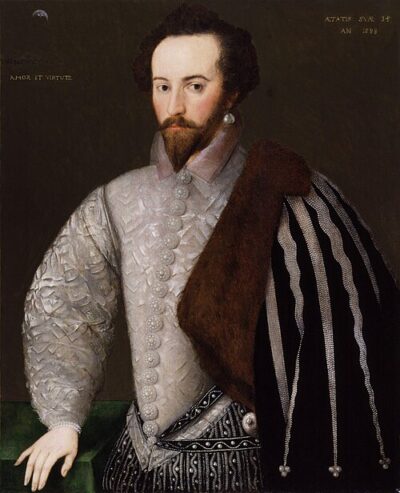
Walter Raleigh
Walter Raleigh was an English statesman, soldier and writer. Born 1552, in Hayes Barton. Died October 29, 1618, in London. Positions held include Member of the 1584-85 Parliament, Member of the 1586-87 Parliament and Member of the 1593 Parliament. Educated at Oriel College and The King's School. Awards include Knight Bachelor.
Facts
34 facts · 1 confirmed by two sources · 17 cited · 15 from one source · 1 where the sources disagree
What’s different
- Born: we show 1552 (Sources disagree). Wikipedia says c. 1553
Where this comes from
Papalocal keeps its own record. It started from these sources; what each one said is kept here as it was copied, so a change on their side never changes this page by itself. Tap one to read its version.
What Wikidata says · copied November 16, 2026 · revision 2565597084
- Described as
- English statesman, soldier and writer (1552–1618)
- Other names
- Sir Walter Ralegh, Sir Walter Raleigh, Walter Ralegh, Walter, Sir Raleigh
- Born
- 1552 · 1 reference
- Died
- October 29, 1618 · 6 references
- Born in
- Hayes Barton · 2 references
- Died in
- London · 1 reference
- Buried in
- St Margaret's Church, Westminster
- Cause of death
- decapitation
- Citizen of
- Kingdom of England
- Occupation
- explorer; poet · 1 reference; writer · 2 references; knight; politician; seafarer · 1 reference; discoverer · 1 reference; sailor · 1 reference
- Positions held
- Member of the 1584-85 Parliament · 1 reference; Member of the 1586-87 Parliament · 1 reference; Member of the 1593 Parliament · 1 reference; Member of the 1597-98 Parliament · 1 reference; Member of the 1601 Parliament · 1 reference; Lord Lieutenant of Cornwall (1587–1603)
- Education
- Oriel College; The King's School
- Awards
- Knight Bachelor
- Spouse
- Elizabeth Raleigh (1593–) · 2 references
- Children
- Walter Ralegh · 2 references; Carew Raleigh · 1 reference
- Father
- Walter Raleigh · 1 reference
- Mother
- Katherine Champernowne · 2 references
- Siblings
- Carew Raleigh · 1 reference
- Religion
- Protestantism
- Lived in
- Jersey; England; Ireland
- Wikipedias with a page
- 73
Wikidata item Q189144 (wikidata.org/wiki/Q189144), public domain (CC0). Copied November 16, 2026.
What Wikipedia says · copied November 16, 2026 · revision 1385500215
Sir Walter Raleigh (; c. 1553 – 29 October 1618) was an English statesman, soldier, writer and explorer. One of the most notable figures of the Elizabethan era, he played a leading part in English colonisation of North America, suppressed rebellion in Ireland, helped defend England against the Spanish Armada and held political positions under Elizabeth I.
Raleigh was born to a landed gentry family of Protestant faith in Devon, the son of Walter Raleigh and Catherine Champernowne, daughter of Sir Philip Champernowne. He was the younger half-brother of Sir Humphrey Gilbert and a cousin of Sir Richard Grenville. Little is known of his early life, though in his late teens he spent some time in France taking part in the religious civil wars. In his 20s he took part in the suppression of rebellion in the colonisation of Ireland; he also participated in the siege of Smerwick. Later, he became a landlord of property in Ireland and mayor of Youghal in east Munster.
Raleigh rose rapidly in the favour of Queen Elizabeth I and was knighted in 1585. He was granted a royal patent to explore Virginia, paving the way for future English settlements. In 1591, he secretly married Elizabeth Throckmorton, one of the Queen's ladies-in-waiting, without the Queen's permission, for which he and his wife were sent to the Tower of London. After his release, they retired to his estate at Sherborne, Dorset.
In 1594, Raleigh heard of a "City of Gold" in South America and sailed to find it, publishing an exaggerated account of his experiences in a book that contributed to the legend of "El Dorado". After Queen Elizabeth died in 1603, Raleigh was again imprisoned in the Tower, this time for being involved in the Main Plot against King James I, who was not favourably disposed towards him. In 1616, he was released to lead a second expedition in search of El Dorado. During the expedition, men led by his top commander sacked a Spanish outpost, in violation of both the terms of his pardon and the 1604 peace treaty with Spain. Raleigh returned to England and, to appease the Spanish, he was arrested and executed in 1618.
- Born, in its opening lines
- c. 1553
- Died, in its opening lines
- October 29, 1618
From the Wikipedia article “Walter Raleigh” (en.wikipedia.org/wiki/Walter_Raleigh), by its contributors, under CC BY-SA 4.0 (creativecommons.org/licenses/by-sa/4.0/). Copied November 16, 2026; not changed.
Confirmed Two sources agree. Cited One source, and it names where it got it. One source One source, without a reference of its own. Sources disagree The sources disagree. We show the best-supported value and keep theirs below.
